

Nearly 60 percent of American online retailers say their biggest challenge is converting raw sales data into real growth. For entrepreneurs using Shopify or WooCommerce, the daily flood of numbers can make it tough to spot trends that truly matter. When you understand how ecommerce data strategies work, you gain the power to uncover what drives higher average order value, smarter marketing moves, and increased sales. This article distills essential tactics proven to help you make smarter decisions and maximize results.
Table of Contents
- What Are Ecommerce Data Strategies?
- Types Of Ecommerce Data And Insights
- How Ai-Driven Basket Analysis Works
- Applying Insights To Increase Order Value
- Risks, Data Ownership, And Common Pitfalls
Key Takeaways
| Point | Details |
|---|---|
| Ecommerce Data Strategies | Utilize advanced analytics and AI to convert raw data into actionable insights for informed decision-making. |
| Types of Ecommerce Data | Understand various data categories such as transactional, customer, and behavioral data to enhance marketing and operational strategies. |
| AI-Driven Basket Analysis | Leverage machine learning to identify product purchasing patterns, optimizing Marketing and inventory management. |
| Risks and Mitigation | Be aware of data privacy issues and ensure compliance with laws by implementing robust data governance and security measures. |
What Are Ecommerce Data Strategies?
Ecommerce data strategies represent systematic approaches that leverage advanced analytics, artificial intelligence, and comprehensive sales information to drive business growth and optimize operational performance. These strategic frameworks transform raw transactional data into actionable insights that enable precise decision making across marketing, inventory management, customer experience, and revenue generation.
At their core, ecommerce data strategies emerge from sophisticated analytical methodologies that blend technological innovation with commercial intelligence. They typically encompass several critical dimensions:
- Data Collection: Gathering comprehensive information from multiple touchpoints
- Advanced Analytics: Applying statistical models and machine learning techniques
- Predictive Modeling: Forecasting future trends and customer behaviors
- Strategic Implementation: Translating insights into concrete business actions
The blueprint for an effective ecommerce data strategy involves integrating multiple data sources, utilizing AI-powered tools, and developing a holistic approach to understanding customer interactions. By designing robust analytics frameworks, businesses can transform raw information into strategic advantages that drive sustainable growth and competitive differentiation.

Pro tip: Start by mapping your current data collection processes and identifying potential gaps in your analytics infrastructure to build a more comprehensive ecommerce data strategy.
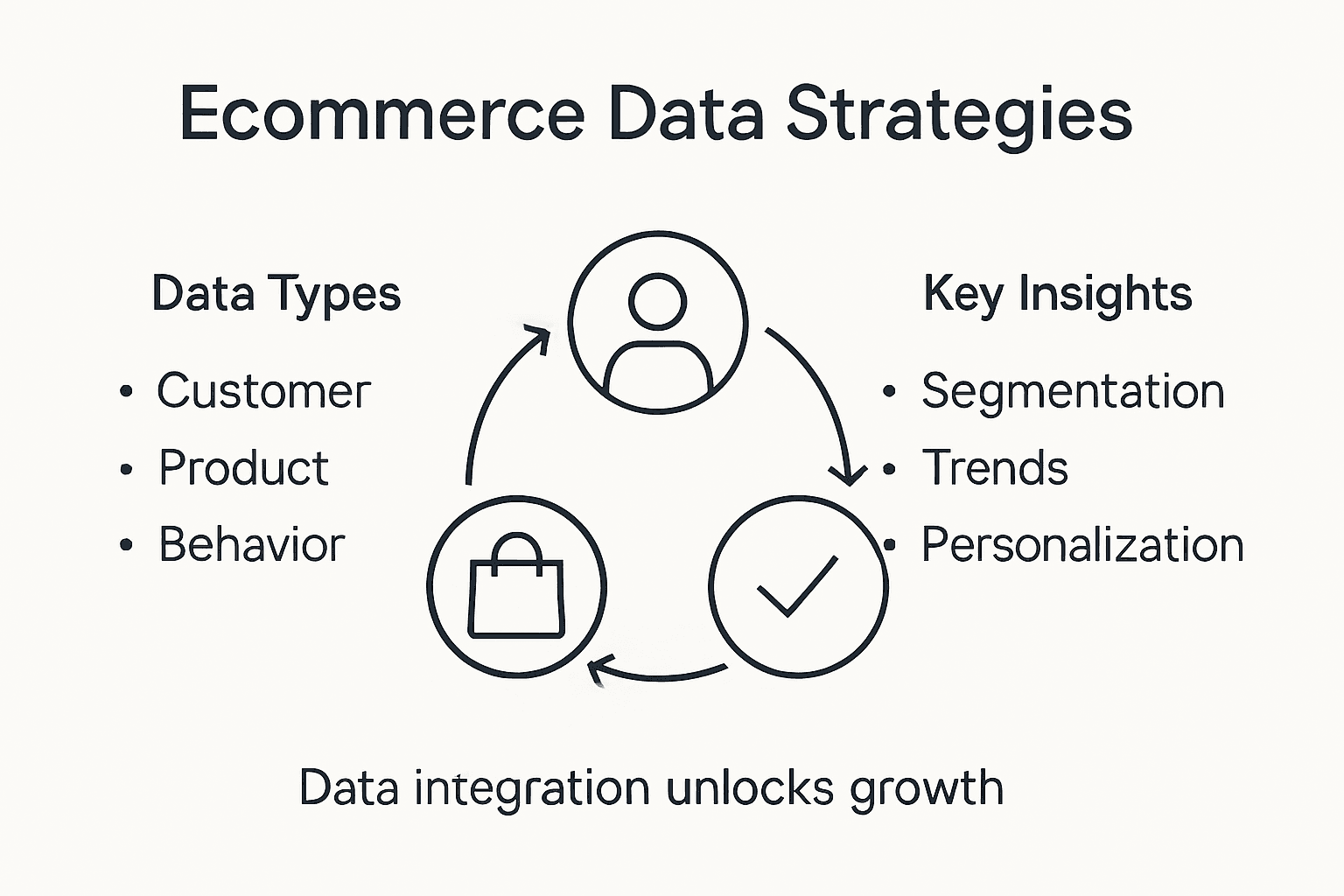
Types of Ecommerce Data and Insights
Ecommerce data represents a complex ecosystem of information that powers strategic decision making for online businesses. Sophisticated analytical frameworks categorize these data types into distinct yet interconnected domains, each offering unique insights into business performance and customer behavior.
The primary categories of ecommerce data include:
- Transactional Data: Capturing purchase details, order history, revenue streams
- Customer Data: Demographic information, contact details, engagement patterns
- Behavioral Data: Website interactions, click-through rates, navigation paths
- Product Performance Data: Sales volumes, inventory levels, pricing trends
- Marketing Analytics: Campaign performance, conversion rates, customer acquisition metrics
Comprehensive ecommerce analytics platforms break down these data types into actionable intelligence that enable businesses to understand customer journeys, predict market trends, and optimize operational strategies. By synthesizing information across these categories, online retailers can develop nuanced insights that drive targeted marketing, personalized customer experiences, and strategic growth initiatives.
Understanding the interconnectedness of these data types allows businesses to create holistic strategies that transform raw information into competitive advantages. Each data category provides a unique lens through which businesses can analyze performance, identify opportunities, and make data-driven decisions that directly impact revenue and customer satisfaction.
Here’s a summary of how different ecommerce data types support business goals:
| Data Category | Key Insight Provided | Main Business Application |
|---|---|---|
| Transactional Data | Reveals purchase trends | Revenue forecasting |
| Customer Data | Uncovers demographic segments | Targeted marketing |
| Behavioral Data | Tracks site navigation patterns | User experience improvement |
| Product Performance Data | Highlights inventory turnover | Stock optimization |
| Marketing Analytics | Measures campaign effectiveness | Conversion rate enhancement |
Pro tip: Implement a centralized data management system that integrates multiple data sources to create a comprehensive view of your ecommerce performance and customer interactions.
How AI-Driven Basket Analysis Works
AI-driven basket analysis represents a sophisticated approach to uncovering hidden patterns in customer purchasing behavior by leveraging advanced machine learning algorithms. Advanced computational techniques systematically analyze transaction data to identify statistically significant product relationships, revealing opportunities for strategic product placement, bundling, and personalized marketing recommendations.
The core process of AI-powered basket analysis involves several critical stages:
- Data Collection: Aggregating comprehensive transaction records
- Pattern Recognition: Identifying statistically correlated product purchases
- Association Rule Generation: Creating predictive models of customer behavior
- Insight Extraction: Transforming raw data into actionable business strategies
Machine learning algorithms like neural networks continuously refine their analytical capabilities, enabling increasingly precise predictions about customer purchasing patterns. These sophisticated models can detect nuanced connections between products that human analysts might overlook, providing unprecedented insights into consumer behavior and preferences.
By employing advanced AI techniques, businesses can move beyond traditional analytics to develop highly targeted marketing strategies, optimize inventory management, and create personalized shopping experiences that directly drive revenue growth. The ability to predict and influence customer purchasing decisions represents a transformative approach to ecommerce strategy.
Pro tip: Implement machine learning models that continuously update their insights, ensuring your basket analysis remains dynamic and responsive to evolving customer behaviors.
Applying Insights to Increase Order Value
Order value optimization represents a critical strategy for ecommerce businesses seeking sustainable revenue growth. Real-time data analytics enable precise customer segmentation and targeted marketing approaches that directly impact purchasing behaviors and increase overall transaction values.
Key strategies for leveraging data insights to boost average order value include:
- Personalized Product Recommendations: Suggesting complementary items based on purchase history
- Dynamic Pricing Strategies: Implementing intelligent pricing models
- Strategic Product Bundling: Creating value-driven package deals
- Targeted Upselling Techniques: Presenting high-margin alternatives
- Contextual Marketing: Delivering personalized offers at optimal moments
Comprehensive data-driven approaches transform traditional marketing by enabling businesses to craft precise, individualized customer experiences that naturally encourage higher spending. By analyzing granular transaction data, companies can identify subtle patterns and create sophisticated recommendation engines that feel intuitive and valuable to customers.
Successful implementation requires a holistic approach that combines advanced analytics, machine learning algorithms, and deep understanding of customer preferences. The goal is not merely to increase sales volume, but to create meaningful interactions that provide genuine value to customers while simultaneously driving revenue growth.
Pro tip: Continuously experiment with different data-driven recommendation strategies, tracking incremental changes in average order value to refine your approach.
Risks, Data Ownership, and Common Pitfalls
Data strategies in ecommerce represent a double-edged sword, offering immense potential for growth while simultaneously exposing businesses to significant operational risks. Global research highlights the complex landscape of data privacy, regulatory compliance, and technological vulnerabilities that can compromise both business performance and customer trust.
The primary risks and challenges in ecommerce data strategies include:
- Privacy Breaches: Unauthorized data access and potential customer information leaks
- Regulatory Non-Compliance: Violations of data protection laws like GDPR and CCPA
- Data Quality Issues: Inaccurate, incomplete, or outdated information
- Algorithmic Bias: Unintended discriminatory outcomes in AI-driven recommendations
- Security Vulnerabilities: Potential system exploits and cyber attack risks
Successful navigation of these challenges requires a proactive, comprehensive approach that prioritizes transparency, robust security protocols, and continuous monitoring. Businesses must develop sophisticated data governance frameworks that not only protect customer information but also create clear, trustworthy mechanisms for data collection, usage, and potential customer opt-out.
Compare common ecommerce data risks and how to actively mitigate them:
| Risk Type | Impact on Business | Mitigation Strategy |
|---|---|---|
| Privacy Breach | Loss of customer trust | Strong encryption, staff training |
| Regulatory Non-Compliance | Legal penalties | Ongoing compliance audits |
| Data Quality Issues | Poor decision making | Routine data validation |
| Algorithmic Bias | Unfair recommendations | Regular model review |
| Security Vulnerability | Business disruption | Frequent security updates |
The most effective data strategies balance technological innovation with ethical considerations, ensuring that data-driven insights serve both business objectives and customer interests. This approach demands ongoing education, adaptive technologies, and a commitment to maintaining the highest standards of data integrity and user privacy.
Pro tip: Implement regular third-party security audits and maintain transparent data usage policies to build customer trust and mitigate potential risks.
Unlock Growth with AI-Driven Ecommerce Data Strategies Today
If you are struggling to convert complex transactional data into clear, actionable insights that actually increase your average order value you are not alone. Many ecommerce entrepreneurs face challenges like identifying product relationships, applying predictive basket analysis, and mastering personalized upselling that the article highlights as core to successful ecommerce data strategies. Understanding advanced analytics and AI-powered basket analysis is one thing but implementing those insights in your Shopify or WooCommerce store is a game changer.
APUS NEST is designed exactly for store owners who want to harness these powerful concepts without needing a data science team. Upload your sales data, uncover hidden product pairings, and get expert reports that help you optimize cross-sell offers and strategic bundling to boost revenue. With clear data ownership, no subscription fees, and the ability to export insights for your marketing as the article stresses you maintain full control while driving real growth.
Take your ecommerce strategy beyond theory into practice now. Discover how seamless AI-driven market basket analysis can reveal unexpected revenue opportunities. Explore APUS NEST and start increasing your order values with confidence today.
Learn More About Increasing Order Value with Data
Experience AI-Driven Basket Analysis Tools
Visit APUS NEST Today

Frequently Asked Questions
What are ecommerce data strategies?
Ecommerce data strategies are systematic approaches that leverage analytics and sales information to drive business growth and enhance operational performance, transforming raw data into actionable insights for decision-making.
How can AI-driven basket analysis benefit my ecommerce business?
AI-driven basket analysis can uncover hidden patterns in customer purchasing behavior, allowing businesses to optimize product placements, recommend personalized marketing strategies, and improve inventory management based on predictive models.
What types of data are crucial for ecommerce analytics?
Crucial types of ecommerce data include transactional data, customer data, behavioral data, product performance data, and marketing analytics, each providing unique insights necessary for informed business decision-making.
What are common risks associated with ecommerce data strategies?
Common risks include privacy breaches, regulatory non-compliance, data quality issues, algorithmic bias, and security vulnerabilities, all of which require proactive measures to safeguard customer information and maintain trust.
Recommended
- Data Driven Ecommerce: Unlocking Revenue Potential - ApusNest Blog | ApusNest
- Complete Guide to AI in Ecommerce Analytics - ApusNest Blog | ApusNest
- Sales Data Analysis: Unlocking E-Commerce Growth - ApusNest Blog | ApusNest
- Why Use AI in E-commerce: Understanding Its Impact - ApusNest Blog | ApusNest
- B2B – nSales A/S
