

Most American e-commerce businesses collect sales data but struggle to turn it into meaningful action. Understanding what drives real revenue is more important than ever as online competition intensifies and margins shrink. Over 60 percent of American retailers admit they risk missing growth opportunities due to poor sales data analysis. This article will help illuminate what effective sales data analysis really means for online success and show why mastering it gives your American business a powerful edge.
Table of Contents
- Defining Sales Data Analysis for E-Commerce
- Types of Sales Data Insights and Tools
- How AI Enables Deeper Revenue Discovery
- Actionable Use Cases for Online Retailers
- Common Mistakes And Data Misinterpretations
Key Takeaways
| Point | Details |
|---|---|
| Importance of Sales Data Analysis | Effective sales data analysis uncovers insights into customer behavior and revenue opportunities, enabling businesses to make informed decisions. |
| Advanced Tools and Techniques | Utilizing AI and advanced analytics tools supports deeper revenue discovery and predictive insights, improving operational efficiency. |
| Common Misinterpretations | E-commerce businesses must avoid misinterpreting data, such as confusing correlation with causation, to prevent flawed strategies. |
| Holistic Data Integration | Investing in integrated analytics platforms allows for a comprehensive view of performance across various data sources, enhancing strategic decision-making. |
Defining Sales Data Analysis for E-Commerce
Sales data analysis in e-commerce represents a strategic process of examining and interpreting digital sales information to uncover actionable business insights. By systematically collecting and analyzing transactional data, online retailers can transform raw numbers into powerful strategic intelligence. Sales data analysis techniques enable businesses to understand customer purchasing patterns, product performance, and revenue opportunities.
At its core, sales data analysis involves breaking down complex sales metrics into comprehensible components. These typically include key performance indicators like total revenue, average order value, conversion rates, and product category performance. E-commerce managers use advanced statistical modeling to track these metrics, identifying trends that reveal which products resonate with customers and which marketing strategies generate the most significant returns. Businesses can leverage detailed revenue and order volume assessments to optimize inventory management, pricing strategies, and promotional campaigns.
The primary goals of sales data analysis extend beyond simple number crunching. Advanced analysis helps online retailers predict future sales trends, understand customer segmentation, and make data-driven decisions that directly impact business growth. By examining purchase histories, seasonal variations, and cross-product relationships, businesses can develop targeted marketing strategies, personalize customer experiences, and ultimately increase overall revenue.
Here’s a summary of key e-commerce sales metrics and their strategic value:
| Metric | What It Measures | Business Impact |
|---|---|---|
| Total Revenue | All sales generated | Assesses overall performance |
| Average Order Value | Value per transaction | Indicates upsell/cross-sell success |
| Conversion Rate | Visits converted to purchases | Optimizes marketing effectiveness |
| Product Category Performance | Sales by product category | Informs inventory/pricing strategy |
| Customer Lifetime Value | Predicted spend per customer | Guides retention initiatives |
Pro Tip - Strategic Data Review: Schedule monthly deep-dive analysis sessions where you review your sales data comprehensively, looking beyond surface-level metrics to uncover nuanced insights that can transform your e-commerce strategy.
Types of Sales Data Insights and Tools
E-commerce sales data insights can be categorized into several critical dimensions that help businesses understand their performance and customer behavior. Marketing decision support systems enable online retailers to explore complex scenarios by analyzing historical transaction data and identifying strategic opportunities. These systems typically break down insights into key categories such as revenue analysis, customer segmentation, product performance, and conversion tracking.
Advanced sales data tools provide multifaceted analytical capabilities that go beyond basic reporting. These tools can generate predictive models, track real-time performance metrics, and visualize complex data relationships. Marketing intelligence platforms help businesses gather and interpret everyday market information, transforming raw data into actionable strategic recommendations. Core sales data insights often include detailed metrics like average order value, customer lifetime value, purchase frequency, product affinity, and seasonal trend analysis.
Comprehensive sales data analysis typically involves leveraging multiple tools and techniques to create a holistic view of business performance. Modern e-commerce analytics platforms integrate data from various sources, including website traffic, customer interactions, transaction records, and external market trends. These integrated systems enable businesses to develop nuanced understandings of their sales ecosystem, identify potential growth opportunities, and make data-driven strategic decisions that can significantly impact revenue and customer engagement.
Pro Tip - Holistic Insight Integration: Invest in analytics platforms that offer comprehensive integration capabilities, allowing you to connect multiple data sources and create a unified, 360-degree view of your e-commerce performance.
How AI Enables Deeper Revenue Discovery
Artificial intelligence has revolutionized e-commerce sales analysis by uncovering sophisticated patterns that traditional analytical methods often miss. Advanced neural network approaches enable businesses to capture complex demand relationships, transforming raw sales data into predictive insights that can dramatically improve revenue strategies. AI-powered systems can analyze massive datasets, identifying subtle correlations and trends that human analysts might overlook, providing unprecedented depth of market understanding.

Modern AI technologies like machine learning and neural networks offer remarkable capabilities in sales forecasting and revenue prediction. Convolutional Neural Networks can automatically extract nuanced features from structured sales data, enabling more accurate predictive models that adapt in real time. These intelligent systems can process multiple data dimensions simultaneously, including customer behavior, seasonal trends, product interactions, and market fluctuations, creating comprehensive revenue discovery mechanisms that go far beyond traditional statistical analysis.
The true power of AI in revenue discovery lies in its ability to generate actionable insights across multiple business dimensions. By analyzing historical sales patterns, customer segmentation, and emerging market trends, AI systems can provide e-commerce businesses with granular recommendations for product positioning, pricing strategies, and targeted marketing interventions. These intelligent platforms can predict potential revenue opportunities, identify underperforming product lines, and suggest optimized cross-selling and upselling strategies with remarkable precision.
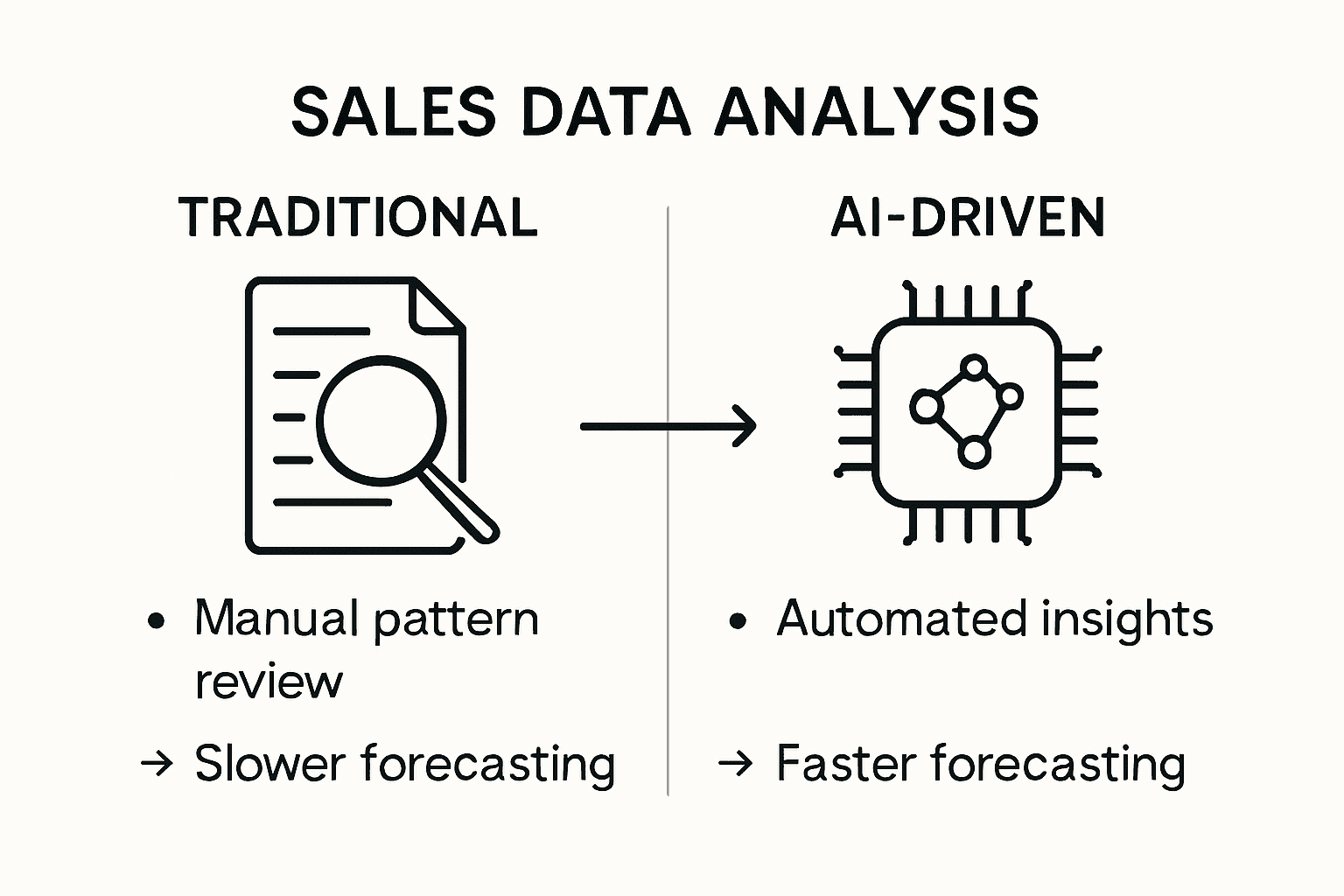
The following table compares traditional and AI-driven sales analysis approaches:
| Aspect | Traditional Analysis | AI-Driven Analysis |
|---|---|---|
| Data Volume Handled | Limited | Massive, multidimensional |
| Pattern Detection | Manual, often linear | Automated, complex pattern recognition |
| Speed of Insights | Slower, periodic | Real-time, continuous |
| Forecast Accuracy | Lower, basic projections | Higher, adapts to emerging trends |
Pro Tip - Strategic AI Integration: Start small by implementing AI-driven analytics on a specific product category or sales channel, allowing your team to gradually build expertise and confidence in leveraging advanced predictive technologies.
Actionable Use Cases for Online Retailers
Online retailers can leverage sophisticated sales data analysis techniques to transform raw information into strategic business opportunities. Advanced ranking models enable businesses to optimize product search results and improve customer engagement by understanding complex purchasing patterns. These data-driven approaches help retailers develop targeted strategies that directly impact revenue generation, customer retention, and overall market positioning.
Practical use cases for sales data analysis span multiple critical business functions. Product recommendation systems can be dramatically enhanced by analyzing customer purchase histories, identifying cross-selling opportunities, and predicting future buying behaviors. Inventory management becomes more precise through predictive analytics that forecast demand fluctuations, helping retailers minimize stockouts and reduce carrying costs. Dynamic pricing strategies can be implemented by analyzing real-time market trends, competitor pricing, and customer willingness to pay, allowing for more agile and responsive pricing models.
Customer segmentation represents another powerful application of sales data analysis. By dissecting customer behavior across different dimensions such as purchase frequency, average order value, and product preferences, retailers can create highly targeted marketing campaigns. These insights enable personalized communication strategies, tailored promotional offers, and more effective customer retention initiatives. Advanced analytics can also help identify high-value customer segments, understand churn risks, and develop proactive engagement strategies that maximize customer lifetime value.
Pro Tip - Incremental Analysis Strategy: Start by focusing on one or two key metrics that directly impact your business, and gradually expand your analytical capabilities as you gain confidence in interpreting and acting on data-driven insights.
Common Mistakes And Data Misinterpretations
E-commerce businesses frequently encounter significant challenges when analyzing sales data, often falling prey to systematic misinterpretation that can lead to misguided strategic decisions. Demand sensing techniques reveal that traditional forecasting methods can create dangerous blind spots, causing retailers to misread market signals and react inappropriately. Common mistakes include over-relying on historical data without considering current market dynamics, assuming linear relationships between variables, and failing to account for external factors that might dramatically influence sales performance.
One of the most prevalent data misinterpretation errors involves misunderstanding correlation versus causation. Businesses often mistake statistical correlations for causal relationships, leading to flawed strategic planning. For instance, observing that two product categories frequently appear together in transactions does not necessarily mean one drives the sales of the other. Similarly, seasonal sales spikes might be incorrectly attributed to marketing efforts when they could result from broader economic trends or consumer behavior shifts. Marketing mix modeling emphasizes the critical need for comprehensive analysis that considers multiple interconnected factors beyond simplistic linear interpretations.
Another significant pitfall is the tendency to cherry-pick data that confirms existing beliefs while ignoring contradictory evidence. This confirmation bias can create dangerous echo chambers within organizations, preventing genuine insight and innovative thinking. Effective sales data analysis requires a disciplined approach that welcomes unexpected findings, embraces statistical complexity, and maintains a rigorous commitment to objective interpretation. Successful e-commerce businesses cultivate a culture of data skepticism, continuously challenging assumptions and seeking nuanced understanding rather than settling for superficial explanations.
Pro Tip - Critical Data Evaluation: Develop a systematic approach to data review that includes multiple team members with diverse perspectives, ensuring a more holistic and balanced interpretation of your sales analytics.
Unlock E-Commerce Growth with Advanced Sales Data Analysis
Understanding complex sales metrics and uncovering hidden product relationships are critical challenges for online retailers aiming to increase revenue and improve customer experience. This article highlights the need for deeper insights through artificial intelligence and strategic data interpretation. If you want to avoid common misinterpretations and leverage AI-driven analytics to identify real cross-selling opportunities, increasing your Average Order Value (AOV) is within your reach.
Discover how APUS NEST can empower your Shopify or WooCommerce store to transform raw sales data into actionable insights. Our AI-powered platform performs advanced market basket analysis that reveals powerful product affinities and customer purchase patterns. You receive clear, data-driven recommendations to optimize product bundling and marketing campaigns with no complicated setups.
Start maximizing your revenue potential today with APUS NEST — the SaaS solution designed specifically for e-commerce entrepreneurs who want transparent, subscription-free analytics and the freedom to export and use their data across platforms.
Explore APUS NEST now

Take control of your sales data and unlock growth opportunities before your competitors do. Visit APUS NEST and get your free report to start discovering hidden revenue insights that drive smarter business decisions.
Frequently Asked Questions
What is sales data analysis in e-commerce?
Sales data analysis in e-commerce is the process of examining and interpreting digital sales information to uncover actionable insights. It involves tracking key metrics like total revenue, conversion rates, and product performance to inform business decisions.
Why is sales data analysis important for online retailers?
Sales data analysis helps online retailers understand customer purchasing patterns, optimize pricing and inventory strategies, and predict future sales trends, ultimately driving business growth and improving customer experiences.
What metrics should e-commerce managers focus on in their sales data analysis?
E-commerce managers should focus on key metrics such as total revenue, average order value, conversion rates, product category performance, and customer lifetime value to gauge performance and make data-driven decisions.
How can artificial intelligence enhance sales data analysis?
Artificial intelligence can enhance sales data analysis by identifying complex patterns and correlations in large datasets, improving sales forecasting accuracy and allowing for actionable insights that traditional analysis methods might miss.
Recommended
- Complete Guide to Sales Trend Analysis in E-commerce - ApusNest Blog | ApusNest
- 7 Essential E-Commerce Data Analysis Tips for Higher Sales - ApusNest Blog | ApusNest
- Guide to E-Commerce Data Analysis for Increased Sales - ApusNest Blog | ApusNest
- Actionable Ecommerce Analytics Explained: Boost Revenue - ApusNest Blog | ApusNest
