

Most online retailers collect mountains of data but fail to turn it into action. In fact, over 60 percent of e-commerce businesses struggle to use analytics for meaningful growth. Without clear insights, revenue opportunities slip by unnoticed while effort gets spent on guesswork. This guide breaks down how actionable ecommerce analytics moves past bland reports to uncover concrete, profitable strategies that transform your store’s raw numbers into real business wins.
Table of Contents
- Defining Actionable Ecommerce Analytics
- Types of Ecommerce Data and Metrics
- How Market Basket Analysis Works
- Integrating Analytics with Shopify and Woocommerce
- Leveraging Insights to Increase Revenue
- Common Pitfalls and Best Practices
Key Takeaways
| Point | Details |
|---|---|
| Actionable Ecommerce Analytics | Transforms raw data into strategic insights, providing executable recommendations tailored to enhance revenue growth. |
| Types of Ecommerce Metrics | Understanding performance, behavioral, and advanced metrics is critical for creating effective marketing strategies and optimizing product offerings. |
| Market Basket Analysis | Identifies product relationships among consumer purchases, enabling retailers to develop targeted cross-selling and upselling strategies. |
| Common Pitfalls and Best Practices | Avoid collecting data without purpose; instead, establish clear goals and continuously validate data for more effective decision-making. |
Defining Actionable Ecommerce Analytics
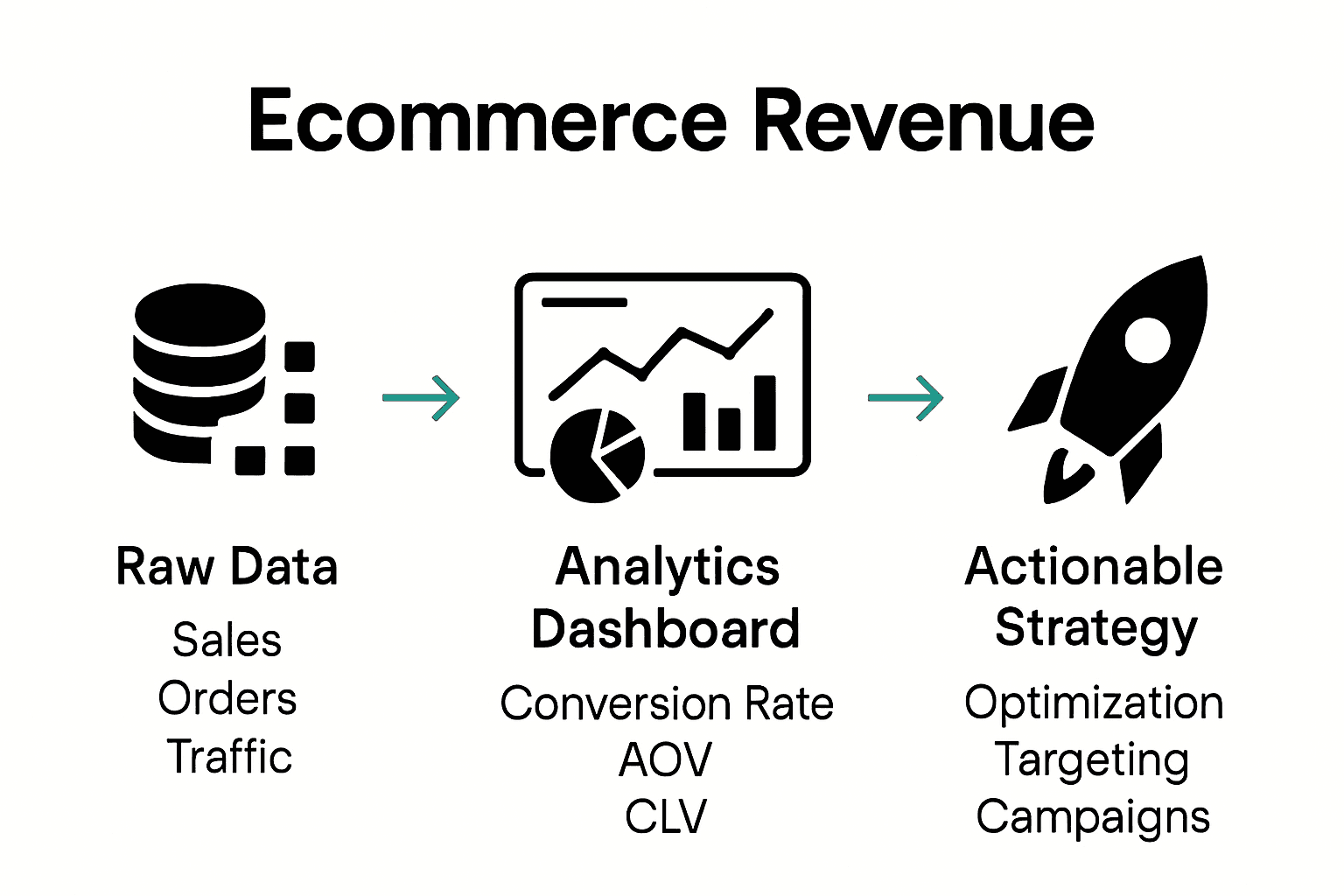
Actionable ecommerce analytics transforms raw sales data into strategic insights that directly impact revenue growth. Unlike generic reporting, actionable analytics provide specific, executable recommendations tailored to your online store’s unique performance landscape. These insights go beyond surface-level metrics like total sales, diving deep into customer behavior, product relationships, and untapped revenue opportunities.
At its core, actionable ecommerce analytics means converting complex data points into clear, implementable strategies. Think of it as having a strategic advisor who doesn’t just show you numbers but tells you exactly what to do next. Understanding Ecommerce Analytics: Unlocking Insights reveals how these analytics help merchants make informed decisions.
Key characteristics of actionable analytics include:
- Predictive recommendations, not just historical data
- Granular insights about product performance
- Clear pathways to increase average order value
- Identification of cross-selling and upselling opportunities
- Customer segmentation beyond basic demographics
Successful online retailers leverage these analytics to create targeted marketing campaigns, optimize product placement, and understand nuanced customer purchasing patterns. By translating complex data into strategic actions, ecommerce entrepreneurs can transform their sales approach from reactive to proactive, ultimately driving sustainable revenue growth.
Types of Ecommerce Data and Metrics
Ecommerce data and metrics represent the lifeblood of online retail strategy, providing crucial insights into business performance and customer behavior. Understanding Ecommerce Metrics: A Comprehensive Guide reveals the multifaceted nature of these critical measurements. As research from JSTOR indicates, categorizing these metrics is essential for developing targeted business strategies.
Performance Metrics form the foundational layer of ecommerce analytics, including key indicators like:
- Conversion rate
- Average order value
- Total revenue
- Gross profit margin
- Customer acquisition cost
Beyond basic performance tracking, behavioral metrics dive deeper into customer interactions. These include website engagement statistics, product page views, cart abandonment rates, and customer journey mapping. Each metric tells a story about how customers interact with your online store, revealing potential friction points and optimization opportunities.
Advanced ecommerce metrics extend into predictive and strategic domains. Customer lifetime value, repeat purchase rates, and segmentation analytics transform raw data into strategic insights. By understanding these nuanced metrics, online retailers can create personalized marketing strategies, optimize product offerings, and ultimately drive sustainable revenue growth. The goal isn’t just collecting numbers but translating them into actionable business intelligence that directly impacts bottom-line performance.

How Market Basket Analysis Works
Market basket analysis is a powerful data mining technique that reveals hidden connections between products customers purchase together. Market Basket Analysis Guide explains how this method uncovers valuable insights into consumer purchasing behaviors. According to research from arXiv, the core of market basket analysis lies in identifying statistically significant associations between products across multiple transactions.
The process involves several key steps:
- Data Collection: Gathering transactional data from purchase history
- Association Rule Generation: Identifying which products are frequently bought together
- Metric Calculation:
- Support: Frequency of item combinations
- Confidence: Likelihood of purchasing related items
- Lift: Strength of the product relationship beyond random chance
Practical applications of market basket analysis extend far beyond simple product recommendations. Journals Kart highlights how retailers can use these insights to optimize store layouts, design targeted marketing campaigns, and create strategic product bundles. Imagine discovering that customers who buy running shoes are highly likely to purchase protein supplements – this insight allows for precise cross-selling strategies that feel natural rather than forced.
At its core, market basket analysis transforms raw transaction data into a strategic roadmap for increasing average order value. By understanding subtle connections between products, online retailers can create personalized shopping experiences, recommend complementary items, and ultimately drive revenue growth. The magic lies not just in collecting data, but in translating those complex patterns into actionable marketing and inventory strategies that resonate with customer preferences.
Integrating Analytics with Shopify and WooCommerce
E-commerce platforms like Shopify and WooCommerce have transformed how online businesses track and leverage performance data. 7 Essential Marketing Analytics Tools List for E-commerce Success highlights the critical importance of seamless analytics integration for driving strategic business decisions. These platforms offer built-in analytics capabilities, but truly powerful insights come from understanding how to extract and apply the right data.
Integration Strategies for e-commerce analytics typically involve:
- Connecting native platform analytics
- Installing third-party tracking plugins
- Configuring custom event tracking
- Setting up advanced conversion monitoring
- Implementing cross-platform data synchronization
When integrating analytics, merchants must focus on key performance indicators (KPIs) that directly impact revenue. Tracking mechanisms should capture comprehensive data points including:
- Visitor traffic sources
- Conversion rates
- Average order value
- Customer acquisition cost
- Product performance metrics
Successful integration transforms raw data into actionable strategies. By connecting analytics tools directly with Shopify or WooCommerce, online retailers can create dynamic, responsive marketing approaches that adapt in real-time to customer behavior. The goal isn’t just collecting numbers, but developing a living, breathing understanding of your store’s performance ecosystem that guides every strategic decision.
Leveraging Insights to Increase Revenue
Transforming raw data into revenue-driving strategies requires a strategic approach to analytics interpretation. 7 Effective Ways to Maximize Revenue in E-commerce reveals the critical connection between data insights and bottom-line growth. Successful online retailers don’t just collect numbers; they create actionable narratives that guide precise marketing and product optimization strategies.
Revenue Acceleration Strategies based on data insights include:
- Identifying high-performing product clusters
- Optimizing pricing through demand elasticity analysis
- Creating personalized cross-sell recommendations
- Developing targeted marketing campaigns
- Reducing customer acquisition costs
- Improving customer retention rates
Advanced revenue insights go beyond surface-level metrics. Conversion Optimization techniques involve deep analysis of:
- Customer journey mapping
- Abandonment rate analysis
- Lifetime value prediction
- Segmentation strategy development
- Purchase behavior pattern recognition
The most powerful revenue growth comes from viewing analytics as a dynamic, living system. By continuously interpreting data, online retailers can create adaptive strategies that respond in real-time to changing customer preferences. Insights become more than just numbers – they transform into a strategic roadmap that guides every business decision, turning raw information into a predictive engine for sustainable growth.
Common Pitfalls and Best Practices
Navigating e-commerce analytics requires a strategic approach that balances technical precision with actionable insights. According to research from JSTOR, many online retailers fall into predictable traps that can significantly hinder their data-driven decision-making processes. Understanding these common pitfalls is crucial for developing a robust analytics strategy that drives meaningful business growth.
Critical Pitfalls to Avoid:
- Collecting data without clear objectives
- Overrelying on vanity metrics
- Neglecting data quality and consistency
- Failing to segment customer data effectively
- Ignoring potential bias in data interpretation
- Treating analytics as a one-time exercise
Best Practices for Effective Analytics:
- Establish clear, measurable business goals
- Implement rigorous data validation processes
- Create comprehensive customer segmentation strategies
- Develop a continuous learning and adaptation mindset
- Invest in team training and data literacy
- Use multiple data sources for comprehensive insights
Successful e-commerce analytics is an ongoing journey of discovery and refinement. The most effective approaches treat data as a living, breathing ecosystem that requires constant nurturing, critical examination, and strategic interpretation. By avoiding common pitfalls and embracing a holistic, adaptive approach, online retailers can transform raw numbers into powerful strategic assets that drive sustained business growth.
Unlock True Revenue Growth with Actionable Ecommerce Analytics
Understanding actionable ecommerce analytics means knowing exactly which actions will boost your store’s performance—not just having data. If you struggle with translating complex sales metrics into clear strategies like identifying cross-selling opportunities or boosting your average order value, you are not alone. The challenge is turning scattered data into meaningful insights such as those gained from market basket analysis, customer segmentation, and conversion tracking.
At APUS NEST, we specialize in helping Shopify and WooCommerce store owners discover hidden product relationships and untapped revenue streams. Our AI-powered platform analyzes your sales data, delivering detailed reports that uncover the product pairings and bundles proven to increase sales. You can start with a free analysis to see immediate opportunities, then access comprehensive, actionable insights without the hassle of subscriptions or data lock-in.

Take control of your ecommerce future today. Visit APUS NEST to upload your sales data and get personalized recommendations. Learn more about how to turn complex numbers into simple, revenue-driving strategies in our Understanding Ecommerce Analytics: Unlocking Insights and explore practical Market Basket Analysis Guide to maximize your store performance. Start transforming your analytics into profits now.
Frequently Asked Questions
What are actionable ecommerce analytics?
Actionable ecommerce analytics transform raw sales data into specific, executable recommendations that help online retailers improve their revenue growth and optimize their business strategies.
How can I use ecommerce analytics to boost sales?
You can use ecommerce analytics to identify high-performing products, optimize pricing, create personalized marketing campaigns, and uncover opportunities for cross-selling and upselling to increase average order value.
What are key performance metrics to track in ecommerce analytics?
Key performance metrics include conversion rate, average order value, customer acquisition cost, gross profit margin, and customer lifetime value, all of which provide insights into business performance and customer behavior.
How does market basket analysis enhance ecommerce strategy?
Market basket analysis identifies associations between products frequently purchased together, allowing retailers to optimize store layouts, create targeted marketing campaigns, and improve cross-selling strategies, ultimately increasing average order value.
