

AI is shaking up online shopping in ways most people have never seen before. Picture this. Some retailers are using AI to predict exactly what you want and change their prices in real time, boosting sales by as much as 30 percent. Sounds high-tech, right? Turns out the real secret is how these systems are quietly learning from every click and purchase, pulling off levels of personalization and efficiency that were impossible just a few years ago.
Table of Contents
- What Is AI And How It Relates To E-commerce?
- The Importance Of AI In Enhancing Customer Experience
- Understanding AI’s Role In Inventory Management
- How AI Drives Marketing Strategies In E-commerce
- Real-World Examples Of AI Transforming Online Retail
Quick Summary
| Takeaway | Explanation |
|---|---|
| AI improves e-commerce efficiency | AI enables businesses to analyze data quickly, maximizing operational efficiency and accuracy in decision-making. |
| Personalization enhances customer engagement | AI-driven personalization creates tailored shopping experiences, increasing customer satisfaction and loyalty. |
| Predictive algorithms optimize inventory management | AI forecasts demand accurately, helping to manage stock levels and minimize waste effectively. |
| AI transforms marketing campaigns | Intelligent algorithms customize marketing efforts, improving targeting and increasing return on investment. |
| Automated customer support is vital | AI-powered chatbots provide instant responses, offering round-the-clock assistance and enhancing customer service quality. |
What is AI and How It Relates to E-commerce?
Artificial Intelligence transforms e-commerce by bringing powerful computational capabilities to online retail environments. At its core, AI represents sophisticated computer systems capable of performing tasks that traditionally require human intelligence, such as learning, problem solving, and pattern recognition.
Understanding AI’s Core Capabilities
In e-commerce, AI functions through advanced algorithms and machine learning models that analyze massive datasets to generate actionable insights. These intelligent systems can process customer behaviors, sales patterns, and market trends far more quickly and accurately than manual human analysis.
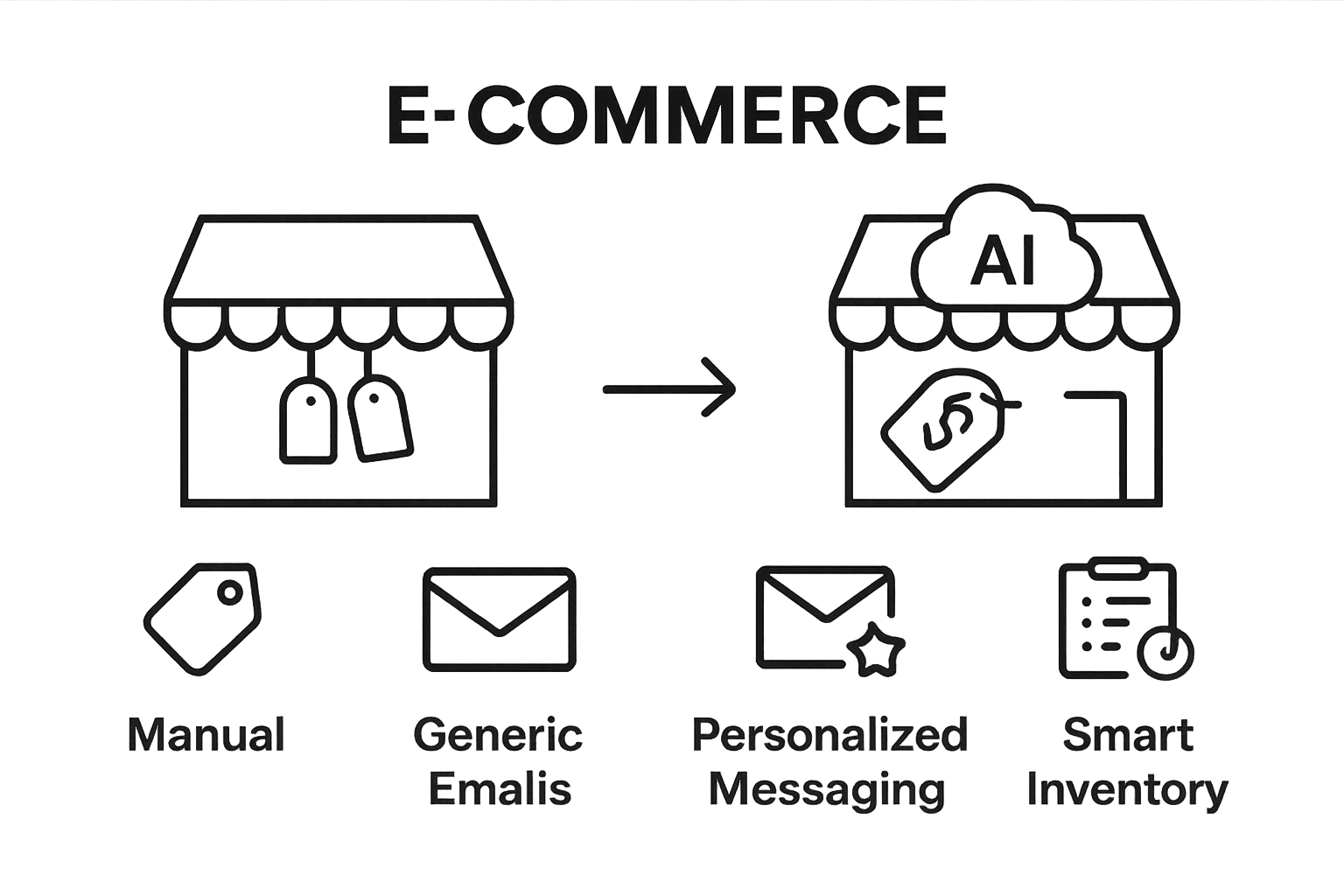 Our guide on AI strategies for e-commerce store owners provides deeper insights into these technological capabilities.
Key AI capabilities in e-commerce include:
- Predictive customer behavior modeling
- Real-time personalization of shopping experiences
- Dynamic pricing optimization
- Automated customer service interactions
- Advanced product recommendation systems
Practical Applications in Online Retail
According to academic research from Wiley Online Library, AI integration in e-commerce enhances operational efficiency by enabling intelligent recommendation systems, automated customer interactions, and data-driven decision making. These technologies help online businesses understand customer preferences, predict purchasing patterns, and create more targeted marketing strategies.
The power of AI lies in its ability to transform raw data into strategic insights. By analyzing thousands of customer interactions simultaneously, AI can identify subtle patterns that human analysts might miss, enabling e-commerce businesses to make more informed decisions about product placement, pricing, and marketing approaches. This computational intelligence represents a significant leap forward in how online retailers understand and engage with their customer base.
The Importance of AI in Enhancing Customer Experience
AI has revolutionized customer experience in e-commerce by creating more personalized, responsive, and intelligent interactions that adapt to individual consumer needs. The technology transforms traditional customer engagement from static, one-size-fits-all approaches to dynamic, individualized experiences that anticipate and fulfill customer expectations.
Personalization at Scale
Customer experience optimization through AI enables online businesses to deliver hyper-personalized interactions that feel uniquely tailored to each shopper. By analyzing extensive customer data points like browsing history, purchase patterns, and preferences, AI systems can generate recommendations and experiences that feel remarkably individualized.
Explore our comprehensive guide on customer insights analytics to understand how these technologies work.
Key personalization capabilities include:
- Real-time product recommendations
- Customized homepage experiences
- Individualized marketing communications
- Contextual pricing strategies
- Proactive customer support
Intelligent Customer Support Transformation
According to research from the American Public University, AI-powered technologies like chatbots and virtual assistants are dramatically improving customer service interactions. These intelligent systems provide instantaneous, 24/7 support, resolving queries quickly and efficiently while maintaining a consistent quality of service that human agents might struggle to deliver consistently.
By integrating advanced natural language processing, these AI systems can understand context, interpret customer intent, and provide precise, helpful responses. This technological approach not only reduces response times but also creates more engaging and satisfying customer interactions that feel intuitive and supportive.
Understanding AI’s Role in Inventory Management
AI has transformed inventory management from a reactive process to a predictive and strategic function in e-commerce. By leveraging advanced machine learning algorithms, businesses can now anticipate demand, optimize stock levels, and minimize financial risks associated with traditional inventory approaches.
Predictive Demand Forecasting
AI systems analyze complex datasets encompassing historical sales patterns, seasonal trends, market fluctuations, and external economic indicators to generate precise inventory predictions. These intelligent models can forecast product demand with remarkable accuracy, enabling e-commerce businesses to maintain optimal stock levels. Our comprehensive AI and e-commerce guide offers deeper insights into these advanced forecasting techniques.
Key predictive inventory management capabilities include:
- Real-time demand prediction
- Automated reordering thresholds
- Dynamic pricing optimization
- Supply chain risk assessment
- Seasonal trend anticipation
Reducing Operational Inefficiencies
According to research from the National Bureau of Economic Research, AI technologies significantly reduce forecasting errors in supply chain management. By minimizing expensive overstocking and preventing stockout scenarios, AI helps e-commerce businesses optimize their inventory investments and improve overall operational efficiency.
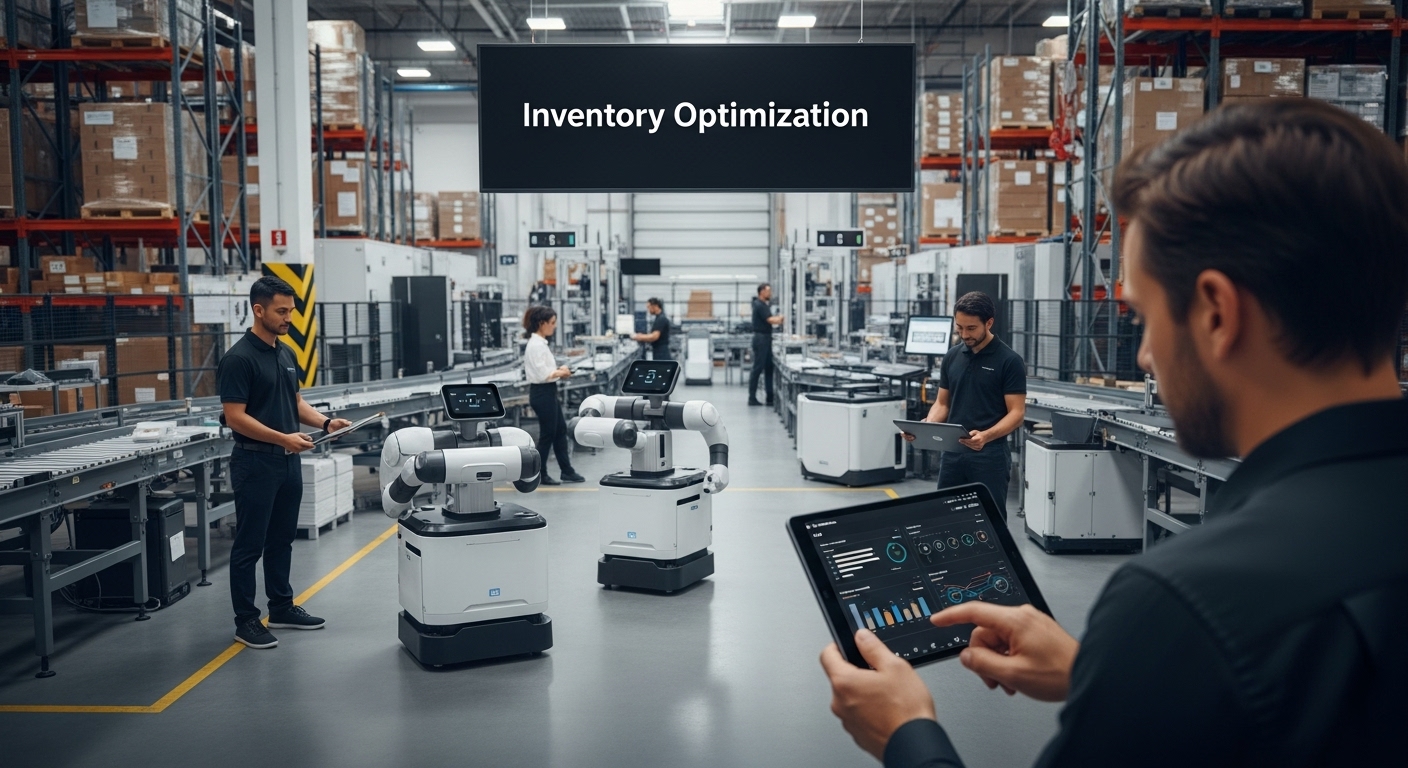
The strategic application of AI in inventory management goes beyond simple number crunching. These intelligent systems continuously learn and adapt, incorporating new data points to refine their predictive models. This dynamic approach allows businesses to respond swiftly to market changes, consumer behavior shifts, and unexpected disruptions, maintaining a competitive edge in the fast-evolving e-commerce landscape.
How AI Drives Marketing Strategies in E-commerce
AI has fundamentally reshaped marketing strategies in e-commerce, transforming traditional approaches into sophisticated, data-driven techniques that can predict consumer behavior, personalize interactions, and optimize marketing investments with unprecedented precision.
Predictive Consumer Behavior Analysis
AI technologies enable e-commerce businesses to move beyond generic marketing tactics by developing hyper-targeted marketing strategies based on intricate consumer insights. Machine learning algorithms analyze extensive datasets including browsing histories, purchase patterns, demographic information, and real-time interactions to create nuanced consumer profiles. Discover more about data-driven campaign optimization to understand these advanced techniques.
Key AI-powered marketing capabilities include:
- Precise audience segmentation
- Predictive purchase likelihood modeling
- Dynamic content personalization
- Sentiment analysis and trend prediction
- Automated marketing campaign optimization
Intelligent Marketing Campaign Management
According to research published in the Journal of Informatics Education and Research, AI solutions are dramatically enhancing marketing performance metrics in e-commerce. These intelligent systems can autonomously manage marketing campaigns, continuously learning and adjusting strategies based on real-time performance data.
By integrating advanced machine learning algorithms, AI transforms marketing from a reactive to a proactive discipline. These systems can instantaneously identify emerging trends, predict consumer responses, and recommend precise interventions that maximize marketing effectiveness and return on investment. The result is a more agile, responsive, and intelligent approach to e-commerce marketing that adapts seamlessly to changing consumer landscapes.
Below is a table organizing the key AI-powered marketing capabilities discussed in the article, helping readers quickly see how AI enhances the marketing function in e-commerce.
| Capability | Description |
|---|---|
| Precise Audience Segmentation | Divides audiences based on detailed insights for targeted outreach |
| Predictive Purchase Likelihood | Forecasts which customers are likely to make a purchase |
| Dynamic Content Personalization | Customizes marketing messages and content in real time |
| Sentiment Analysis and Trend Prediction | Gauges customer sentiment and anticipates emerging trends |
| Automated Campaign Optimization | Continuously adjusts marketing campaigns for maximum performance |
Real-World Examples of AI Transforming Online Retail
Artificial Intelligence has moved beyond theoretical potential, demonstrating tangible transformations across online retail operations. These practical applications showcase how AI technologies are creating unprecedented efficiencies, personalization, and customer experiences in e-commerce environments.
Intelligent Product Recommendations
AI-powered recommendation systems have revolutionized how online retailers engage customers. Machine learning algorithms analyze individual shopping behaviors, creating uniquely tailored product suggestions that dramatically increase conversion rates. These systems do not simply suggest random items but craft personalized experiences by understanding complex consumer preferences and purchasing patterns. Learn more about advanced data-driven campaign strategies to see how these technologies work.
Key AI recommendation strategies include:
- Collaborative filtering techniques
- Content-based recommendation models
- Hybrid recommendation systems
- Real-time personalization engines
- Cross-category product matching
Supply Chain and Operational Optimization
According to research from McKinsey & Company, AI is transforming supply chain management through sophisticated predictive analytics. Companies are using machine learning to optimize inventory levels, predict demand fluctuations, and streamline logistics operations with remarkable precision.
These AI applications go beyond simple data processing. Intelligent systems can now anticipate market trends, adjust pricing dynamically, and provide granular insights that enable businesses to make proactive decisions. By integrating advanced algorithms with real-world operational data, e-commerce companies are creating more responsive, efficient, and customer-centric business models that adapt instantaneously to changing market conditions.
The table below summarizes key real-world applications of AI in online retail, making it easy to compare where AI is having tangible impact across e-commerce operations.
| AI Application | Main Benefit | Example Features |
|---|---|---|
| Product Recommendation Systems | Increases conversion through personalized offers | Collaborative filtering, real-time suggestions |
| Inventory & Supply Chain Optimization | Maintains optimal stock, reduces waste | Predictive analytics, dynamic pricing |
| Automated Customer Support | Provides instant, 24/7 assistance | Chatbots, virtual assistants |
| Dynamic Pricing | Boosts sales by adjusting prices in real time | Real-time analysis, context-based pricing |
| Data-driven Marketing | Maximizes ROI with targeted campaigns | Audience segmentation, automated campaign tuning |
Unlock Hidden Revenue with AI-Powered Insights for Your Store
Have you ever wondered how leading e-commerce brands boost profits using AI while you struggle with unpredictable sales, missed cross-sell opportunities, and manual product pairing? This article explained how AI can transform your store by revealing powerful product relationships, predicting customer behavior, and personalizing the shopping experience at scale. But extracting these insights from your own data can feel overwhelming if you do not have the right tools.
Now is the time to take control and let your sales data drive results. Discover how APUS NEST empowers Shopify and WooCommerce owners to quickly upload sales history, uncover hidden product pairings, and receive actionable reports that fuel higher average order values. Ready to see exactly where you are missing revenue? Get your free report or explore our full analytics to unlock every cross-sell opportunity and watch your store grow. Visit APUS NEST’s main page to get started today, or learn more about AI strategies for store owners and improving customer insights with analytics.
Frequently Asked Questions
What is the role of AI in e-commerce?
AI plays a crucial role in e-commerce by enabling businesses to analyze large volumes of data, understand customer behavior, and create personalized shopping experiences. It enhances operational efficiency through predictive analytics and intelligent systems that optimize inventory and streamline customer interactions.
How does AI improve customer experience in online retail?
AI improves customer experience by providing hyper-personalized recommendations, customized marketing communications, and proactive customer support through chatbots and virtual assistants. These technologies help create engaging and responsive shopping interactions tailored to individual consumer needs.
What are the key applications of AI in inventory management for e-commerce?
AI applications in inventory management include predictive demand forecasting, automated reordering, and dynamic pricing optimization. These capabilities allow e-commerce businesses to maintain optimal stock levels, reduce overstocking and stockouts, and ultimately improve operational efficiency.
How is AI transforming marketing strategies in e-commerce?
AI transforms marketing strategies by enabling precise audience segmentation, predictive purchase modeling, and automated campaign optimization. These capabilities allow e-commerce retailers to implement data-driven marketing strategies that enhance engagement and maximize return on investment.
Recommended
- AI and Ecommerce Guide: Strategies for Success in 2025 - ApusNest Blog | ApusNest
- APUS NEST | Stop Guessing, Start Growing
- Customer Insights Analytics Guide: Unlocking Value in 2025 - ApusNest Blog | ApusNest
- 7 Proven Ways to Boost Shopify Sales in 2025 - ApusNest Blog | ApusNest
- The Impact of AI on SEO in 2025: Key Changes for Businesses
