

Most American businesses now depend on data to guide every decision in ecommerce, yet fewer than one in three confidently use analytics to their full advantage. In an industry where customer habits shift overnight, adopting a data-driven approach sets apart those who thrive from those who simply keep up. This guide sheds light on how American retailers can turn raw information into meaningful strategy for smarter growth and stronger customer connections.
Table of Contents
- Defining Data Driven Ecommerce Strategies
- Types of Ecommerce Data and Their Value
- How AI Reveals Product Relationships
- Revenue Opportunities With Market Basket Analysis
- Common Pitfalls and Data Privacy Concerns
Key Takeaways
| Point | Details |
|---|---|
| Data-Driven Decision Making | Leveraging analytics and digital technologies allows businesses to make informed e-commerce decisions based on consumer behavior data. |
| Types of E-commerce Data | Key data types such as Transactional Data and Customer Behavioral Data are essential for developing targeted marketing strategies. |
| AI in Product Analysis | AI technologies enhance product relationship understanding, revealing patterns that improve recommendation systems and customer experiences. |
| Ethics and Data Privacy | Navigating the complexities of data privacy is crucial for maintaining customer trust while utilizing data-driven insights effectively. |
Defining Data Driven Ecommerce Strategies
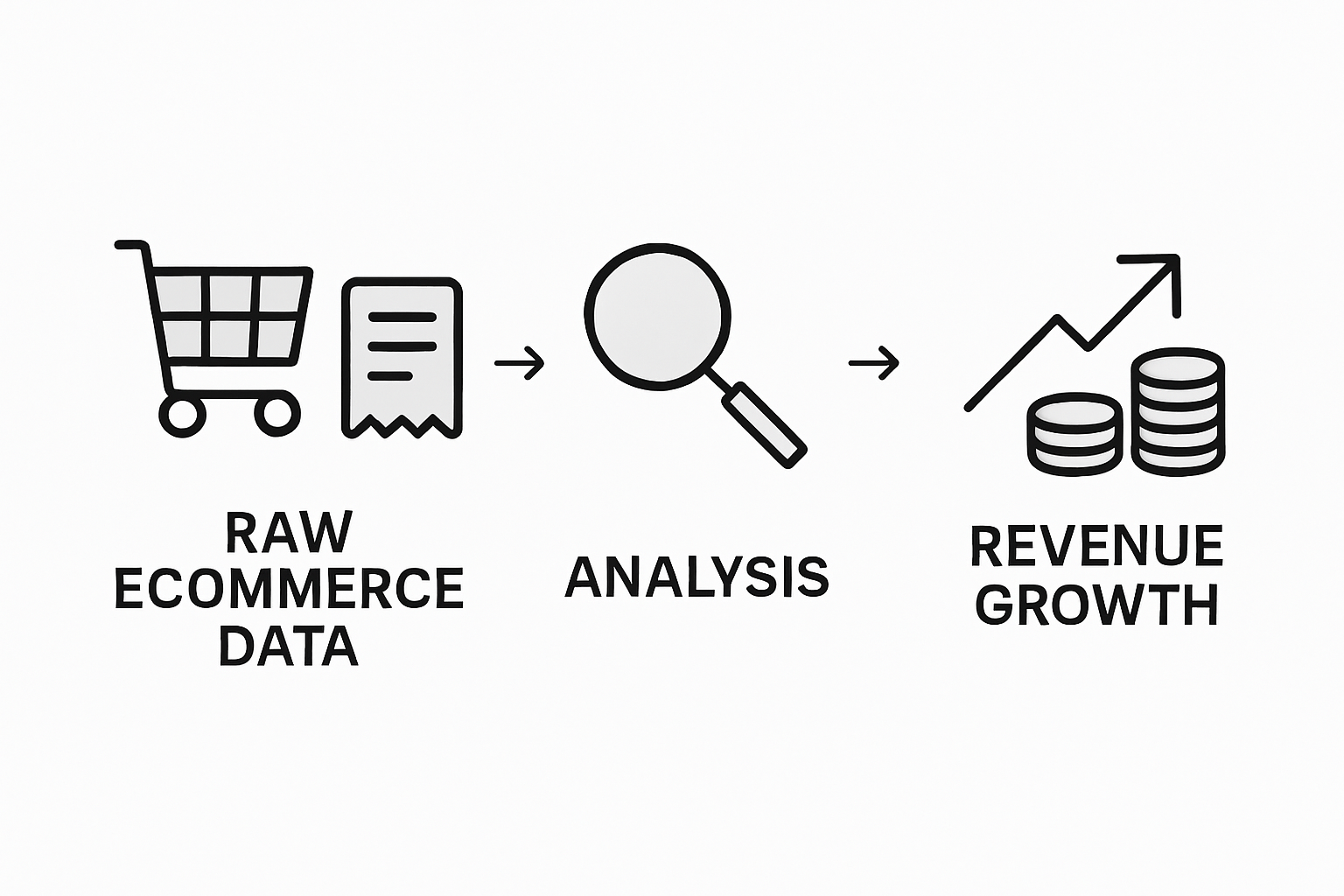
Data driven ecommerce strategies represent a transformative approach to online retail, leveraging advanced analytics and digital technologies to make precision business decisions. By systematically collecting, analyzing, and interpreting sales and customer interaction data, businesses can unlock powerful insights that drive revenue growth and operational efficiency.
The core of data driven strategies involves understanding complex consumer behaviors through sophisticated analytical techniques. Modern e-commerce marketing strategies now integrate Big Data and Artificial Intelligence to gain deep consumer insights, enabling businesses to predict trends and create highly personalized shopping experiences. This approach moves beyond traditional intuition based methods, allowing retailers to make decisions grounded in concrete statistical evidence.
Key components of effective data driven ecommerce strategies include:
- Customer Segmentation: Analyzing purchase history, browsing patterns, and demographic information
- Predictive Analytics: Forecasting future purchasing trends and customer behaviors
- Personalization Engines: Tailoring product recommendations and marketing messages
- Performance Tracking: Monitoring key metrics like conversion rates, average order value, and customer lifetime value
Implementing these strategies requires robust technological infrastructure and a commitment to continuous learning. Digital technologies are fundamentally transforming e-commerce operations in the Fourth Industrial Revolution, creating opportunities for businesses willing to invest in advanced analytics capabilities. Success hinges not just on collecting data, but on developing the analytical skills to translate raw information into actionable strategic insights.
Types of Ecommerce Data and Their Value
Understanding the diverse types of ecommerce data is crucial for developing strategic business insights and driving targeted marketing efforts. These data categories provide a comprehensive view of customer interactions, sales performance, and operational dynamics, enabling businesses to make informed decisions that directly impact revenue and growth.
The primary types of ecommerce data include Transactional Data, which captures the core details of customer purchases, including product details, pricing, quantities, and timing. Customer Behavioral Data offers deeper insights into user interactions, tracking website navigation patterns, time spent on product pages, cart abandonment rates, and browsing history. Advanced systems like SmartBundle now integrate customer segmentation techniques to automate product bundling and identify high-potential sales opportunities, demonstrating the sophisticated analytical potential of modern data collection.
Key categories of ecommerce data encompass:
- Purchase History: Comprehensive records of customer transactions
- Customer Demographics: Age, location, income level, and other personal attributes
- Web Analytics: User engagement metrics, traffic sources, and conversion rates
- Inventory Data: Stock levels, product performance, and supply chain insights
- Marketing Interaction Data: Email engagement, ad click-through rates, and campaign performance
The true value of ecommerce data lies not just in collection, but in strategic interpretation. By analyzing these diverse data types through advanced analytics methodologies, businesses can develop predictive models, personalize customer experiences, optimize pricing strategies, and ultimately drive significant revenue growth. Successful data utilization transforms raw information into a powerful strategic asset that can differentiate a business in an increasingly competitive digital marketplace.
How AI Reveals Product Relationships
Artificial Intelligence represents a transformative technology for understanding complex product interactions, enabling e-commerce businesses to uncover nuanced relationships that traditional analysis methods might miss. By leveraging advanced machine learning algorithms, AI can identify intricate patterns of customer purchase behavior, product compatibility, and potential bundling opportunities that humans might overlook.

The core mechanism of AI product relationship discovery involves sophisticated pattern recognition algorithms that analyze multiple data dimensions simultaneously. Advanced analytics frameworks can now quantify interactive effects across different decision points, allowing businesses to develop more intelligent product recommendation systems. These algorithms examine thousands of data points, including purchase history, browsing patterns, customer demographics, and seasonal trends to reveal hidden connections between products.
Key techniques AI employs to reveal product relationships include:
- Collaborative Filtering: Recommending products based on similar customer purchase behaviors
- Association Rule Mining: Identifying frequently co-purchased item combinations
- Semantic Product Matching: Understanding product attributes beyond surface-level categorizations
- Predictive Recommendation Models: Forecasting potential product pairings
- Network Analysis: Mapping complex product relationship graphs
AI-powered product recommendation strategies enable businesses to move beyond simple linear recommendations, creating dynamic, intelligent systems that adapt in real time. By understanding these intricate product relationships, e-commerce platforms can dramatically improve customer experience, increase average order value, and create more personalized shopping journeys that feel intuitive and natural to consumers.
Revenue Opportunities With Market Basket Analysis
Market Basket Analysis (MBA) represents a powerful data-driven strategy that enables e-commerce businesses to unlock hidden revenue potential by understanding complex product purchasing patterns. This analytical approach goes beyond traditional sales tracking, revealing intricate relationships between products that can dramatically transform marketing, pricing, and inventory strategies.
Intelligent systems like SmartBundle now automate product bundling by integrating advanced customer segmentation and data analytics techniques, allowing businesses to identify high-potential product combinations with unprecedented precision. By analyzing thousands of transaction records, these sophisticated algorithms can uncover non-obvious product relationships that human analysts might completely miss.
Key revenue opportunities revealed through Market Basket Analysis include:
- Cross-Selling Strategies: Identifying complementary product pairs
- Intelligent Bundling: Creating product packages with higher perceived value
- Targeted Promotions: Designing marketing campaigns based on purchase patterns
- Inventory Optimization: Strategically positioning related products
- Personalized Recommendations: Generating dynamic, data-driven suggestions
Comprehensive market basket analysis guides demonstrate that successful implementation can increase average order value by revealing strategic product connections. By understanding these nuanced relationships, businesses can create more intuitive shopping experiences, encourage larger purchases, and ultimately drive significant revenue growth through data-powered insights.
Common Pitfalls and Data Privacy Concerns
Data-driven e-commerce strategies represent immense potential, but they also introduce complex challenges around data privacy, ethical use, and potential misuse of customer information. Businesses must navigate a delicate balance between leveraging powerful insights and maintaining customer trust, understanding that every data point represents real human behavior and personal information.
Research examining big data-driven strategies highlights critical concerns surrounding sustainable consumer behavior and data privacy, emphasizing the need for transparent, responsible data management practices. The digital landscape has transformed rapidly, creating unprecedented opportunities for personalized marketing while simultaneously raising significant ethical questions about data collection, storage, and utilization.
Key data privacy and ethical considerations include:
- Consent Management: Ensuring clear, informed customer agreement for data usage
- Data Anonymization: Protecting individual identities within aggregate datasets
- Secure Storage: Implementing robust cybersecurity protocols
- Transparent Reporting: Clearly communicating data collection practices
- Opt-Out Mechanisms: Providing customers control over their personal information
Purchase data strategies must prioritize ethical considerations, recognizing that customer trust is far more valuable than short-term analytical gains. By developing comprehensive data governance frameworks that respect individual privacy rights, businesses can build long-term customer relationships founded on transparency, security, and mutual respect.
Unlock Hidden Ecommerce Revenue with Data Driven Insights
The article highlights how data driven ecommerce strategies like Market Basket Analysis and AI powered product recommendations reveal hidden product relationships that boost revenue and customer engagement. Many store owners struggle to analyze transactional and behavioral data to craft effective cross sell tactics and intelligent bundling. Understanding complex product pairings requires advanced analytics and clear, actionable insights to increase average order value and improve customer experience.
APUS NEST offers a powerful solution designed specifically for Shopify and WooCommerce merchants ready to harness these insights. By analyzing your sales data with AI technology, the platform uncovers proven product associations and revenue opportunities you might miss. You can upload your CSV files or integrate directly, then receive detailed reports that guide you to optimize product placements and marketing strategies without needing subscriptions or sacrificing data ownership.
Ready to transform your ecommerce store and unlock untapped growth potential now?
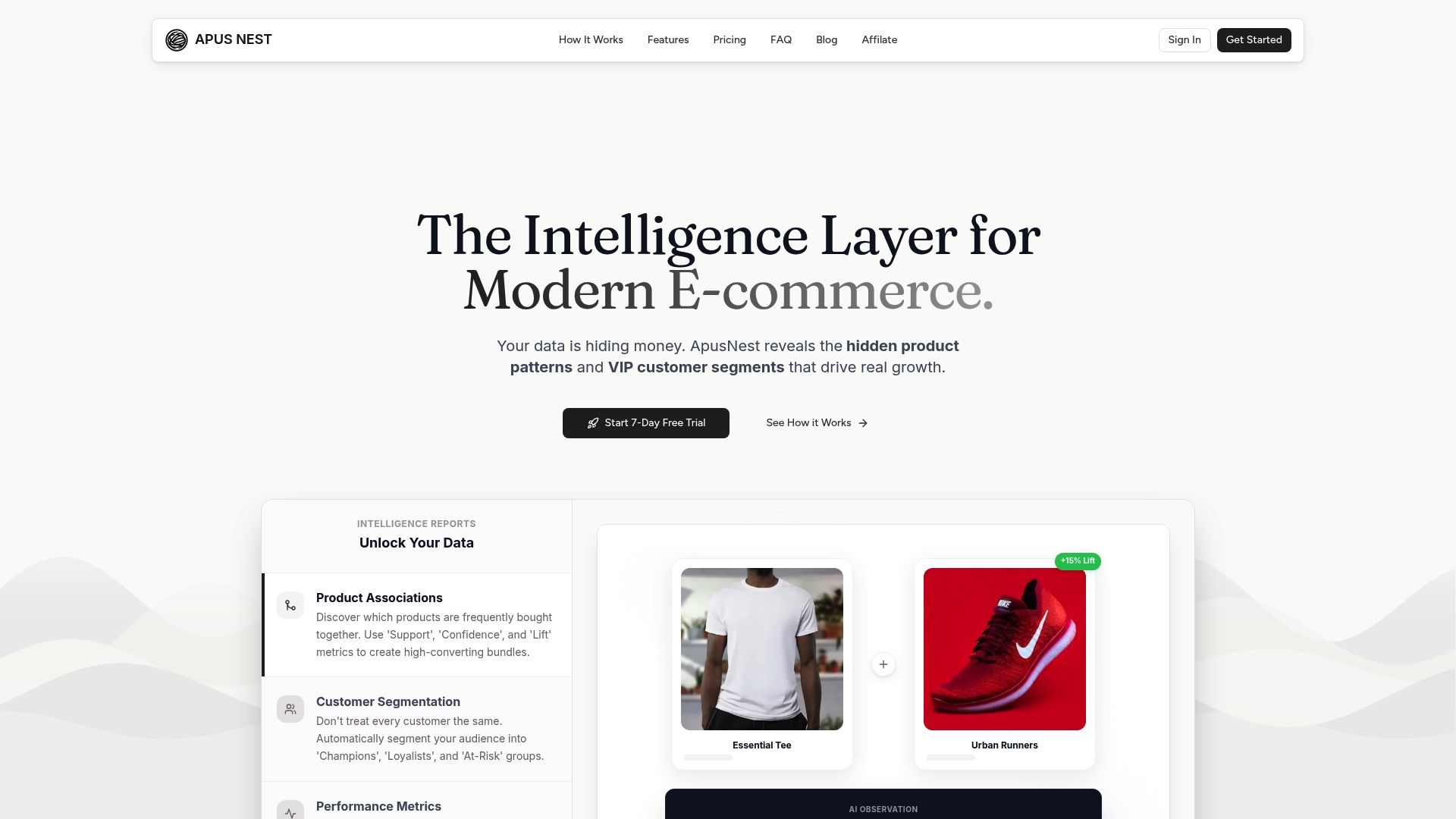
Experience the power of Market Basket Analysis and AI driven strategies with APUS NEST. Discover how to increase your sales through actionable product relationship insights and implement smarter bundling today by visiting APUS NEST. Start by exploring our easy upload and reporting features at APUS NEST and take control of your ecommerce data to maximize revenue growth.
Frequently Asked Questions
What are data-driven eCommerce strategies?
Data-driven eCommerce strategies involve using analytics and digital technologies to make informed business decisions based on customer and sales data. This approach helps businesses understand consumer behavior and optimize marketing efforts.
How can businesses utilize predictive analytics in eCommerce?
Businesses can use predictive analytics to forecast future purchasing trends and customer behaviors. This enables tailored marketing strategies and personalized shopping experiences, enhancing customer satisfaction and increasing sales.
What is Market Basket Analysis and how does it benefit eCommerce?
Market Basket Analysis examines purchasing patterns to identify relationships between products. This analysis helps in developing cross-selling strategies, intelligent product bundling, and targeted promotions, ultimately driving higher revenue.
What ethical considerations should businesses keep in mind when using eCommerce data?
Businesses must prioritize data privacy by ensuring consent management, data anonymization, secure storage, transparent reporting, and opt-out mechanisms, helping maintain customer trust and comply with regulations.
Recommended
- Understanding Data-Driven Campaign Optimization for E-Commerce - ApusNest Blog | ApusNest
- Actionable Ecommerce Analytics Explained: Boost Revenue - ApusNest Blog | ApusNest
- Guide to E-Commerce Data Analysis for Increased Sales - ApusNest Blog | ApusNest
- Ecommerce Insights Explained: Driving Store Growth - ApusNest Blog | ApusNest
