

Everyone talks about growing an online store, but the secret sauce is in the numbers you track every day. Brace yourself. Businesses fueled by data are 23 times more likely to win new customers and 6 times more likely to keep them. It sounds like a cold, spreadsheet world, yet these numbers become the heartbeat of any shop’s success story—if you know how to read them.
Table of Contents
- What Are Ecommerce Metrics And Why They Matter
- Key Ecommerce Metrics Every Store Owner Should Know
- How Ecommerce Metrics Influence Business Decisions
- Understanding Data Sources And Collection Methods In Ecommerce
- Interpreting Ecommerce Metrics For Actionable Insights
Quick Summary
| Takeaway | Explanation |
|---|---|
| Track essential ecommerce metrics. | Monitor conversion rates, customer acquisition costs, and average order value to gauge business success. |
| Leverage data for strategic decisions. | Use ecommerce metrics to guide marketing, inventory management, and customer experience improvements. |
| Analyze cart abandonment rates. | Identifying reasons for abandoned carts can reveal purchasing barriers, enabling you to streamline the checkout process. |
| Utilize advanced data collection methods. | Incorporate various channels like website analytics and CRM systems for comprehensive insights into customer behavior. |
| Prioritize ethical data practices. | Ensure robust privacy protections and transparent data usage policies to build trust with customers while maximizing insights. |
What Are Ecommerce Metrics and Why They Matter
Ecommerce metrics are quantitative measurements that track and analyze the performance of an online store, providing critical insights into business health, customer behavior, and revenue potential. These numerical indicators serve as a diagnostic tool, helping store owners understand precisely how their digital enterprise is performing across multiple dimensions.
The Fundamental Importance of Digital Performance Tracking
In the competitive world of online retail, understanding your store’s metrics isn’t just helpful—it’s essential for survival. Research from McKinsey shows that data-driven businesses are 23 times more likely to acquire customers and 6 times more likely to retain them compared to those operating without strategic metrics analysis.
Ecommerce metrics transform abstract sales data into actionable intelligence, revealing critical insights such as:
- Customer acquisition costs
- Conversion rates
- Average order value
- Customer lifetime value
- Product performance
Practical Context and Strategic Significance
Think of ecommerce metrics like a sophisticated GPS for your online business. They don’t just tell you where you are—they help you chart the most efficient route to growth. By understanding these metrics, you gain the ability to make surgical, targeted improvements that directly impact your bottom line.
When you read more about ecommerce analytics insights, you’ll discover how these measurements provide a comprehensive view of your digital storefront’s performance. They bridge the gap between raw data and strategic decision making, enabling you to optimize everything from product placement to marketing campaigns with precision and confidence.
Ultimately, ecommerce metrics are more than numbers—they’re the language of digital business success, speaking directly to your store’s potential for growth, efficiency, and long-term profitability.
Key Ecommerce Metrics Every Store Owner Should Know
Successful online businesses rely on a comprehensive understanding of key performance indicators that reveal the true health and potential of their digital storefront. These metrics go far beyond simple sales numbers, offering nuanced insights into customer behavior, operational efficiency, and strategic opportunities.
Core Performance Metrics That Drive Business Growth
Every ecommerce store should track a set of fundamental metrics that collectively paint a complete picture of business performance. Research from Forrester indicates that top-performing online retailers consistently monitor these critical indicators to make data-driven decisions.
The most essential metrics include:
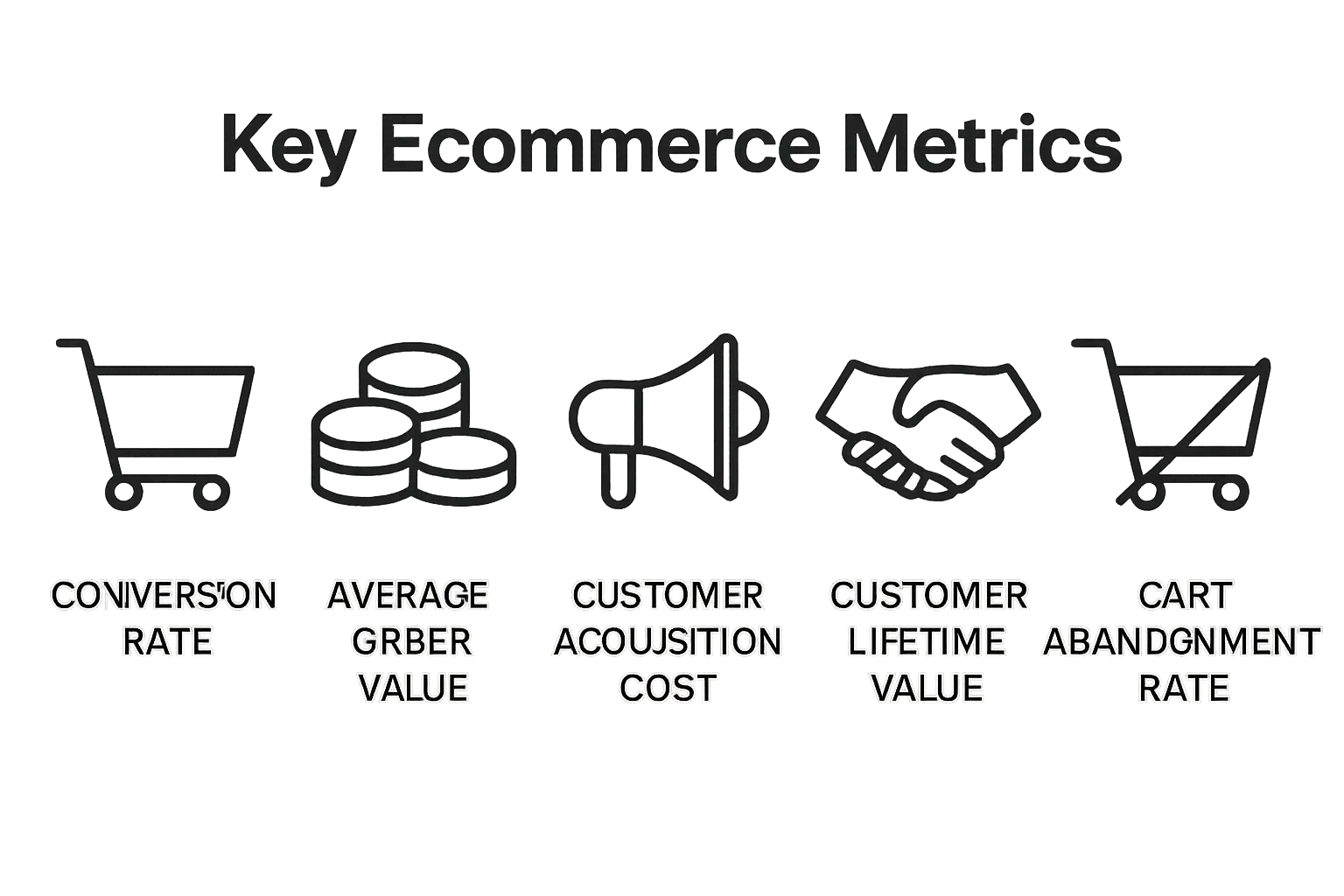
- Conversion Rate: Percentage of website visitors who complete a purchase
- Average Order Value (AOV): Total revenue divided by number of orders
- Customer Acquisition Cost (CAC): Total marketing expenses divided by new customers acquired
- Customer Lifetime Value (CLV): Predicted total revenue from a customer relationship
- Cart Abandonment Rate: Percentage of users who add items to cart but do not complete purchase
Strategic Insights from Detailed Metric Analysis
Understanding these metrics is more than a numbers game—it’s about uncovering actionable strategies to enhance your online business. When you explore advanced e-commerce data analysis techniques, you gain the ability to transform raw data into powerful business intelligence.
Take conversion rate, for instance. A low conversion rate might signal issues with website design, product pricing, or checkout complexity. By drilling down into this metric, you can identify specific barriers preventing potential customers from completing purchases and develop targeted improvements.
Similarly, tracking Average Order Value helps you design strategic upselling and cross-selling approaches. If your AOV is lower than industry benchmarks, you might experiment with bundle deals, volume discounts, or complementary product recommendations to encourage larger purchases.
Remember: these metrics are interconnected. A holistic approach to analyzing them provides a 360-degree view of your ecommerce performance, enabling more sophisticated and nuanced business strategies.
Below is a summary table defining the most essential ecommerce metrics mentioned in this guide and explaining their purpose.
| Metric Name | Definition | Strategic Value |
|---|---|---|
| Conversion Rate | Percentage of website visitors who complete a purchase | Measures effectiveness of website and sales funnel |
| Average Order Value (AOV) | Total revenue divided by number of orders | Indicates revenue per purchase; guides upselling |
| Customer Acquisition Cost | Total marketing expenses divided by new customers acquired | Evaluates marketing spend efficiency |
| Customer Lifetime Value | Predicted total revenue from a customer relationship | Helps plan retention and loyalty strategies |
| Cart Abandonment Rate | Percentage of users who add items to cart but do not complete purchase | Identifies friction and potential lost revenue |
How Ecommerce Metrics Influence Business Decisions
Ecommerce metrics are not just passive numbers on a spreadsheet—they are powerful strategic tools that drive critical business decisions across every aspect of an online store’s operations. By transforming raw data into actionable insights, these metrics become the compass guiding entrepreneurs toward more intelligent, targeted strategies.
Translating Data into Strategic Roadmaps
Research from Harvard Business Review demonstrates that organizations using data-driven decision making are 5% more productive and 6% more profitable than their competitors. In ecommerce, this translates into understanding precisely how each metric can reshape business strategy.
Key strategic decision areas influenced by metrics include:
- Product portfolio management
- Marketing resource allocation
- Customer experience optimization
- Pricing and discount strategies
- Inventory and supply chain planning
Precision Decision Making Through Metric Analysis
Consider how specific metrics drive nuanced business choices. Customer Acquisition Cost (CAC), for instance, doesn’t just reveal marketing spending—it helps determine the sustainability of current customer recruitment strategies. A rising CAC might signal the need to refine targeting, explore alternative marketing channels, or improve conversion efficiency.
Similarly, Cart Abandonment Rate provides critical insights into potential friction points in the purchasing journey. When you explore advanced analytics approaches, you’ll discover how this metric can prompt targeted website redesigns, simplified checkout processes, or more compelling product presentations.
Metrics enable entrepreneurs to move from intuition-based to evidence-based decision making. Instead of relying on hunches, store owners can make surgical, data-supported choices that directly impact revenue, customer satisfaction, and long-term growth. By treating metrics as a comprehensive diagnostic tool, businesses transform numerical data into a strategic advantage that keeps them agile and competitive in the dynamic world of online retail.

Understanding Data Sources and Collection Methods in Ecommerce
Data is the lifeblood of modern ecommerce, powering strategic insights and enabling businesses to make informed decisions. Understanding the diverse sources and sophisticated collection methods is crucial for transforming raw information into actionable intelligence that drives business growth.
Primary Ecommerce Data Collection Channels
Research from Gartner reveals that companies leveraging comprehensive data collection strategies are 3 times more likely to report significant marketing ROI. Ecommerce businesses can gather critical data through multiple interconnected channels:
The following table presents primary data sources for ecommerce businesses alongside the types of insights each can provide for online retail success.
| Data Source | Main Insights Provided |
|---|---|
| Website analytics platforms | Visitor behavior, conversion paths, engagement rates |
| CRM systems | Customer profiles, purchase histories, retention signals |
| Payment gateway transactions | Payment success rates, sales volumes, refunds |
| Social media interactions | Brand sentiment, referral traffic, audience interests |
| Email marketing platforms | Open rates, click-throughs, campaign effectiveness |
| Customer support interactions | Pain points, satisfaction trends, product feedback |
| Inventory management systems | Stock levels, turnover rates, supply chain efficiency |
- Website analytics platforms
- Customer relationship management (CRM) systems
- Payment gateway transactions
- Social media interactions
- Email marketing platforms
- Customer support interactions
- Inventory management systems
Sophisticated Data Collection and Integration Techniques
Effective data collection goes beyond simple aggregation—it requires strategic integration and intelligent analysis. Modern ecommerce platforms utilize advanced tracking technologies that capture nuanced customer behaviors, preferences, and interaction patterns.
When you explore advanced data analysis techniques, you’ll discover how sophisticated tracking pixels, machine learning algorithms, and cross-platform integration can transform fragmented data into comprehensive customer insights.
Key data collection considerations include ensuring robust privacy protections, maintaining transparent data usage policies, and implementing secure storage mechanisms. By treating customer data as a valuable asset and prioritizing ethical collection practices, businesses can build trust while generating powerful strategic insights that drive competitive advantage in the dynamic digital marketplace.
Interpreting Ecommerce Metrics for Actionable Insights
Interpreting ecommerce metrics is an art and science that transforms raw numerical data into strategic business intelligence. Beyond simply tracking numbers, successful online businesses develop the capability to decode complex metric relationships and extract meaningful, transformative insights.
Contextualizing Metric Performance
Research from MIT Sloan Management Review highlights that businesses effectively interpreting metrics are 26% more likely to exceed their revenue targets. Successful interpretation requires understanding metrics not in isolation, but as interconnected components of a broader business ecosystem.
Key principles for meaningful metric interpretation include:
- Establishing clear baseline performance standards
- Comparing metrics against industry benchmarks
- Recognizing contextual variations
- Understanding metric interdependencies
- Identifying leading versus lagging indicators
Advanced Metric Correlation and Insights Extraction
Metric interpretation goes far beyond surface level analysis. For instance, a seemingly positive conversion rate might mask underlying issues if paired with declining Average Order Value or increasing Customer Acquisition Costs.
When you explore comprehensive data analysis strategies, you’ll discover sophisticated techniques for extracting nuanced insights that reveal complex business dynamics.
Successful metric interpretation requires a holistic approach that combines quantitative analysis with qualitative understanding. By developing a multidimensional perspective, ecommerce entrepreneurs can transform numerical data into strategic roadmaps that drive sustainable growth, optimize operational efficiency, and create more compelling customer experiences.
Turn Ecommerce Insights Into Revenue Growth—Reveal Your Store’s Full Potential
You have just learned how understanding ecommerce metrics can unlock hidden opportunities for your business. But facing raw data alone may leave you asking: Which findings actually translate into real revenue growth? Many store owners struggle with turning analytics on conversion rates, average order value, and product performance into actionable strategies that increase profits. Don’t let indecision stall your growth. Now is the time to bridge those knowledge gaps with advanced, AI-powered analysis.

Take the next step and let your metrics work for you with APUS NEST. Upload your Shopify or WooCommerce sales data to discover product pairings, optimize cross-sells, and boost your average order value—all with transparent, exportable reports tailored to your store. Try the free version or unlock full reports and actionable recommendations to turn analysis into results right away. Ready to maximize the value of every customer visit? Visit APUS NEST’s main site now to start growing with confidence.
Frequently Asked Questions
What are ecommerce metrics?
Ecommerce metrics are quantitative measurements that track and analyze the performance of an online store, providing insights into business health, customer behavior, and revenue potential.
Why are ecommerce metrics important for online stores?
Ecommerce metrics are essential for survival in online retail as they help businesses make data-driven decisions, allowing them to acquire and retain customers more effectively compared to those not analyzing metrics.
What are the key ecommerce metrics every store owner should monitor?
Store owners should track metrics such as conversion rate, average order value (AOV), customer acquisition cost (CAC), customer lifetime value (CLV), and cart abandonment rate to evaluate their store’s performance.
How can ecommerce metrics influence business decisions?
Ecommerce metrics drive critical business decisions by providing insights into areas like product portfolio management, marketing allocation, customer experience, pricing strategies, and inventory planning.
Recommended
- Understanding Why Leverage Ecommerce Analytics in Business - ApusNest Blog | ApusNest
- Understanding Ecommerce Analytics: Unlocking Insights - ApusNest Blog | ApusNest
- E Commerce Analysis Report Guide for 2025 Success - ApusNest Blog | ApusNest
- Understanding Ecommerce Conversion: Boosting Online Sales - ApusNest Blog | ApusNest
- Essential SEO Metrics to Track for Digital Success
- blog | siift | Understanding Growth Metrics for Startups Explained
