

Nearly 60 percent of American e-commerce businesses cite competitor analysis as their most valuable strategic tool for staying ahead in crowded online markets. Understanding rival tactics goes far beyond simply spying on prices or website features. For Shopify and WooCommerce entrepreneurs, mastering competitor analysis backed by market basket insights means discovering hidden patterns that power smart product bundling and stronger global revenue growth.
Table of Contents
- Defining Competitor Analysis In E-commerce
- Types Of Competitor Analysis And Their Uses
- Key Metrics To Track For Shopify And Woocommerce
- Leveraging Market Basket Insights For Growth
- Common Pitfalls And How To Avoid Them
Key Takeaways
| Point | Details |
|---|---|
| Competitor Analysis Is Essential | Regular competitor analysis helps e-commerce businesses understand market dynamics and identify growth opportunities. |
| Utilize Diverse Analytical Methods | Employ various competitor analysis types, such as pricing analysis and customer sentiment tracking, to gain comprehensive insights. |
| Track Key Metrics Consistently | Monitor financial performance, customer acquisition, and retention metrics for informed decision-making and sustainable growth. |
| Avoid Common Pitfalls | Prevent misidentifying competitors by expanding analysis efforts to include indirect and emerging rivals, ensuring a robust competitive strategy. |
Defining Competitor Analysis in E-commerce
Competitor analysis represents a systematic strategic process for understanding and evaluating rival businesses within an online marketplace. At its core, this approach empowers e-commerce entrepreneurs to make informed decisions by identifying comprehensive market dynamics, revealing critical insights about business rivals’ strengths, weaknesses, and strategic positioning.
The fundamental goal of competitor analysis transcends simple observation. Businesses utilize advanced digital tools and structured frameworks to conduct deep research into rivals’ online presence, pricing strategies, product offerings, and customer experience models. By examining multiple dimensions of competitive landscapes, entrepreneurs can uncover strategic opportunities for differentiation and growth that might otherwise remain hidden.
Successful competitor analysis involves several key methodological steps. These typically include identifying both direct and indirect competitors, evaluating their digital marketing approaches, analyzing product pricing and positioning, investigating customer engagement strategies, and understanding their unique value propositions. Modern e-commerce professionals leverage sophisticated analytics platforms to transform raw competitive data into actionable strategic insights that can drive meaningful business improvements.
Pro Tip: Conduct competitor analysis quarterly to stay ahead of market shifts and maintain a dynamic, responsive business strategy that adapts quickly to emerging trends and competitive pressures.
Types of Competitor Analysis and Their Uses
Competitor analysis encompasses several critical strategic approaches that enable e-commerce businesses to gain comprehensive market insights. Understanding these specialized analysis types helps entrepreneurs develop nuanced strategies for growth and differentiation in increasingly competitive digital marketplaces.
The primary types of competitor analysis include product intelligence, pricing analysis, marketing strategy evaluation, customer sentiment tracking, and brand positioning research. Product intelligence focuses on examining competitors’ product assortments, identifying gaps, and understanding emerging trends. Pricing analysis involves systematically comparing price points, discount strategies, and value propositions across similar product categories. Marketing strategy evaluation explores digital advertising approaches, search engine optimization tactics, social media engagement, and content marketing techniques.

Customer sentiment tracking represents another crucial analysis type, involving deep examination of customer reviews, feedback mechanisms, and online reputation management. By analyzing multiple competitive dimensions, businesses can uncover subtle market insights that inform product development, customer experience improvements, and strategic positioning. Brand positioning research completes the analytical toolkit, helping entrepreneurs understand how rivals communicate their unique value propositions and differentiate themselves in crowded digital marketplaces.
Pro Tip: Create a standardized competitor analysis template that allows for consistent, repeatable assessments across different analysis types, enabling more systematic and actionable strategic insights.
Here’s a summary of major competitor analysis types and their business impact:
| Analysis Type | Main Goal | Business Impact |
|---|---|---|
| Product Intelligence | Track competitor products and trends | Reveals assortment gaps, boosts innovation |
| Pricing Analysis | Compare pricing and value strategies | Optimizes pricing, strengthens competitiveness |
| Marketing Strategy Evaluation | Study rivals’ advertising and SEO tactics | Enhances campaign performance, targets new audiences |
| Customer Sentiment Tracking | Examine reviews and reputation | Improves service, builds loyalty |
| Brand Positioning Research | Identify brand messaging and differentiation | Guides branding, aids market positioning |
Key Metrics to Track for Shopify and WooCommerce
Successful e-commerce entrepreneurs understand that tracking the right metrics is crucial for sustainable growth and profitability. Comprehensive e-commerce metrics provide a holistic view of store performance, enabling merchants to make data-driven decisions that directly impact revenue and customer satisfaction.
The most critical metrics fall into several key categories: financial performance, customer acquisition, conversion effectiveness, and customer retention. Financial metrics include average order value, gross profit margin, and total revenue. Acquisition metrics track customer acquisition cost, traffic sources, and marketing channel effectiveness. Conversion metrics encompass conversion rate, cart abandonment rate, and checkout process efficiency. Customer retention metrics measure repeat purchase rate, customer lifetime value, and churn rate, providing insights into long-term business sustainability.
Advanced WooCommerce and Shopify performance indicators reveal nuanced insights beyond basic reporting. These include detailed product performance analysis, customer segmentation data, seasonal trend tracking, and comparative performance benchmarks. Sophisticated store owners leverage these metrics to identify emerging opportunities, optimize pricing strategies, refine marketing campaigns, and create targeted customer experiences that drive sustainable growth.
Pro Tip: Develop a monthly dashboard that consolidates your top 5-7 most critical metrics, allowing for quick strategic assessment and immediate identification of performance trends or potential issues.
This table contrasts key Shopify and WooCommerce metrics, highlighting their benefits for your store:
| Metric Category | Example Metric | Benefit to Store |
|---|---|---|
| Financial | Average Order Value | Increases per-sale revenue |
| Acquisition | Customer Acquisition Cost | Reduces marketing spend, boosts ROI |
| Conversion | Cart Abandonment Rate | Improves checkout efficiency |
| Retention | Repeat Purchase Rate | Grows long-term customer value |
| Advanced | Product Performance | Helps focus on top-selling items |
Leveraging Market Basket Insights for Growth
Advanced market basket analysis provides e-commerce entrepreneurs powerful strategies for uncovering hidden revenue opportunities, enabling businesses to transform raw transaction data into strategic growth insights. By systematically examining product purchasing patterns, companies can identify complex relationships between items that might otherwise remain invisible.
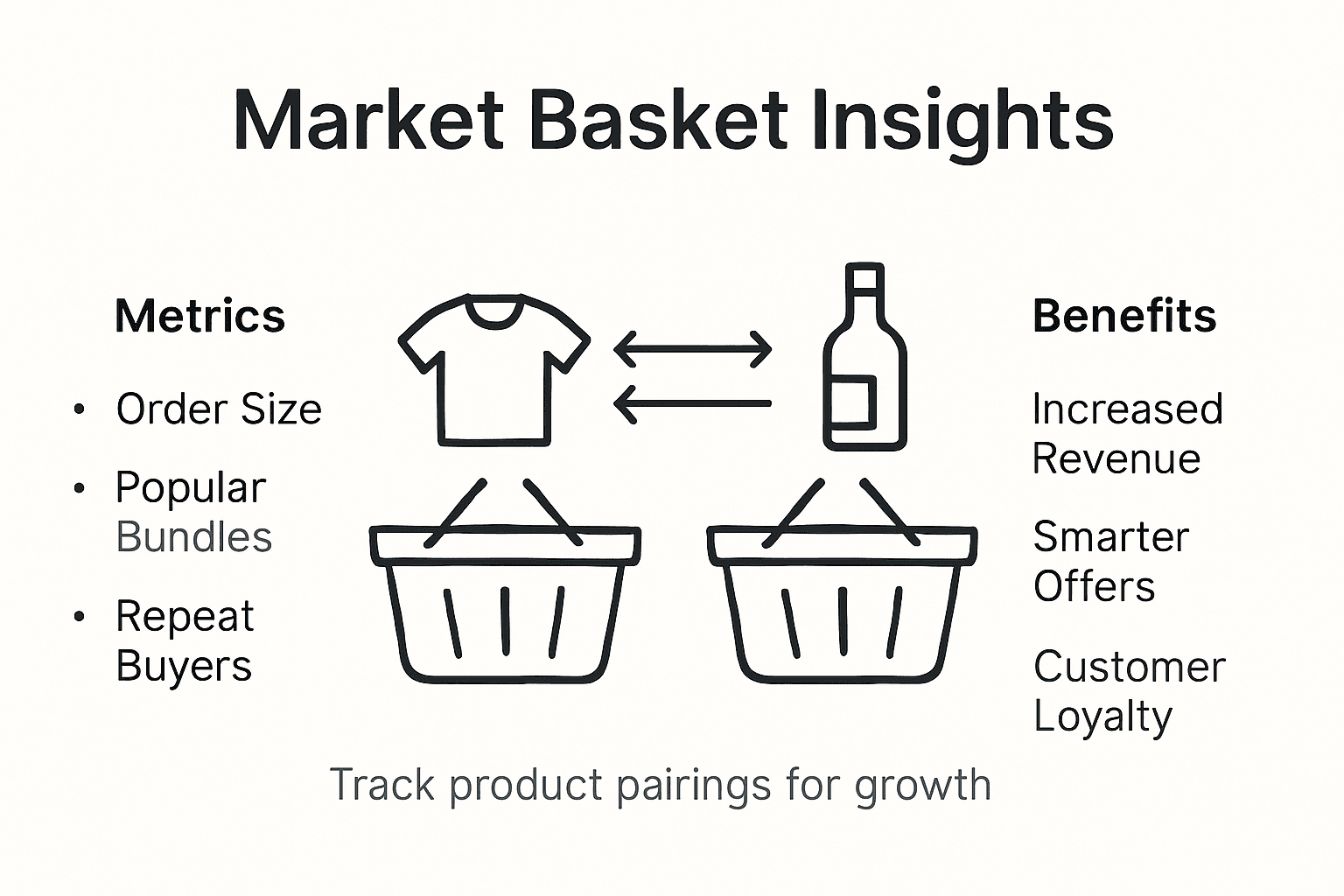
The core objective of market basket analysis involves detecting statistically significant product associations that can drive multiple strategic initiatives. These insights enable sophisticated cross-selling techniques, personalized product recommendations, and intelligent inventory management. Predictive algorithms help businesses understand not just what customers are buying, but anticipate what they might want to purchase next, creating opportunities for strategic product bundling and targeted marketing campaigns.
Machine learning techniques revolutionize market basket analysis by revealing nuanced customer behavioral patterns, extending beyond traditional transactional data interpretation. Advanced analytics can segment customers based on purchasing behaviors, predict future buying trends, and create dynamically personalized shopping experiences. By understanding complex product relationships and customer preferences, e-commerce businesses can develop more intelligent recommendation systems that increase average order value and customer satisfaction.
Pro Tip: Implement a continuous market basket analysis process that updates insights monthly, allowing your business to adapt quickly to changing customer preferences and emerging product trends.
Common Pitfalls and How to Avoid Them
Systematic competitor analysis requires navigating several complex challenges that can significantly undermine strategic decision-making. E-commerce entrepreneurs must develop a sophisticated approach that goes beyond surface-level observations, recognizing that competitive intelligence is a nuanced and dynamic process requiring constant refinement and critical thinking.
One of the most prevalent mistakes involves misidentifying competitor types and failing to conduct comprehensive research. Many businesses restrict their analysis to direct competitors, overlooking indirect and potential emerging competitors that could disrupt their market position. Strategic competitor tracking demands a multifaceted approach that includes analyzing businesses with adjacent product lines, emerging startups, and international players who might enter the market with innovative solutions.
Maintaining the relevance and accuracy of competitive intelligence demands a proactive and adaptive methodology, rather than treating analysis as a static, one-time exercise. Successful e-commerce professionals continuously update their competitive insights, triangulate data from multiple sources, and develop dynamic frameworks that can quickly incorporate new information. This approach helps businesses anticipate market shifts, identify emerging trends, and make informed strategic decisions that provide a sustainable competitive advantage.
Pro Tip: Create a standardized quarterly competitor analysis review process that includes diverse data sources, cross-functional team input, and a systematic method for updating and acting on competitive insights.
Unlock Hidden Revenue with Advanced Competitor Insights for Your E-commerce Store
Competitor analysis reveals the crucial need to understand market dynamics, product relationships, and customer behavior to stand out in today’s crowded online space. If you struggle with uncovering actionable product pairing opportunities or optimizing your cross-sell strategies, you are not alone. Many e-commerce entrepreneurs using Shopify or WooCommerce face challenges turning raw sales data into clear insights that increase average order value and improve long-term growth.
APUS NEST offers a powerful solution designed to address these challenges directly. Our AI-driven market basket analysis platform helps you uncover complex product associations and hidden revenue streams that traditional analysis often misses. Whether you want to better understand your customers’ purchasing patterns, refine your product bundling, or optimize your marketing campaigns APUS NEST delivers detailed, actionable reports that empower smarter decisions. With flexible options including free insights and comprehensive paid analytics, you can gain a competitive edge without subscriptions or loss of data control.
Explore how you can transform competitor analysis concepts into measurable growth by visiting APUS NEST. Start unlocking your store’s full revenue potential today and implement data-driven strategies that work. Need help integrating with WooCommerce or Shopify Check out our guides and resources to maximize your ROI.
Discover How APUS NEST Works
Learn More About Market Basket Analysis
Get Started with Your Free Report

Take control of your e-commerce growth now by leveraging advanced competitor analysis insights through APUS NEST. Visit APUS NEST and unlock the hidden revenue in your data today.
Frequently Asked Questions
What is the purpose of competitor analysis in e-commerce?
Competitor analysis in e-commerce aims to systematically evaluate rival businesses to understand their strengths, weaknesses, and strategic positioning. This process helps entrepreneurs identify market dynamics and uncover opportunities for differentiation and growth.
What are the main types of competitor analysis?
The primary types of competitor analysis include product intelligence, pricing analysis, marketing strategy evaluation, customer sentiment tracking, and brand positioning research. Each type provides unique insights that can inform strategic business decisions.
How can I effectively track key metrics for my e-commerce store?
To effectively track key metrics, focus on categories such as financial performance, customer acquisition, conversion effectiveness, and customer retention. Develop a monthly dashboard to consolidate your most critical metrics, enabling quick strategic assessments and identification of trends.
What is market basket analysis and how does it benefit e-commerce?
Market basket analysis examines product purchasing patterns to identify associations between items. This analysis can drive cross-selling strategies, personalized recommendations, and effective inventory management, ultimately increasing average order value and improving customer satisfaction.
Recommended
- Actionable Ecommerce Analytics Explained: Boost Revenue - ApusNest Blog | ApusNest
- Role of Analytics in Marketing for E-Commerce Growth - ApusNest Blog | ApusNest
- 7 Essential E-Commerce Data Analysis Tips for Higher Sales - ApusNest Blog | ApusNest
- Data Driven Ecommerce: Unlocking Revenue Potential - ApusNest Blog | ApusNest
