

Nearly 60 percent of American e-commerce stores overlook crucial data patterns that could unlock higher average order value. With global competition rising, relying on guesswork for product bundling leaves profits on the table. Understanding precisely how customer behaviors and sales trends interact empowers Shopify and WooCommerce businesses to create smarter, more profitable product bundles that actually drive growth.
Table of Contents
- Step 1: Analyze Current Sales And Customer Data
- Step 2: Identify Profitable Product Relationships
- Step 3: Develop Actionable Bundling And Cross-Sell Plans
- Step 4: Implement Data-Driven Marketing Campaigns
- Step 5: Measure And Optimize Strategy Effectiveness
Quick Summary
| Key Point | Explanation |
|---|---|
| 1. Analyze Sales Data Thoroughly | Gather and examine detailed sales and customer metrics to uncover trends and growth opportunities. |
| 2. Identify Product Relationships | Use advanced techniques to uncover how products interact, enhancing marketing and sales strategies. |
| 3. Develop Cross-Sell and Bundling Plans | Create strategic bundles and personalized cross-sell recommendations to increase average order value. |
| 4. Implement Data-Driven Marketing | Design targeted campaigns using predictive analytics to reach specific audience segments effectively. |
| 5. Measure and Optimize Continuously | Establish a robust framework for evaluating marketing effectiveness and continually refine strategies. |
Step 1: Analyze current sales and customer data
Your journey toward maximizing e-commerce sales begins with a strategic deep dive into your existing sales and customer data. By carefully examining your performance metrics, you can uncover hidden opportunities and develop targeted strategies that drive revenue growth.
To effectively analyze your sales data, start by gathering comprehensive information from multiple sources utilizing advanced e-commerce data analysis techniques. Collect transactional records, customer purchase histories, product performance reports, and website analytics. Focus on key performance indicators such as average order value, conversion rates, customer lifetime value, and product category performance. Use spreadsheet software or specialized analytics platforms to organize this data into clear, actionable insights.
Break down your analysis into specific segments: customer demographics, purchase behavior, product preferences, and sales trends. Look for patterns that reveal which products sell together, which customer groups generate the most revenue, and what marketing channels drive the highest conversions. Pay special attention to metrics like repeat purchase rates, cart abandonment percentages, and seasonal sales fluctuations.
Pro tip: Create a standardized monthly reporting template that automatically tracks your most critical sales metrics to maintain consistent performance monitoring and quickly identify emerging trends.
Here is a summary of the most valuable e-commerce sales metrics and their business significance:
| Metric | What It Measures | Why It Matters | Business Impact |
|---|---|---|---|
| Average Order Value | Typical revenue per transaction | Shows purchasing power | Higher value boosts profit |
| Conversion Rate | Visitor-to-buyer ratio | Indicates site performance | Reveals funnel effectiveness |
| Customer Lifetime Value | Projected total customer spend | Assesses long-term value | Guides retention strategy |
| Product Category Performance | Sales by category | Uncovers top sellers | Aids inventory allocation |
| Cart Abandonment Rate | Frequency of abandoned carts | Reveals friction points | Identifies improvement areas |
Step 2: Identify profitable product relationships
Unlocking the potential of your e-commerce sales requires understanding how different products interact and complement each other. By identifying strategic product relationships, you can create more effective marketing strategies that boost overall revenue and customer satisfaction.
To effectively map out profitable product connections, utilize advanced network based analysis techniques for product relationships. Start by examining your sales data to discover which products are frequently purchased together, looking beyond simple transaction records to understand deeper purchasing patterns. Analyze clickstream data, customer browsing behaviors, and historical purchase histories to reveal nuanced connections between different product categories. Pay attention to both direct complementary relationships (products that naturally go together) and potential cross sell opportunities that might not be immediately obvious.
Consider employing machine learning techniques to uncover more sophisticated product relationships. Look for patterns such as products purchased in sequence, items that appear in the same customer baskets, and potential bundles that could increase average order value. Group products into logical clusters based on customer preferences, seasonal trends, and compatibility. Evaluate these relationships not just by frequency of purchase, but by their potential to drive higher margins and customer lifetime value.
Pro tip: Develop a dynamic product relationship matrix that updates monthly, allowing you to continuously refine your understanding of emerging product connections and optimize your merchandising strategies.
Step 3: Develop actionable bundling and cross-sell plans
Transforming your product relationships into profitable marketing strategies requires a systematic approach that combines data insights with creative merchandising techniques. By crafting intelligent bundling and cross-sell plans, you can significantly increase your average order value and customer satisfaction.
Start by creating strategic product bundles using market basket analysis techniques. Examine your historical sales data to identify products that customers frequently purchase together, then design bundles that offer genuine value. Focus on combinations that solve customer problems or enhance product utility. Consider complementary items that naturally work together, such as cameras with memory cards, or skincare products that form a complete routine. Price these bundles attractively to incentivize larger purchases while ensuring you maintain healthy profit margins.

Implement a dynamic cross-sell strategy that adapts to individual customer behaviors. Use customer segmentation to personalize recommendations, creating targeted offers based on purchase history, browsing patterns, and demographic information. Develop algorithmic rules that suggest relevant add-ons during the shopping experience, such as showing complementary products on product pages, in shopping carts, and during checkout. Continuously refine these recommendations by tracking conversion rates and customer feedback, allowing your cross-sell approach to evolve with changing consumer preferences.
Pro tip: Create a flexible bundling framework that allows for real-time price and product adjustments, enabling you to quickly respond to seasonal trends and inventory dynamics.
The following table compares bundling and cross-sell strategies to help optimize e-commerce sales:
| Aspect | Bundling Approach | Cross-Sell Approach |
|---|---|---|
| Target Products | Frequently paired items | Related add-ons and upgrades |
| Customer Benefit | Simplifies purchase choices | Enhances shopping experience |
| Optimal Timing | Before checkout | During product viewing and cart |
| Profit Potential | Increases average order value | Boosts upsell rates and margin |
Step 4: Implement data-driven marketing campaigns
Taking your marketing strategy to the next level requires a sophisticated approach that transforms raw data into targeted, personalized customer experiences. By implementing truly data-driven marketing campaigns, you can create more precise, effective communication that resonates with your specific audience segments.
Begin by developing comprehensive marketing campaigns using advanced predictive analytics. Leverage your customer data to create highly segmented audience profiles that go beyond basic demographics. Analyze behavioral patterns, purchase histories, browsing interactions, and engagement metrics to build nuanced customer personas. Design campaign messaging and targeting that speaks directly to each segment’s unique preferences, pain points, and motivations. Use machine learning algorithms to predict optimal communication channels, timing, and content for maximum impact.
Create a dynamic campaign framework that allows for real-time optimization and adaptive strategies. Implement tracking mechanisms that capture granular performance data across multiple touchpoints, enabling you to continuously refine your approach. Develop automated testing protocols that can quickly adjust messaging, visuals, and targeting based on immediate campaign performance insights. Monitor key performance indicators such as conversion rates, customer acquisition costs, engagement metrics, and return on ad spend to ensure your campaigns consistently deliver measurable business value.
Pro tip: Build a centralized marketing insights dashboard that integrates data from multiple sources, providing a holistic view of campaign performance and enabling rapid strategic adjustments.
Step 5: Measure and optimize strategy effectiveness
Evaluating the performance of your e-commerce marketing strategy is crucial for continuous improvement and sustainable growth. By implementing a robust measurement framework, you can transform raw data into actionable insights that drive strategic decisions.
Start by establishing comprehensive performance measurement techniques for marketing effectiveness. Create a holistic dashboard that tracks key performance indicators across multiple dimensions. Focus on metrics that reveal true business impact such as customer acquisition cost, lifetime value, conversion rates, average order value, and return on marketing investment. Break down these metrics by campaign, customer segment, and product line to uncover granular insights. Develop comparative analysis frameworks that allow you to benchmark current performance against historical data and industry standards.
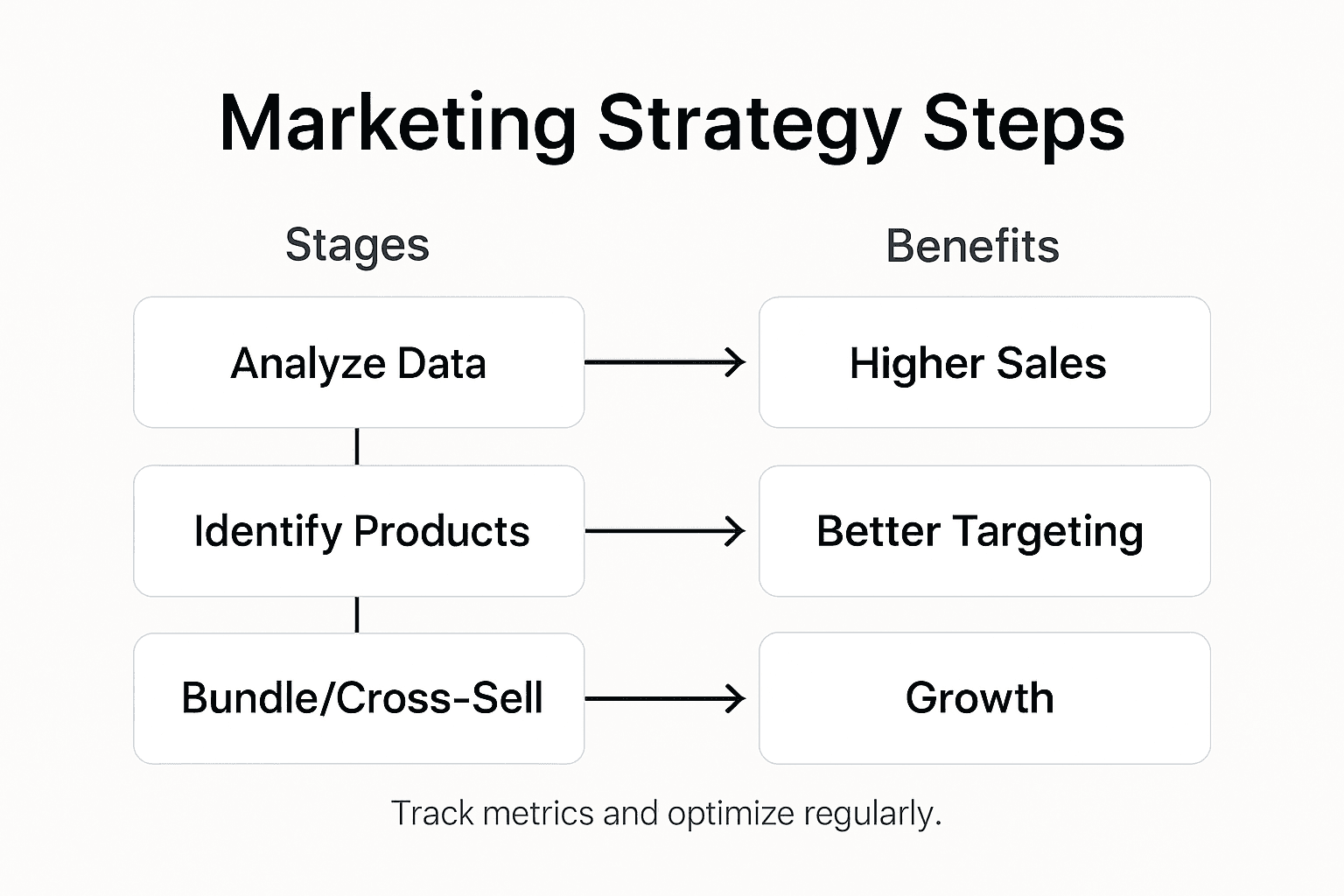
Implement a continuous optimization cycle that goes beyond simple data collection. Use statistical analysis and machine learning techniques to identify meaningful patterns and predictive trends in your marketing performance. Set up automated reporting systems that flag significant deviations or opportunities for improvement. Conduct regular strategic reviews where you critically evaluate each campaign component for potential refinement. This iterative approach ensures your marketing strategy remains adaptive, responsive, and aligned with changing customer behaviors and market dynamics.
Pro tip: Create a quarterly strategic review process that includes cross-functional team input, ensuring comprehensive analysis and diverse perspectives on marketing performance.
Unlock Your E-Commerce Potential with Data-Driven Insights
Struggling to turn your sales data into actionable marketing strategies The article highlights key challenges like analyzing complex product relationships and crafting intelligent bundling and cross-sell plans to maximize your average order value and customer lifetime value APUS NEST is designed exactly for these needs Our AI-powered SaaS platform helps Shopify and WooCommerce store owners analyze sales data effortlessly and discover hidden product pairings that can boost revenue and enhance customer experience
Experience how advanced market basket analysis reveals the product combinations your customers truly want Plus APUS NEST gives you detailed reports and personalized recommendations so you can implement data-driven bundling and cross-sell strategies with confidence This means you save time and reduce guesswork while optimizing your marketing campaigns based on solid evidence
Act now to transform your e-commerce sales strategy with actionable insights from APUS NEST

Discover how to increase your average order value and customer satisfaction by leveraging AI-powered analytics Visit APUS NEST today to upload your sales data and unlock powerful selling opportunities Stay ahead of the competition and grow your store smarter and faster with our transparent, subscription-free platform Explore more at APUS NEST, and get started on elevating your marketing strategy now.
Frequently Asked Questions
How do I analyze my current e-commerce sales data?
To analyze your current e-commerce sales data, start by gathering comprehensive information from your transactional records, customer purchase histories, and website analytics. Break down the data into segments like customer demographics and sales trends to uncover actionable insights. Focus on key metrics such as conversion rates and average order value to identify areas for improvement.
What are some effective ways to identify profitable product relationships?
To identify profitable product relationships, examine your sales data to find products frequently purchased together. Utilize techniques such as market basket analysis and machine learning to uncover complex purchasing patterns. Group complementary products logically to enhance cross-selling opportunities and increase overall revenue.
How can I create effective product bundles for my e-commerce business?
To create effective product bundles, analyze historical sales data to see which products customers commonly buy together. Design bundles that provide value and solve customer needs, such as pairing skincare products for a complete routine. Price these bundles attractively to encourage larger purchases while maintaining healthy profit margins.
What steps can I take to implement data-driven marketing campaigns?
To implement data-driven marketing campaigns, start by segmenting your audience based on behavioral patterns and purchase histories. Create personalized messaging that resonates with each segment’s preferences and pain points. Continuously track key performance indicators to refine and optimize your campaigns for better results.
How do I measure the effectiveness of my e-commerce marketing strategy?
To measure the effectiveness of your marketing strategy, establish a dashboard that tracks key performance indicators such as conversion rates and customer acquisition costs. Conduct regular strategic reviews to evaluate each campaign’s performance and apply statistical analysis to identify areas for improvement. Optimize your strategy continuously to adapt to changing customer behaviors.
How often should I review my e-commerce marketing metrics?
You should review your e-commerce marketing metrics at least quarterly to assess performance and adjust your strategy as needed. Regularly evaluate key metrics like average order value and customer lifetime value to spot trends and react promptly. This practice keeps your marketing efforts aligned with current market dynamics.
Recommended
- Understanding Ecommerce Growth Strategies Guide - ApusNest Blog | ApusNest
- Marketing Campaigns Step by Step for E-commerce Success - ApusNest Blog | ApusNest
- 7 Effective Ways to Maximize Revenue in E-commerce - ApusNest Blog | ApusNest
- Ecommerce Growth Strategies Explained: Unlocking Revenue - ApusNest Blog | ApusNest
