

Most American brands see up to 30 percent higher profits by using data-driven marketing to increase average order value. Whether your store runs on Shopify or WooCommerce, the path to smarter growth starts with understanding what your sales data is really telling you. If you are looking for sharper strategies that can elevate every customer purchase, this guide delivers a practical approach for e-commerce owners ready to turn raw data into real results.
Table of Contents
- Step 1: Set Up Your Sales Data Collection
- Step 2: Analyze Product Relationships with AI Tools
- Step 3: Identify High-Value Cross-Sell Opportunities
- Step 4: Implement Targeted Marketing Campaigns
- Step 5: Track Results and Refine Strategies
Quick Summary
| Key Point | Explanation |
|---|---|
| 1. Collect and Organize Sales Data | Establish a systematic approach for gathering sales records from various sources to maintain data integrity. |
| 2. Utilize AI Tools for Insights | Leverage AI analytics platforms to discover product relationships and enhance marketing strategies effectively. |
| 3. Identify Profitable Cross-Sell Opportunities | Segment customers based on purchase behavior to find product combinations that maximize average order values. |
| 4. Design Targeted Marketing Campaigns | Create tailored campaigns for distinct customer segments using insights from previous analysis to boost effectiveness. |
| 5. Continuously Track and Adjust Strategies | Implement a cyclical analysis process to refine marketing efforts based on performance metrics and customer behavior. |
Step 1: Set Up Your Sales Data Collection
Successful e-commerce marketing begins with robust sales data collection. In this section, you will learn how to create a systematic approach for gathering and organizing your online store’s transaction information to unlock powerful insights.
Start by identifying the core data sources for your sales records. This typically includes your e-commerce platform (such as Shopify or WooCommerce), payment processors, and customer relationship management (CRM) systems. Ensure you can export data in standardized formats like CSV, which allow for easy analysis. University best practices recommend establishing consistent data organization methods to maintain data integrity across different sources.
Here’s a quick comparison of common e-commerce sales data sources and the unique value each provides:
| Data Source | Unique Insights Provided | Importance for Analysis |
|---|---|---|
| E-commerce Platform | Item sales volume, product SKUs | Core transactions and inventory |
| Payment Processor | Payment methods, refund history | Revenue tracking, fraud prevention |
| CRM System | Customer profiles, loyalty status | Segmentation, targeting strategies |
Next, develop a structured data collection workflow. Begin by mapping out all potential data points you want to track product sales, customer demographics, purchase times, transaction values, and shipping information. Create a centralized repository where these datasets can be consolidated and easily accessed. Pay special attention to maintaining clean and consistent data entry formats to prevent future analysis complications.
Pro tip: Always maintain backup copies of your raw sales data in multiple secure locations to prevent potential loss and ensure you can recover critical business insights if a system failure occurs.
Step 2: Analyze Product Relationships with AI Tools
Unlocking powerful insights about your product relationships requires advanced artificial intelligence techniques that transform raw sales data into strategic marketing opportunities. In this step, you will learn how to leverage AI tools to discover hidden connections between products and optimize your sales strategy.
AI marketing tools can dramatically enhance your understanding of product interactions by using machine learning algorithms to identify patterns that human analysis might miss. Start by selecting an AI analytics platform that integrates seamlessly with your existing e-commerce data infrastructure. These tools analyze historical transaction data to reveal which products are frequently purchased together, helping you create smarter product bundles, recommend complementary items, and design more effective cross-selling strategies.

Implement your AI analysis by uploading comprehensive sales datasets and configuring the tool to generate insights. Look for patterns such as sequential purchasing behaviors, product affinity scores, and customer segment preferences. Pay close attention to visualization features that help you quickly understand complex product relationship networks. The goal is to transform raw data into actionable marketing intelligence that can directly impact your average order value.
The table below summarizes key AI-generated metrics and their impact on product marketing:
| Metric | Description | Marketing Benefit |
|---|---|---|
| Product Affinity Score | Measures how often products are bought together | Improves bundling and upsell targeting |
| Sequential Purchase Patterns | Tracks typical order of purchases | Supports timing for recommendations |
| Customer Segment Preferences | Uncovers unique buying behaviors by group | Enables personalized campaign messaging |
Pro tip: Always validate AI generated insights with your own business knowledge and conduct small test marketing campaigns before making large scale strategy changes to ensure recommendations align with your specific market dynamics.
Step 3: Identify High-Value Cross-Sell Opportunities
Unlocking the most profitable cross-sell opportunities requires a strategic approach that goes beyond simple product recommendations. In this step, you will learn how to pinpoint the most lucrative product combinations that can dramatically increase your average order value.
Advanced analytics strategies can transform your understanding of customer purchasing behaviors by revealing hidden connections between products. Begin by segmenting your customer data into distinct groups based on purchasing history, demographic information, and behavioral patterns. Look for clusters of customers who consistently purchase complementary or related items. These segments become your primary targets for developing precise cross-sell strategies that feel personalized and relevant.
Dive deeper into your analysis by examining transaction sequences, product affinity scores, and profit margins. Focus on identifying product pairs that not only sell well together but also generate the highest combined revenue. Consider factors like profit margin, frequency of joint purchases, and potential upsell opportunities. Create a matrix that ranks potential cross-sell combinations based on their potential to increase overall order value. This systematic approach transforms raw data into a strategic roadmap for maximizing revenue.
Pro tip: Always test your cross-sell recommendations through small targeted marketing campaigns to validate their effectiveness before full implementation and be prepared to quickly adjust your strategy based on real world performance.
Step 4: Implement Targeted Marketing Campaigns
Transforming your data insights into powerful marketing campaigns requires a strategic and precise approach. In this step, you will learn how to design targeted campaigns that maximize your average order value by delivering the right message to the right customer at the right time.
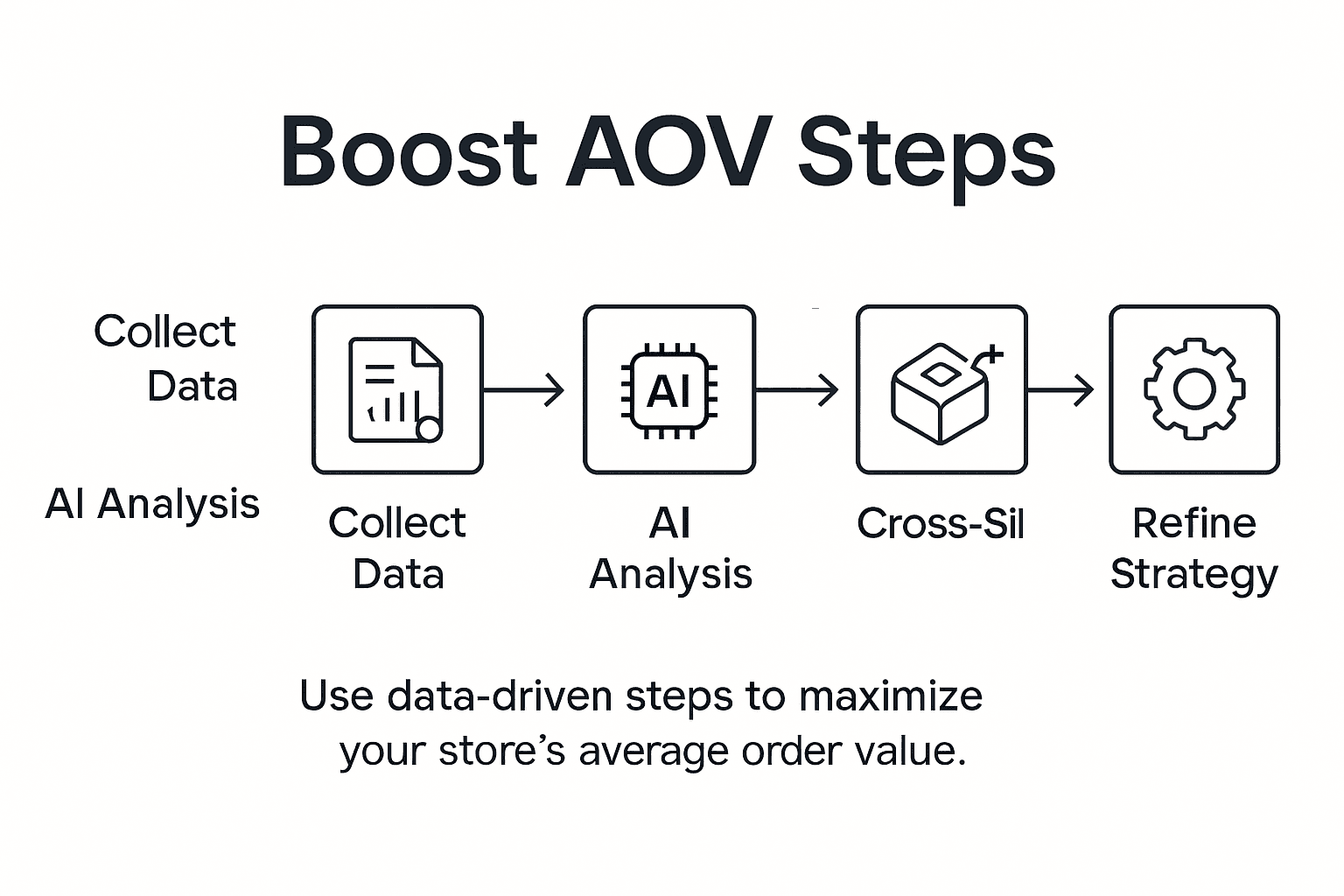
AI marketing tools can automate and personalize your campaign implementation by enabling sophisticated audience segmentation and dynamic content creation. Begin by mapping out your customer segments based on the product relationship insights you discovered in previous steps. Create distinct campaign variations for each customer group, tailoring your messaging and product recommendations to their specific purchasing patterns and preferences. Focus on developing compelling offers that feel uniquely crafted for each audience segment rather than using a onesize fits all approach.
Execute your campaigns through multiple channels including email marketing, social media advertising, and personalized website recommendations. Track key performance indicators such as click through rates, conversion rates, and incremental revenue generated. Use these metrics to continuously refine your targeting strategy, ensuring that each subsequent campaign becomes more precise and effective. Your goal is to create a dynamic marketing ecosystem that adapts in real time to customer behaviors and preferences.
Pro tip: Always maintain a control group in your marketing experiments to accurately measure the true impact of your targeted campaigns and avoid mistaking natural market fluctuations for campaign effectiveness.
Step 5: Track Results and Refine Strategies
Successful data driven marketing is an ongoing process of measurement, analysis, and continuous improvement. In this final step, you will learn how to systematically evaluate your marketing efforts and make precise strategic adjustments that incrementally boost your average order value.
Best practices for analytics success emphasize the critical importance of continuous strategy monitoring and refinement to ensure maximum business performance. Establish a comprehensive tracking dashboard that captures key performance indicators such as conversion rates, average order value, customer lifetime value, and campaign specific metrics. Compare these metrics against your initial baseline to understand the direct impact of your targeted marketing initiatives. Pay special attention to granular data points that reveal subtle shifts in customer behavior and purchasing patterns.
Implement a cyclical optimization process where you regularly review campaign performance and make incremental adjustments. Break down your analysis into specific segments including customer demographics, product categories, and marketing channels. Identify which strategies generate the highest returns and which require modification. Create experimental variations of your most successful campaigns to test potential improvements, always maintaining a data driven approach that prioritizes measurable outcomes over intuitive assumptions.
Pro tip: Develop a quarterly strategic review process where you comprehensively assess your marketing performance and realign your tactics based on the most recent data insights to maintain a dynamic and responsive marketing approach.
Unlock Your E-Commerce Growth with Data-Driven Insights
The article highlights the challenge of turning raw sales data into actionable strategies that boost average order value through smart product relationships and targeted marketing. Many e-commerce store owners struggle to identify high-value cross-sell opportunities and leverage advanced analytics effectively without complicated tools. If you want to move beyond manual data tracking and intuitive guesses, a solution that simplifies market basket analysis and surfaces hidden revenue potential becomes essential.
APUS NEST offers an AI-powered platform specifically designed to tackle the very pain points this guide addresses. With seamless integrations for Shopify and WooCommerce and easy CSV uploads, you gain detailed, data-backed reports revealing which products sell best together and how to craft personalized cross-sell strategies that increase your customer’s cart size. Transparency and full data ownership mean you can trust the insights and export them to optimize marketing campaigns on your terms.
Take control of your sales data and maximize your profits today. Discover how APUS NEST empowers e-commerce entrepreneurs to transform analytics into growth through practical, actionable insights that align perfectly with the strategies in the article.

Ready to boost your average order value with AI-driven analysis and effortless product recommendations Explore the possibilities at APUS NEST platform and start your free report to uncover hidden cross-sell opportunities tailored to your store’s unique sales data. Don’t wait to turn your sales data into your most powerful marketing asset.
Frequently Asked Questions
What are the key steps to set up sales data collection for my e-commerce store?
To set up sales data collection, identify core data sources like your e-commerce platform and payment processors, ensuring data export in standardized formats like CSV. Create a structured workflow by mapping out the data points you want to track and develop a centralized repository for easy access.
How can I use AI tools to analyze product relationships effectively?
You can use AI tools to analyze product relationships by uploading your sales data to an analytics platform and configuring it to reveal patterns such as frequently purchased product pairs. Look for metrics like product affinity scores to enhance cross-selling strategies and improve overall sales performance.
What is the best way to identify high-value cross-sell opportunities?
To identify high-value cross-sell opportunities, segment your customer data based on purchasing history and behavior, then analyze product pairs that generate the highest combined revenue. Create a ranking matrix of these pairs to prioritize which combinations to promote, potentially increasing order value by targeting the right customers.
How do I implement targeted marketing campaigns based on my data insights?
Implement targeted marketing campaigns by creating distinct variations for each customer segment based on their purchasing patterns. Tailor your messaging and product recommendations to resonate with each group, and execute through various channels such as email marketing and social media.
What metrics should I track to refine my marketing strategies?
Track key performance indicators like conversion rates, average order value, and customer lifetime value to assess your marketing strategies. Establish a comprehensive dashboard to monitor these metrics and regularly review performance to make necessary adjustments and optimize results.
How often should I review and refine my marketing strategies?
You should conduct a quarterly review of your marketing strategies to assess performance against your initial baseline. Regularly analyze specific segments to identify successful tactics and areas for improvement, ensuring that your marketing approach remains responsive to changing customer behaviors.
Recommended
- Understanding AOV: Average Order Value Explained - ApusNest Blog | ApusNest
- Understanding Data-Driven Campaign Optimization for E-Commerce - ApusNest Blog | ApusNest
- Marketing Campaigns Step by Step for E-commerce Success - ApusNest Blog | ApusNest
- Understanding Data Analysis for Marketers Guide - ApusNest Blog | ApusNest
