

American Shopify store owners often miss out on real growth by overlooking the power hidden in their data. With fierce competition and customer expectations rising, it is not enough to watch orders roll in. Digging into advanced sales analysis helps ambitious merchants discover untapped opportunities to increase average order value. This guide reveals practical, data-driven strategies aimed at turning every transaction into a smarter, more profitable decision.
Table of Contents
- 1. Analyze Your Shopify Sales Data for Insights
- 2. Identify Product Relationships for Effective Cross-Selling
- 3. Create Powerful Product Bundles to Increase AOV
- 4. Leverage AI Tools for Smarter Marketing Decisions
- 5. Optimize Product Placement Based on Buyer Behavior
- 6. Personalize Offer Strategies Using Customer Data
- 7. Export and Apply Insights to Other Marketing Tools
Quick Summary
| Key Insight | Explanation |
|---|---|
| 1. Analyze sales data for insights | Understand critical metrics like conversion rates and customer acquisition costs to drive growth. |
| 2. Implement effective cross-selling strategies | Identify and recommend product pairings based on customer purchase behavior to increase average order value. |
| 3. Use AI tools for targeted marketing | Leverage AI analytics for smarter campaigns and personalized recommendations that align with customer preferences. |
| 4. Optimize product placement | Strategically position products to maximize visibility and enhance customer interactions, increasing sales potential. |
| 5. Personalize offers using customer data | Create tailored marketing strategies based on comprehensive customer profiles to boost engagement and conversions. |
1. Analyze Your Shopify Sales Data for Insights
Understanding your Shopify store’s sales data is more than just tracking numbers. It’s about transforming raw information into strategic business intelligence that drives revenue growth. By diving deep into your sales metrics, you can uncover hidden patterns and opportunities that most store owners miss.
Effective sales data analysis allows you to track critical performance metrics across your customer journey, including conversion rates, average order value, and customer acquisition costs. These insights provide a comprehensive view of your store’s health and potential areas for improvement.
To start analyzing your Shopify sales data effectively, begin by examining your most critical metrics. Look at which products generate the most revenue, identify your top-performing sales channels, and understand customer purchasing behaviors. Pay special attention to patterns like repeat purchase rates, seasonal trends, and product combinations that frequently appear together.
Utilize Shopify’s built-in analytics tools to segment your customer data. Group customers by purchase frequency, total spend, and product preferences. This segmentation enables you to create targeted marketing campaigns and personalized shopping experiences that can significantly boost your conversion rates.
Consider tracking metrics beyond basic sales numbers. Analyze metrics like customer lifetime value, cart abandonment rates, and product-level profitability. These deeper insights can help you make data-driven decisions about inventory management, pricing strategies, and marketing investments.
Pro tip: Set up weekly or monthly data review sessions to consistently monitor your store’s performance and quickly adapt your strategies based on emerging trends.
2. Identify Product Relationships for Effective Cross-Selling
Cross-selling is a strategic approach to increasing your Shopify store’s revenue by understanding and leveraging product relationships. By identifying which items customers frequently purchase together, you can create smarter, more personalized product recommendations that boost average order value.
Advanced cross-selling relies on sophisticated techniques like collaborative filtering and association rule mining that analyze purchase patterns and user preferences. These methods help you uncover hidden connections between products that might not be immediately obvious.
To implement effective cross-selling strategies, start by examining your sales data for natural product pairings. Look for items that are often purchased in the same transaction or have complementary features. For example, if customers who buy a camera frequently purchase additional memory cards, you can create targeted recommendations that highlight these related products.
Your cross-selling approach should focus on creating value for the customer, not just increasing sales. Recommend products that genuinely enhance the customer’s original purchase or solve a related problem. This customer-centric strategy builds trust and increases the likelihood of additional purchases.
Utilize Shopify’s recommendation tools and analytics to automate your cross-selling efforts. Set up product suggestion algorithms that dynamically update based on real-time purchase data. This allows you to continuously refine your recommendations and improve their relevance.
Pro tip: Create product bundles that offer a slight discount when customers purchase complementary items together, incentivizing cross-selling while providing clear value to the customer.
3. Create Powerful Product Bundles to Increase AOV
Product bundling is a strategic approach to boosting your Shopify store’s average order value by intelligently grouping complementary products that provide enhanced value to customers. When executed correctly, bundles transform a simple purchase into an attractive, value-packed opportunity.
Product bundling techniques encourage customers to buy more by offering multiple items packaged together at a compelling discount. This strategy simplifies the shopping experience while simultaneously increasing product exposure and reducing cart abandonment.
To create effective product bundles, start by analyzing your sales data to identify natural product combinations. Look for items that complement each other logically or solve related customer needs. For instance, a camera bundle might include memory cards, a protective case, and a tripod at a slightly discounted total price.
Consider different bundling approaches such as pure bundles (fixed set of products), mixed bundles (optional item selections), and cross sell bundles that introduce customers to new product lines. The key is to create bundles that feel like genuine value rather than forced combinations.
Ensure your bundles provide a clear financial incentive for customers. Calculate bundle pricing to offer a meaningful discount that motivates larger purchases while maintaining healthy profit margins. Typically, a 10 to 20 percent discount can effectively encourage customers to spend more.
Pro tip: Periodically rotate your product bundles and track their performance to continuously optimize your offering and keep your customers excited about new value propositions.
4. Leverage AI Tools for Smarter Marketing Decisions
Artificial intelligence has transformed marketing from a guesswork approach to a precision driven strategy. AI tools now offer Shopify store owners unprecedented insights into customer behavior, enabling more intelligent and targeted marketing decisions.
AI marketing technologies automate complex consumer data analysis, helping you uncover hidden patterns and predictive trends that traditional methods might miss. These advanced tools can segment your audience, personalize recommendations, and optimize advertising spend with remarkable accuracy.
Start by integrating AI powered analytics into your Shopify marketing workflow. Look for tools that can perform tasks like customer segmentation, predictive modeling, and automated campaign optimization. These technologies can help you understand purchasing behaviors, predict future trends, and create highly targeted marketing strategies.
Consider using AI tools for key marketing functions such as personalized product recommendations, automated email marketing, and dynamic pricing strategies. These technologies can analyze individual customer data to create unique experiences that significantly increase conversion rates and customer loyalty.
Implement machine learning algorithms that continuously improve their recommendations by learning from each customer interaction. This means your marketing strategies become more refined and effective over time, adapting to changing customer preferences and market dynamics.
Pro tip: Start with one AI marketing tool and gradually expand your technology stack, focusing on tools that integrate seamlessly with your existing Shopify infrastructure and provide clear, actionable insights.
5. Optimize Product Placement Based on Buyer Behavior
Product placement is a nuanced art of strategically positioning items to maximize visibility and appeal to potential customers. Understanding how and where customers interact with your products can dramatically influence purchasing decisions and overall store performance.
Strategic product positioning directly impacts consumer demand and purchasing behaviors, making it crucial to analyze and optimize your Shopify store’s layout and presentation. The goal is to guide customers intuitively through a shopping experience that feels natural and compelling.
Start by analyzing your current product placement using Shopify analytics. Examine which products customers view most, which pages have higher engagement, and how different placements affect conversion rates. Look for patterns in customer browsing behavior that reveal natural product discovery pathways.
Consider implementing visual hierarchies that draw attention to high margin or strategic products. Place bestsellers and featured items in prominent locations, using techniques like larger images, contrasting backgrounds, or strategic grouping. Group complementary products together to encourage additional purchases and create a more intuitive shopping experience.
Utilize dynamic product recommendations that adapt based on individual customer browsing history. Shopify offers tools that can automatically suggest products based on previous interactions, creating a personalized shopping journey that feels tailored to each customer’s preferences.
Pro tip: Conduct regular A/B testing on product placements, tracking how small changes in positioning, image size, or surrounding context impact your conversion rates and average order value.
6. Personalize Offer Strategies Using Customer Data
Personalized marketing transforms generic promotions into targeted experiences that speak directly to individual customer preferences. By leveraging comprehensive customer data, you can create offers that feel crafted specifically for each shopper.
Advanced personalization strategies use behavioral, transactional, and demographic insights to develop highly relevant marketing communications. This approach goes beyond basic segmentation, creating nuanced, context aware recommendations that significantly improve engagement and conversion rates.
Start by consolidating customer data from multiple touchpoints. Analyze purchase history, browsing behavior, demographic information, and engagement metrics to build comprehensive customer profiles. Use this information to create microsegments that allow for more precise targeting and personalization.
Implement dynamic product recommendations that adapt in real time based on individual customer interactions. These recommendations should consider factors like past purchases, browsing history, and similar customer behaviors. For example, a customer who recently purchased running shoes might receive complementary offers for athletic socks or fitness tracking accessories.
Utilize machine learning algorithms that continuously refine personalization strategies. These tools can predict customer preferences, anticipate potential purchases, and suggest the most compelling offers at the right moment in the customer journey.
Pro tip: Regularly validate and refresh your personalization algorithms by comparing recommended offers against actual customer conversion rates, ensuring your strategies remain accurate and effective.
7. Export and Apply Insights to Other Marketing Tools
Exporting and leveraging your Shopify sales data across multiple marketing platforms can transform isolated insights into a comprehensive growth strategy. By breaking down data silos, you enable a more holistic approach to understanding and engaging your customer base.
Generative AI technologies are revolutionizing how businesses translate complex data into actionable marketing intelligence, allowing for more sophisticated and nuanced marketing approaches. The key is to view your data as a dynamic asset that can be strategically deployed across different tools and platforms.
Start by identifying the core marketing tools in your current ecosystem. This might include email marketing platforms, customer relationship management systems, advertising networks, and analytics dashboards. Look for tools that offer seamless CSV or API integrations with Shopify to simplify your data transfer process.
When exporting data, focus on extracting comprehensive customer information including purchase history, browsing behavior, average order value, and demographic details. Ensure you are maintaining data privacy standards and only transferring anonymized, aggregated information that complies with relevant regulations.
Utilize integrated marketing platforms that can automatically sync and update your customer data across multiple channels. This approach allows for real time personalization and ensures that your marketing strategies remain consistent and adaptive across different touchpoints.
Pro tip: Create a standardized data export template that maintains consistent formatting across different marketing tools, reducing manual intervention and potential data translation errors.
Below is a comprehensive table summarizing the strategies and insights discussed throughout the article regarding optimizing Shopify store operations and marketing.
| Strategy | Implementation | Benefits |
|---|---|---|
| Analyze Sales Data | Examine critical metrics like revenue, top-performing products, customer acquisition costs, and seasonal trends using Shopify analytics tools. | Gaining insights into customer behavior and identifying areas for improvement. |
| Identify Product Relationships | Study frequent purchase combinations and apply recommendation algorithms for cross-selling opportunities. | Encouraging complementary purchases and increasing average order values. |
| Create Product Bundles | Develop attractive bundles of complementary products offering discounts to incentivize larger purchases. | Boosting average order value and customer satisfaction through perceived value. |
| Leverage AI Tools | Utilize AI-powered tools for segmentation, predictive modeling, and personalized marketing decisions. | Enhancing marketing precision, improving campaign efficiency, and building customer loyalty. |
| Optimize Product Placement | Analyze Shopify analytics data to position high-margin or featured products strategically within your store layout. | Maximizing visibility, guiding customers naturally, and increasing conversion rates. |
| Personalize Offer Strategies | Use customer data for creating microsegments and personalized product recommendations based on browsing and purchase history. | Creating highly relevant marketing campaigns that increase engagement and conversions. |
| Export Data Insights | Standardize the exportation of Shopify data to integrate with other marketing tools, ensuring privacy compliance. | Holistic marketing approaches and synchronized strategies across multiple channels. |
Unlock Hidden Revenue with Advanced Data Insights from APUS NEST
The challenge many Shopify store owners face is turning complex sales data into clear strategies for growth. This article highlights key pain points such as analyzing sales metrics, discovering product relationships for cross-selling, and creating impactful bundles to increase average order value. APUS NEST directly addresses these challenges by offering powerful AI-driven market basket analysis that reveals actionable insights from your Shopify sales data. Our platform helps you identify which products pair well, optimize product placement, and personalize offers without guesswork.
Take control of your store’s potential with easy data uploads via CSV or direct platform integration. Whether you want to boost conversion rates, reduce cart abandonment, or craft winning cross-sell campaigns, APUS NEST empowers you to make confident, data-driven marketing decisions. There is no subscription required and you keep full ownership of your data, with export capabilities for use in your other marketing tools.
Experience firsthand how smarter sales data analysis can elevate your store’s revenue today.
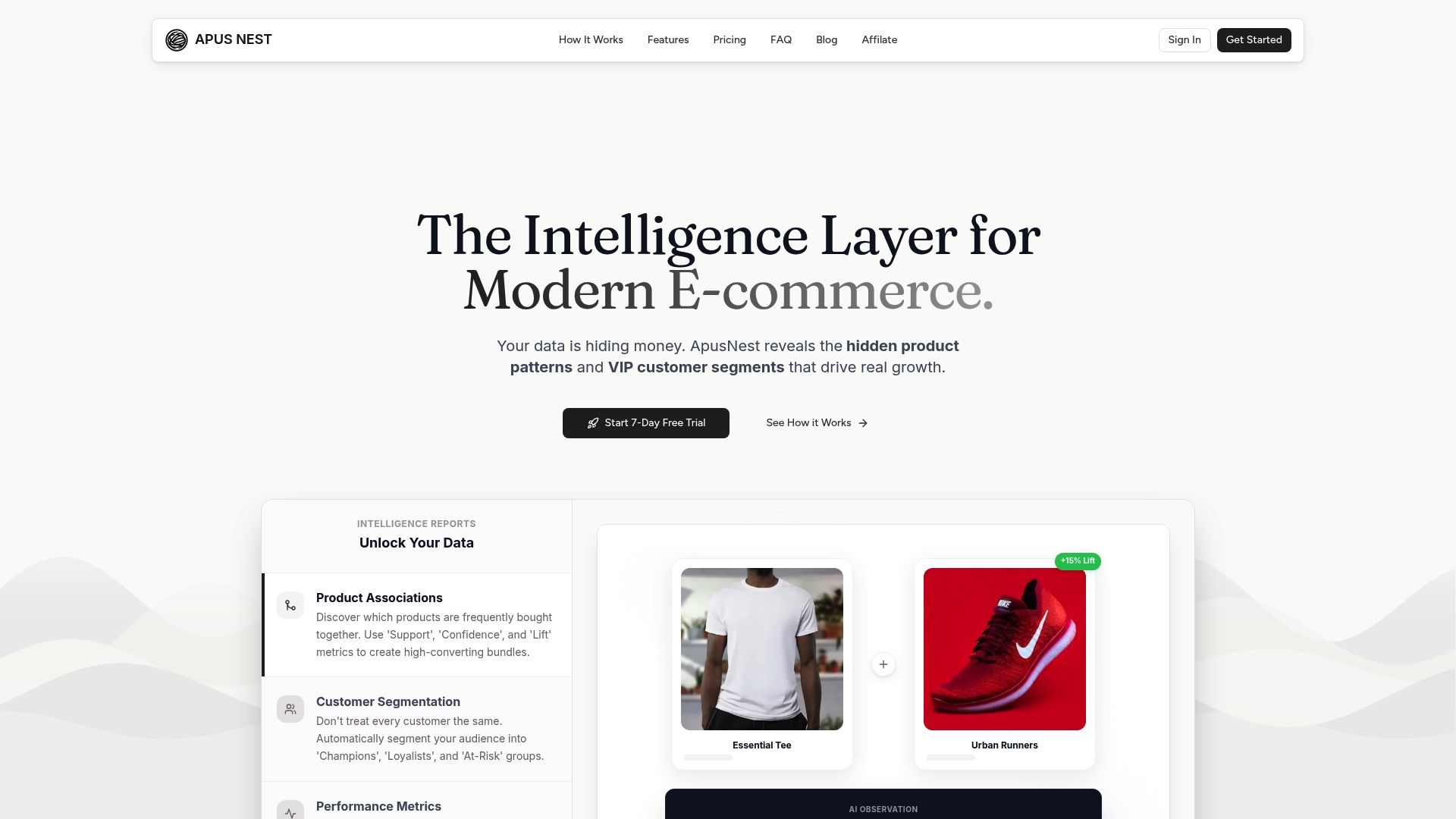
Ready to transform your Shopify marketing with clear, actionable insights Use APUS NEST to unlock your store’s hidden opportunities and create personalized strategies that boost your average order value Visit APUS NEST now to get your free report and start maximizing your growth potential. Learn more about how to analyze sales data and optimize product placement with confidence.
Frequently Asked Questions
How can I analyze my Shopify sales data for better insights?
Understanding your Shopify sales data involves focusing on critical metrics such as conversion rates, average order value, and customer acquisition costs. Start by examining your best-performing products and sales channels, and then utilize Shopify’s built-in analytics tools to track these insights weekly or monthly.
What are effective strategies for cross-selling products on my Shopify store?
To effectively cross-sell, identify products that are commonly purchased together and create targeted recommendations. Analyze your sales data for natural product pairings and consider implementing automated product suggestion algorithms to enhance customer experience and increase average order value.
How do I create product bundles that effectively increase average order value?
Creating product bundles involves grouping complementary products and offering them at a discount to entice larger purchases. Start by analyzing your sales data for logical combinations and consider a discount of 10 to 20 percent to motivate customers to buy more.
What role do AI tools play in optimizing my Shopify marketing efforts?
AI tools can enhance marketing strategies by analyzing customer behavior and automating tasks like segmentation and campaign optimization. Integrate an AI marketing tool into your workflow to start refining your targeted marketing strategies and increasing conversion rates within a few months.
How can I personalize my marketing strategies based on customer data?
To personalize your marketing, consolidate customer data from various touchpoints and analyze it to create detailed customer profiles. Use this information to develop dynamic product recommendations tailored to individual customer preferences, which can significantly improve engagement and conversion rates.
What are the best practices for exporting Shopify data to improve my marketing initiatives?
When exporting Shopify data, focus on customer information like purchase history and browsing behavior. Establish a standardized data export template and use integrated marketing platforms to ensure real-time updates, enhancing the consistency and adaptability of your marketing strategies.
Recommended
- 10 Essential Tips for Boosting Online Sales - ApusNest Blog | ApusNest
- 7 Proven Ways to Boost Shopify Sales in 2025 - ApusNest Blog | ApusNest
- Black Friday Shopify: Complete Guide to Success - ApusNest Blog | ApusNest
- 7 Top Black Friday Shopify Apps to Boost Store Profits - ApusNest Blog | ApusNest
- Complete Guide to Starting a Style Blog - DressMeUpNY
