

Every e-commerce store is hungry for growth, and the pursuit of the next big opportunity never stops. Yet while most businesses collect mountains of data, only about 20 percent of companies actually convert that raw data into useful business strategies. Surprised? Here’s the twist. The real winners are not just collecting information, but using market intelligence to spot opportunities long before their competitors even catch on.
Table of Contents
- Defining Market Intelligence: What It Is And Its Purpose
- The Importance Of Market Intelligence In E-Commerce
- Key Components Of Effective Market Intelligence
- How Market Intelligence Drives Strategic Decision-Making
- Real-World Applications Of Market Intelligence In Retail
Quick Summary
| Takeaway | Explanation |
|---|---|
| Market intelligence boosts strategic decision-making | By understanding customer behavior and market dynamics, businesses can make informed, proactive choices rather than relying on guesswork. |
| Integrate diverse data sources | Effective market intelligence combines customer feedback, transactional data, and competitive intelligence for comprehensive insights. |
| Focus on customer journey optimization | Tailoring the shopping experience enhances customer satisfaction and can increase conversion rates significantly. |
| Predict industry trends | Advanced analytics enable businesses to forecast market changes, allowing for timely adjustments in strategy. |
| Monitor competitors closely | Keeping an eye on competitor activities helps identify unique opportunities for differentiation and growth. |
Defining Market Intelligence: What It Is and Its Purpose
Market intelligence transforms raw data into strategic insights that power e-commerce decision making. At its core, market intelligence is a systematic approach to gathering, analyzing, and interpreting information about market dynamics, customer behaviors, competitive landscapes, and emerging trends that directly impact business performance.
The Fundamental Components of Market Intelligence
Market intelligence encompasses several critical dimensions that go beyond simple data collection.
To help clarify the essential components of market intelligence in e-commerce, the following table summarizes each key dimension and its primary focus.
| Component | Description |
|---|---|
| Customer Insights | Deep understanding of customer preferences, purchasing patterns, and behavioral trends |
| Competitive Analysis | Tracking competitor strategies, product offerings, and market positioning |
| Market Trends | Identifying emerging opportunities, technological shifts, and industry transformations |
| Customer Feedback | Gathering direct insights from reviews, surveys, and interaction data |
| Transactional Data | Analyzing purchase histories, browsing patterns, and conversion metrics |
| Competitive Intelligence | Monitoring competitor pricing, product offerings, and marketing strategies |
Key components include:
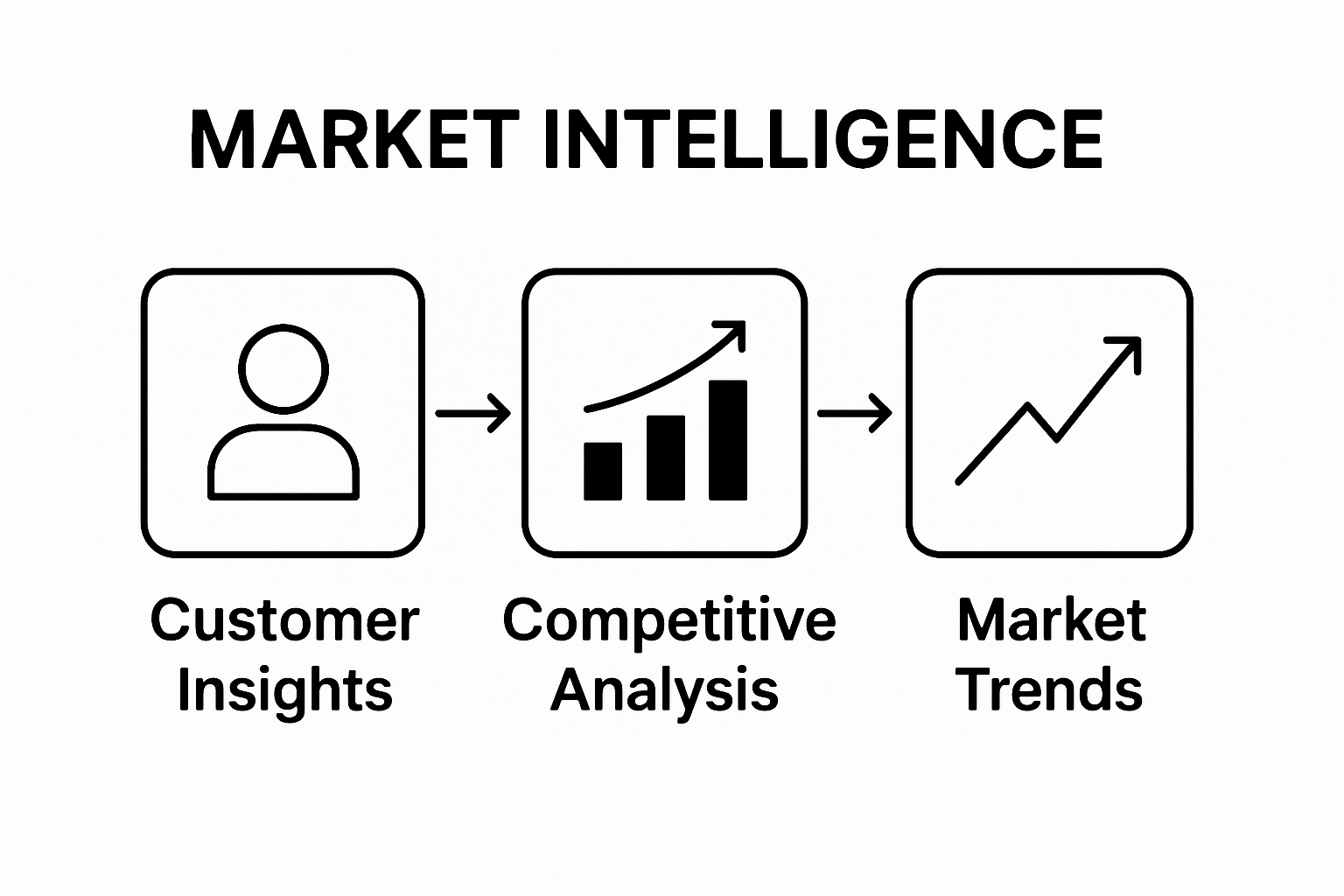
- Customer Insights: Deep understanding of customer preferences, purchasing patterns, and behavioral trends

- Competitive Analysis: Tracking competitor strategies, product offerings, and market positioning
- Market Trends: Identifying emerging opportunities, technological shifts, and industry transformations
Purpose and Strategic Value
For e-commerce entrepreneurs, market intelligence serves as a strategic compass. It enables businesses to make data-driven decisions, anticipate market shifts, and develop proactive strategies. By understanding complex market dynamics, you can optimize product offerings, pricing strategies, and marketing approaches.
Your market intelligence strategy should aim to answer critical questions like: What are customers truly seeking? Where are potential growth opportunities? How can we differentiate ourselves from competitors? Read our guide on market basket analytics to explore advanced techniques for uncovering these insights.
Ultimately, market intelligence transforms uncertain business landscapes into navigable territories, providing e-commerce store owners with the knowledge needed to make informed, strategic decisions that drive sustainable growth and competitive advantage.
The Importance of Market Intelligence in E-Commerce
Market intelligence represents a critical strategic asset for e-commerce businesses seeking sustainable growth and competitive advantage. By systematically collecting and analyzing data, online retailers can transform raw information into actionable insights that drive critical business decisions.
Driving Strategic Decision Making
In the rapidly evolving digital marketplace, market intelligence enables businesses to move beyond guesswork. According to academic research, effective market intelligence provides a comprehensive understanding of complex market dynamics that directly influence business performance.
Key strategic benefits include:
- Proactive Adaptation: Anticipating market shifts before they occur
- Customer Understanding: Developing deeper insights into consumer behavior and preferences
- Competitive Positioning: Identifying unique opportunities for differentiation
Risk Mitigation and Opportunity Identification
Market intelligence serves as a powerful risk management tool for e-commerce entrepreneurs. By continuously monitoring market trends, competitor activities, and emerging consumer demands, businesses can develop preemptive strategies that minimize potential vulnerabilities.
To illustrate how market intelligence directly supports strategic decision-making, this table links core intelligence activities to the specific business decisions they inform in e-commerce.
| Strategic Decision Area | Role of Market Intelligence |
|---|---|
| Product Development | Identifies market gaps and customer needs |
| Pricing Strategies | Uncovers price sensitivity and informs competitive positioning |
| Marketing Resource Allocation | Targets the most promising customer segments |
| Proactive Adaptation | Anticipates market shifts and enables early response |
| Risk Mitigation | Recognizes potential market disruptions and emerging competitive threats |
| Opportunity Identification | Reveals new customer needs and growth areas |
This approach allows e-commerce store owners to:
- Identify potential market disruptions early
- Understand emerging customer needs before competitors
- Develop data-driven product and marketing strategies
Explore our comprehensive guide to e-commerce data analysis to learn more about transforming raw data into strategic insights. By investing in robust market intelligence processes, e-commerce businesses can create a resilient, adaptive approach that turns market complexity into a significant competitive advantage.
Key Components of Effective Market Intelligence
Effective market intelligence is a multifaceted approach that requires strategic integration of diverse data sources and analytical techniques. For e-commerce businesses, understanding these key components is crucial to developing a robust intelligence framework that drives meaningful insights and actionable strategies.
Data Collection and Aggregation
The foundation of market intelligence lies in comprehensive data collection. According to research in business analytics, successful market intelligence demands systematic gathering of information from multiple channels.
Critical data sources include:
- Customer Feedback: Direct insights from reviews, surveys, and interaction data
- Transactional Data: Purchase histories, browsing patterns, and conversion metrics
- Competitive Intelligence: Monitoring competitor pricing, product offerings, and marketing strategies
Advanced Analytical Frameworks
Transforming raw data into meaningful intelligence requires sophisticated analytical approaches. E-commerce entrepreneurs must go beyond simple data collection and implement advanced analytical techniques that uncover deeper market insights.
Key analytical strategies involve:
- Predictive modeling to forecast market trends
- Segmentation analysis to understand distinct customer groups
- Machine learning algorithms for pattern recognition
Learn more about marketplace analytics strategies to enhance your market intelligence capabilities. By developing a comprehensive understanding of these components, e-commerce businesses can create a dynamic intelligence system that adapts to changing market conditions and provides a sustainable competitive advantage.
How Market Intelligence Drives Strategic Decision-Making
Market intelligence transforms raw data into a strategic compass, enabling e-commerce businesses to navigate complex marketplace dynamics with precision and confidence. By converting information into actionable insights, businesses can make informed decisions that directly impact growth, profitability, and competitive positioning.
Translating Data into Strategic Insights
Effective strategic decision-making requires more than just data collection. According to research on firm performance, market intelligence serves as a critical mechanism for translating complex market information into clear, executable strategies.
Key strategic decision areas include:
- Product Development: Identifying market gaps and customer needs
- Pricing Strategies: Understanding price sensitivity and competitive positioning
- Marketing Resource Allocation: Targeting most promising customer segments
Predictive Decision-Making Framework
Market intelligence enables a proactive rather than reactive approach to business strategy. By utilizing advanced analytical techniques, e-commerce businesses can anticipate market shifts, consumer behavior changes, and emerging competitive threats before they fully materialize.
Critical predictive capabilities involve:
- Trend forecasting based on historical and real-time data
- Consumer behavior pattern recognition
- Scenario planning and risk assessment
Explore our comprehensive guide to sales and marketing analytics to deepen your understanding of strategic decision-making techniques. By embracing market intelligence as a core business function, e-commerce entrepreneurs can transform uncertainty into a strategic advantage, making decisions that are not just reactive, but prescient and forward-looking.
Real-World Applications of Market Intelligence in Retail
Market intelligence transforms theoretical insights into practical strategies that drive tangible business outcomes. For e-commerce retailers, these applications represent powerful tools for understanding customer behavior, optimizing operations, and gaining competitive advantages.
Customer Journey Optimization
Understanding the complete customer journey requires sophisticated market intelligence techniques. By mapping detailed customer interactions and touchpoints, e-commerce businesses can create more personalized and engaging shopping experiences.
Key optimization strategies include:
- Personalization: Tailoring product recommendations based on individual purchase histories
- Conversion Path Analysis: Identifying and removing friction points in the purchasing process
- Behavioral Segmentation: Creating targeted marketing campaigns for specific customer groups
Competitive Positioning and Strategy
Market intelligence enables retailers to develop nuanced strategies that differentiate them from competitors. According to comprehensive retail research, businesses can leverage data-driven insights to create unique value propositions.
Competitive intelligence applications involve:
- Monitoring competitor pricing strategies
- Tracking emerging market trends
- Identifying potential product expansion opportunities
Explore our guide to understanding retail analytics terms to gain deeper insights into market intelligence methodologies. By implementing these real-world applications, e-commerce retailers can transform raw data into strategic advantages that drive growth, enhance customer experiences, and create sustainable competitive differentiation.
Unlock Game-Changing Market Intelligence for Your Store Today
Now that you understand how market intelligence drives real growth for e-commerce brands, take the next step to put these insights into action. Many store owners struggle to translate raw data and competitive analysis into real revenue opportunities. Are you missing out on powerful product pairing strategies or failing to identify trends hiding in your sales data? If you want to leverage true customer insights and pinpoint ways to increase your average order value, the right tools matter.

Experience what advanced analysis can do for your business with APUS NEST. Start with a free report to uncover valuable product relationships and receive tailored cross-sell recommendations. Ready for deeper insights? Upgrade to a full report for comprehensive, export-ready analytics and transparent data ownership. Put your new market intelligence to work now and transform hidden trends into sustainable profit. Visit APUS NEST to claim your free report and unlock the full potential of your e-commerce strategy. Or learn more about how AI-powered market basket analysis delivers real results in our market basket analytics guide.
Frequently Asked Questions
What is market intelligence in e-commerce?
Market intelligence in e-commerce involves collecting, analyzing, and interpreting data about market dynamics, customer behavior, and competitors to make informed business decisions.
Why is market intelligence important for e-commerce businesses?
Market intelligence helps e-commerce businesses anticipate market shifts, understand customer preferences, and develop proactive strategies that drive growth and competitive advantage.
How can market intelligence improve customer understanding?
By analyzing customer data, e-commerce businesses can gain insights into purchasing patterns, preferences, and behaviors, allowing for more personalized marketing and product offerings.
What are some key components of effective market intelligence?
Key components include data collection from customer feedback and transactional data, competitive intelligence analysis, and advanced analytical techniques such as predictive modeling and segmentation.
Recommended
- Guide to E-Commerce Data Analysis for Increased Sales - ApusNest Blog | ApusNest
- Marketplace Analytics Guide: Unlock Growth in 2025 - ApusNest Blog | ApusNest
- Understanding Top Retail Analytics Terms for E-Commerce Success - ApusNest Blog | ApusNest
- The Essential Guide to Sales and Marketing Analytics 2025 - ApusNest Blog | ApusNest
- E-commerce SEO in 2025: Essential Strategies for Success
