

Every online retailer collects mountains of customer data and sales numbers. That might sound overwhelming, especially since companies leveraging advanced analytics can see up to a 25 percent boost in profitability, according to Forrester Research. Most people think the real challenge is in the sheer volume of figures. In reality, the secret is understanding the special terminology that transforms this raw data into smart, money-making decisions.
Table of Contents
- The Fundamentals Of Ecommerce Analytics Terminology
- Why Ecommerce Analytics Matters For Online Retailers
- Key Metrics In Ecommerce Analytics Explained
- Interpreting Data: How Ecommerce Analytics Works
- Real-World Applications Of Ecommerce Analytics Terminology
Quick Summary
| Takeaway | Explanation |
|---|---|
| Understand core ecommerce metrics. | Familiarize yourself with key performance indicators like conversion rate and average order value to evaluate success. |
| Leverage data for strategic insights. | Use customer behavior analytics to make informed marketing decisions and optimize product offerings. |
| Focus on customer segmentation. | Analyze customer demographics and behaviors to create personalized experiences and targeted campaigns. |
| Apply advanced analytics techniques. | Implement predictive modeling and statistical analyses to transform raw data into actionable business strategies. |
| Enhance operational efficiency. | Use analytics to streamline inventory management and reduce costs, leading to improved overall performance. |
The Fundamentals of Ecommerce Analytics Terminology
Ecommerce analytics is the systematic process of collecting, measuring, and interpreting digital data related to online retail performance. These analytics provide critical insights into customer behavior, sales trends, and operational efficiency. At its core, ecommerce analytics transforms raw transactional data into actionable intelligence that drives strategic business decisions.
Core Components of Ecommerce Analytics
Understanding ecommerce analytics terminology requires recognizing its fundamental building blocks. Data collection represents the initial stage where information is gathered from multiple sources such as website traffic, sales records, customer interactions, and marketing channels. Learn more about leveraging ecommerce analytics to unlock your store’s potential.
Key data sources include:
- Website visitor tracking
- Transaction records
- Customer demographic information
- Social media engagement metrics
- Email marketing performance data
Interpreting Analytics Metrics
Successful ecommerce analytics hinges on understanding critical performance indicators. These metrics provide nuanced perspectives on business health and customer engagement. By examining data points like conversion rates, average order value, and customer lifetime value, online retailers can develop precise strategic approaches.
According to McKinsey & Company’s research, businesses that leverage comprehensive analytics can increase their revenues by up to 15-20% through targeted insights and personalized customer experiences. This underscores the transformative power of understanding and applying ecommerce analytics terminology effectively.
The journey of mastering ecommerce analytics begins with comprehending its fundamental terminology, recognizing data sources, and developing a strategic approach to interpreting complex digital metrics.
Why Ecommerce Analytics Matters for Online Retailers
Online retailers operate in a hyper-competitive digital marketplace where understanding customer behavior is not just an advantage but a necessity for survival. Ecommerce analytics provides the strategic intelligence needed to make informed decisions, optimize performance, and drive sustainable growth.
Strategic Decision Making Through Data
Data-driven insights transform guesswork into precision strategy. By analyzing comprehensive metrics, online retailers can understand complex customer journeys, predict purchasing behaviors, and allocate resources more effectively. Uncover deeper insights into ecommerce analytics to elevate your business performance.
Key strategic advantages include:
- Identifying high-performing product categories
- Understanding customer segmentation patterns
- Optimizing marketing channel investments
- Predicting potential revenue streams
- Reducing customer acquisition costs
Financial Performance and Risk Mitigation
According to Forrester Research, businesses that leverage advanced analytics can increase their profitability by up to 25% through targeted interventions and proactive strategy adjustments. Ecommerce analytics serves as a critical risk management tool, enabling retailers to:
- Detect potential revenue leakage
- Forecast inventory requirements
- Understand seasonal purchasing trends
- Minimize operational inefficiencies
- Develop personalized customer retention strategies
The true power of ecommerce analytics lies not just in collecting data, but in transforming raw information into actionable strategies that directly impact bottom-line performance. Online retailers who embrace comprehensive analytical approaches position themselves to outperform competitors and create more resilient, responsive business models.
Key Metrics in Ecommerce Analytics Explained
Ecommerce analytics metrics serve as the navigational compass for online retailers, providing critical insights into business performance, customer behavior, and growth potential. Understanding these metrics transforms raw data into strategic intelligence that drives informed decision-making.
Performance and Conversion Metrics
Conversion metrics represent the foundational measurements of online retail success. These indicators track how effectively a store transforms website visitors into paying customers. Dive deeper into understanding Google Analytics for online stores to enhance your analytical capabilities.
Key performance metrics include:
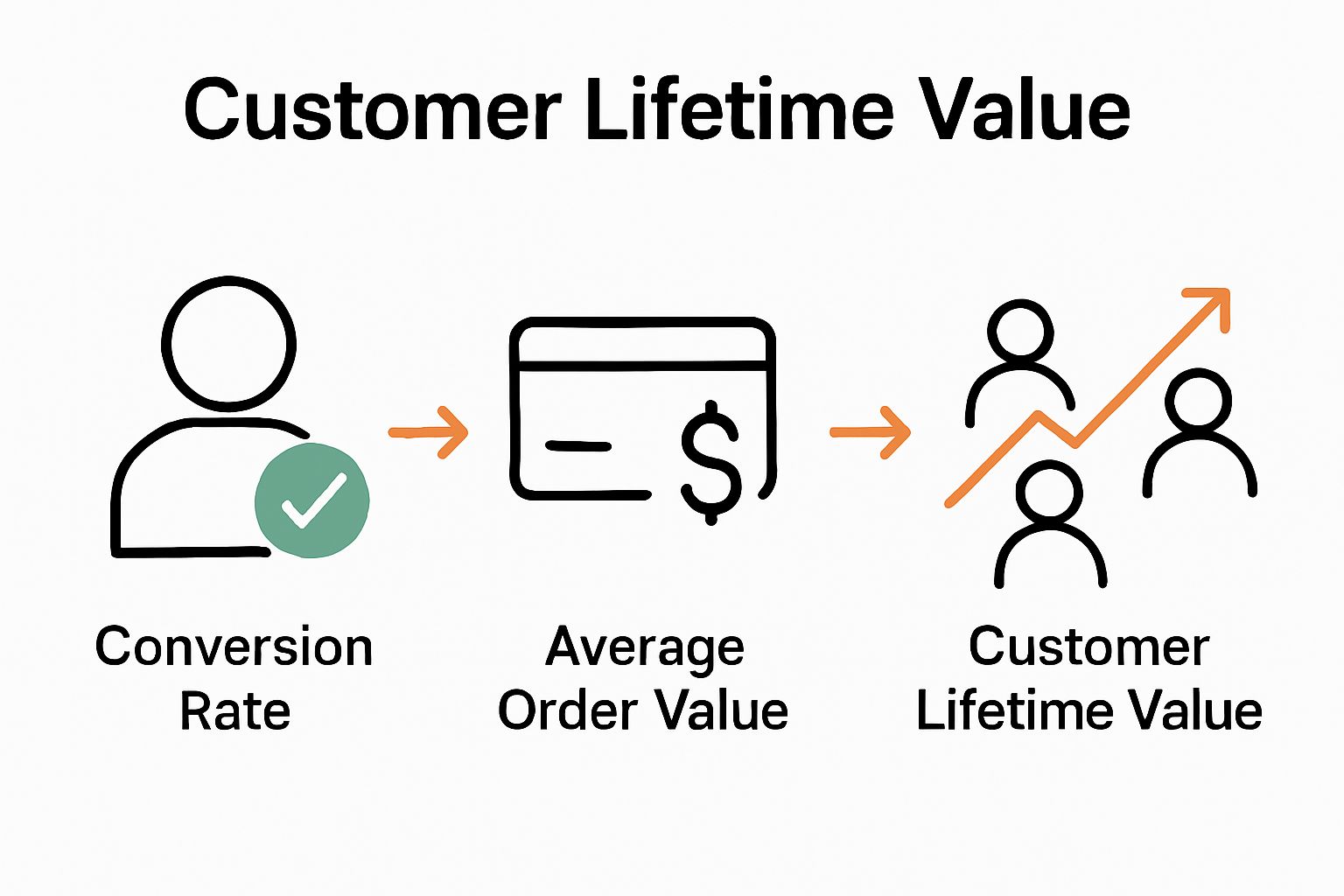
- Conversion rate
- Average order value
- Cart abandonment rate
- Customer acquisition cost
- Revenue per visitor
Customer Behavior and Engagement Analytics
Beyond simple transactional data, advanced ecommerce analytics reveal intricate patterns of customer interaction and engagement. According to Gartner Research, businesses that successfully track customer behavior metrics can improve their marketing effectiveness by up to 40%.
Critical customer behavior metrics encompass:
- Time spent on site
- Pages per session
- Bounce rate
- Repeat purchase rate
- Customer lifetime value
These metrics provide a multidimensional view of customer interactions, enabling online retailers to understand not just what customers buy, but how and why they make purchasing decisions.
Below is a table summarizing key ecommerce analytics metrics alongside their definitions and significance for online retailers.
| Metric | Definition | Significance |
|---|---|---|
| Conversion Rate | Percentage of website visitors who complete a desired action | Indicates overall marketing and site effectiveness |
| Average Order Value | Average amount spent per transaction | Helps guide pricing and bundling strategies |
| Cart Abandonment Rate | Percentage of shoppers who add items but do not complete purchase | Reveals friction points in the checkout process |
| Customer Acquisition Cost | Average cost to acquire a new customer | Assists in evaluating marketing and advertising ROI |
| Revenue per Visitor | Total revenue divided by number of website visitors | Measures website monetization efficiency |
| Repeat Purchase Rate | Percentage of customers who make more than one purchase | Indicates customer loyalty and engagement |
| Customer Lifetime Value | Estimated total revenue from a customer over their relationship | Guides long-term marketing focus and retention efforts |
Interpreting Data: How Ecommerce Analytics Works
Ecommerce analytics is a sophisticated process of transforming complex digital interactions into meaningful business insights. The methodology goes beyond simple data collection, involving intricate processes of gathering, processing, analyzing, and visualizing information that reveals critical patterns in online retail performance.
Data Collection and Aggregation
Raw data gathering represents the foundational stage of ecommerce analytics. This process involves capturing information from multiple digital touchpoints, creating a comprehensive view of customer interactions. Explore advanced techniques for data collection to enhance your analytical capabilities.
Key data collection channels include:
- Website tracking pixels
- Transaction logs
- Customer interaction records
- Social media engagement metrics
- Email marketing response data
Advanced Statistical Analysis
Once data is collected, sophisticated statistical techniques transform raw information into actionable insights. According to MIT Sloan Management Review, businesses that implement advanced analytical models can improve their predictive accuracy by up to 60%.
Advanced analytical approaches involve:
- Regression analysis
- Predictive modeling
- Machine learning algorithms
- Customer segmentation techniques
- Correlation and trend identification
The power of ecommerce analytics lies in its ability to convert complex digital interactions into strategic intelligence.
This table outlines the core steps in the ecommerce analytics process and describes what each step involves.
| Analytics Step | Description |
|---|---|
| Data Collection | Gathering raw data from sites, transactions, customer interactions, and marketing tools |
| Data Aggregation | Compiling data from various sources into a unified dataset for analysis |
| Statistical Analysis | Applying models like regression or predictive algorithms to uncover patterns and trends |
| Data Visualization | Presenting findings in charts, dashboards, or reports for clear business interpretation |
| Strategic Decision Making | Using insights from analytics to inform marketing, inventory, and customer strategies |
Real-World Applications of Ecommerce Analytics Terminology
Ecommerce analytics transforms abstract data points into tangible business strategies, enabling online retailers to make precise, informed decisions that directly impact revenue and customer experience. By translating complex metrics into actionable insights, businesses can create targeted approaches that optimize every aspect of their digital operations.
Personalization and Customer Experience
Customer segmentation represents a powerful application of ecommerce analytics, allowing retailers to create hyper-targeted experiences. Discover advanced retail analytics strategies to enhance your customer engagement approaches. By analyzing behavioral patterns, purchase history, and demographic information, businesses can develop personalized marketing campaigns and product recommendations that significantly increase conversion rates.
Key personalization strategies include:
- Dynamic pricing models
- Individualized product recommendations
- Tailored email marketing campaigns
- Customized user interface experiences
- Targeted promotional offers
Operational Efficiency and Inventory Management
According to Harvard Business Review, companies that implement advanced analytics can reduce inventory costs by up to 30% and improve supply chain efficiency. Ecommerce analytics enables businesses to:
- Predict future inventory requirements
- Optimize stock levels across multiple channels
- Identify slow-moving and high-performing product categories
- Minimize warehousing expenses
- Streamline procurement processes
The true power of ecommerce analytics lies in its ability to convert complex data into strategic intelligence. By understanding and applying these analytical approaches, online retailers can create more responsive, efficient, and customer-centric business models that adapt quickly to changing market dynamics.

Turn Ecommerce Analytics Terms Into Real Revenue With APUS NEST
Have you ever struggled to turn complex ecommerce analytics terminology into results for your Shopify or WooCommerce store? Many online retailers face the same challenge. You learn about customer journeys, market basket analysis, and product relationship metrics, but turning these concepts into actionable growth can feel overwhelming. The risk is missing hidden revenue opportunities that the data is already revealing. You want to stop guessing about product pairing and start seeing higher average order values from every order.

Put your analytics knowledge to work today with APUS NEST. Upload your sales data and see instant reports that highlight product pairing opportunities and actionable insights. By understanding key analytics terms like cross-sell strategies and average order value, you can unlock tailored recommendations in minutes. Get your free market basket analysis report or upgrade to gain full visibility so you can confidently optimize bundles, placements, and marketing campaigns. Get started now and turn your ecommerce expertise into measurable growth.
Frequently Asked Questions
What is ecommerce analytics?
Ecommerce analytics is the systematic process of collecting, measuring, and interpreting digital data related to online retail performance. It turns raw transactional data into actionable insights that help in strategic business decisions.
Why is understanding ecommerce analytics terminology important for online retailers?
Understanding ecommerce analytics terminology helps online retailers interpret key performance indicators and data sources, enabling them to make informed, data-driven decisions that enhance customer experience and optimize business operations.
What are some key metrics in ecommerce analytics?
Some essential metrics in ecommerce analytics include conversion rate, average order value, cart abandonment rate, customer acquisition cost, and customer lifetime value. These metrics provide insights into business performance and customer behavior.
How can ecommerce analytics impact strategic decision-making?
Ecommerce analytics allows online retailers to analyze customer journeys and purchasing behaviors, which helps in identifying high-performing product categories, optimizing marketing investment, and predicting potential revenue streams.
Recommended
- Understanding Why Leverage Ecommerce Analytics in Business - ApusNest Blog | ApusNest
- Understanding Ecommerce Analytics: Unlocking Insights - ApusNest Blog | ApusNest
- Understanding Top Retail Analytics Terms for E-Commerce Success - ApusNest Blog | ApusNest
- Understanding Google Analytics Ecommerce for Online Stores - ApusNest Blog | ApusNest
- Understanding SEO Analytics Tools for Your Business
