

Over 60 percent of american online shoppers say they expect smarter and faster shopping experiences every year. The rapid pace of change in ecommerce is not just a trend, it is setting new standards for both businesses and consumers. Understanding the major forces shaping 2025 will help companies harness innovation, adapt to regulatory shifts, and meet rising expectations in a fiercely competitive digital market.
Table of Contents
- Defining the 2025 Ecommerce Landscape
- Major Trends Shaping Ecommerce in 2025
- AI and Data Analytics Driving Growth
- Evolving Consumer Behavior and Expectations
- Risks, Competition, and Future Opportunities
Key Takeaways
| Point | Details |
|---|---|
| Technological Advances | AI and machine learning are driving significant changes in ecommerce, enhancing recommendation accuracy and personalizing customer interactions. |
| Regulatory Changes | The 2025 US Administration’s new policies on taxation and data privacy will require businesses to adapt their ecommerce strategies. |
| Consumer Expectations | There is a growing demand for personalized, transparent interactions and seamless digital experiences from consumers. |
| Strategic Investment | Companies must focus on integrating AI and data analytics to maintain competitiveness and respond to evolving market demands. |
Defining the 2025 Ecommerce Landscape
The ecommerce landscape in 2025 represents a pivotal moment of technological transformation and strategic adaptation. According to research from eajournals.org, artificial intelligence is fundamentally reshaping online retail through advanced machine learning algorithms that improve recommendation accuracy by 47% and dramatically reduce processing latency.
Key technological developments are driving unprecedented changes in how businesses approach digital commerce. Artificial intelligence and machine learning have become central strategies, enabling companies to achieve remarkable customer behavior prediction accuracy of 92%. These sophisticated algorithms are not just incremental improvements but represent a quantum leap in understanding consumer preferences and purchasing patterns.
The regulatory environment is also evolving rapidly. As noted by allmultidisciplinaryjournal.com, the new US Administration in 2025 has introduced policy shifts that will significantly impact ecommerce operations. These changes encompass critical areas such as:
- Taxation structures for online transactions
- Enhanced data privacy regulations
- Revised international trade agreements
Businesses must remain agile and proactively adapt to these emerging challenges. Mobile commerce continues to be a driving force, now representing 63% of total transactions and signaling a permanent shift in consumer shopping behaviors.
 Learn more about ecommerce strategies in our comprehensive guide on 2025 tips.
The convergence of technological innovation, regulatory adaptation, and changing consumer preferences defines the 2025 ecommerce landscape.
Success will belong to those organizations capable of integrating advanced AI technologies, understanding nuanced consumer behaviors, and maintaining flexibility in an increasingly complex digital marketplace.
Major Trends Shaping Ecommerce in 2025
The ecommerce landscape is experiencing unprecedented transformation, driven by technological innovations and evolving consumer behaviors. According to Reuters, artificial intelligence-powered solutions are revolutionizing online shopping experiences, with AI-based chatbots boosting online sales by nearly 4% during the 2024 holiday season.
Artificial Intelligence is emerging as a critical differentiator in the ecommerce ecosystem. Retailers are increasingly deploying sophisticated chatbot technologies that provide seamless conversational customer service, enabling more personalized and efficient shopping experiences. These AI-driven interactions are not just improving customer engagement but also dramatically streamlining purchasing processes.
Key trends defining the 2025 ecommerce landscape include:
- Advanced personalization through machine learning algorithms
- Integrated AI customer service platforms
- Real-time inventory and pricing optimization
- Enhanced mobile shopping experiences
Consumer spending patterns are also shifting rapidly. Explore our comprehensive AI and ecommerce strategies guide to understand how businesses can leverage these technological advancements. The online marketplace is becoming increasingly sophisticated, with data-driven insights enabling more targeted and efficient marketing approaches.
The convergence of technology, consumer expectations, and innovative business models will continue to reshape ecommerce.
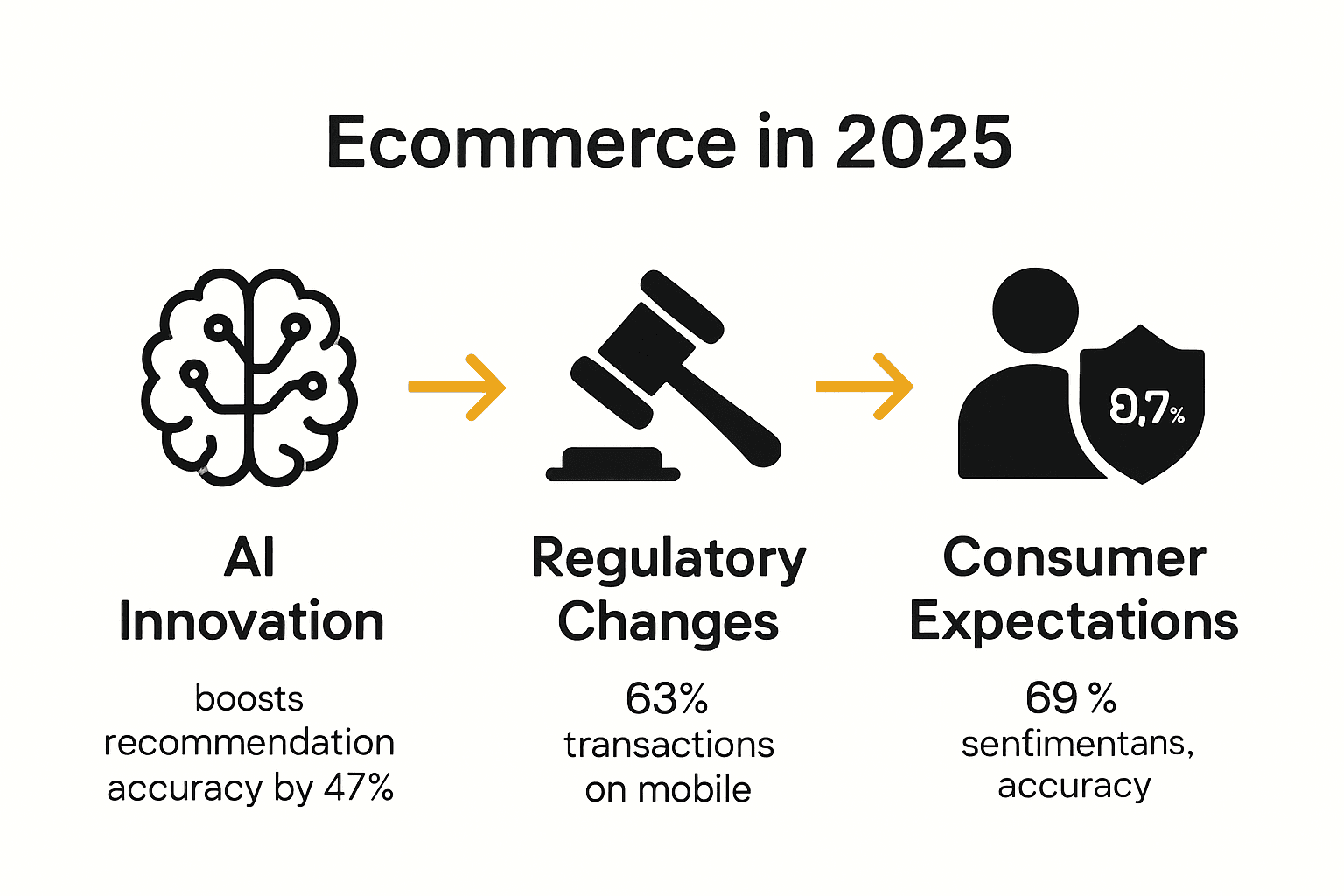 Successful organizations will be those capable of quickly adapting to these dynamic trends, leveraging AI and data analytics to create more responsive, personalized shopping experiences that meet the evolving demands of digital consumers.
AI and Data Analytics Driving Growth
Artificial intelligence is revolutionizing the ecommerce landscape by transforming how businesses understand and engage with customers. According to research from ArXiv, AI-driven sentiment analysis systems are achieving remarkable accuracy of 89.7% in processing customer feedback, providing unprecedented insights into consumer behavior and preferences.
Machine learning algorithms are now capable of extracting nuanced insights from vast pools of customer data, enabling businesses to make more informed strategic decisions. By integrating traditional machine learning techniques with advanced deep learning models, companies can develop more transparent and interpretable systems that drive operational efficiency and customer satisfaction.
Key applications of AI and data analytics in ecommerce include:
- Predictive customer behavior modeling
- Real-time sentiment analysis
- Personalized product recommendations
- Dynamic pricing strategies
- Automated customer service interactions
Explore our comprehensive guide on growth analytics to understand how businesses can leverage these technological advancements. The emerging landscape of AI-powered decision support systems is transforming marketing strategies, allowing for more precise targeting and more efficient resource allocation.
The future of ecommerce will be defined by organizations that can effectively harness the power of AI and data analytics. By developing sophisticated systems that can interpret complex consumer data, predict market trends, and provide actionable insights, businesses can create more responsive, personalized shopping experiences that meet the increasingly sophisticated demands of digital consumers.
Evolving Consumer Behavior and Expectations
Consumer expectations in ecommerce are undergoing a radical transformation, driven by technological advancements and shifting digital experiences. According to research from ArXiv, consumer adoption of AI-powered online retail platforms is increasingly influenced by two critical factors: trust and perceived usefulness.
The technology acceptance model reveals that consumers are becoming more sophisticated in their interactions with online platforms. They no longer simply seek transactional experiences but demand personalized, intelligent interactions that demonstrate genuine understanding of their individual preferences and needs. Trust has emerged as a pivotal element in consumer decision making, with shoppers carefully evaluating the transparency and reliability of AI-driven recommendation systems.
Key shifts in consumer behavior include:
- Heightened expectations for personalized experiences
- Increased comfort with AI-powered interactions
- Demand for transparent and ethical data usage
- Preference for seamless, intuitive digital interfaces
- Greater emphasis on value and relevance over generic offerings
Explore our guide on customer insights analytics to understand the deeper nuances of these evolving consumer dynamics. According to EcomPoser, 80% of retail executives anticipate AI-powered automation becoming central to their strategic approach by the end of 2025.
The future of ecommerce will be defined by businesses that can authentically connect with consumers, leveraging advanced technologies to create meaningful, personalized interactions that transcend traditional transactional relationships. Success will belong to those who view technology not as a replacement for human connection, but as a sophisticated tool for understanding and serving customer needs more effectively.
Risks, Competition, and Future Opportunities
The ecommerce landscape in 2025 is characterized by intense technological competition and strategic complexity. According to DigitalCommerce360, 67% of B2B ecommerce companies are actively leveraging artificial intelligence and machine learning to drive growth, with 90% viewing AI as critical to their long-term strategic objectives.
Technological disruption is reshaping competitive dynamics, with businesses facing significant challenges in adopting and integrating advanced technologies. While 41% of companies have fully integrated AI capabilities, the remaining market is racing to close the technological gap. Investment trends indicate a robust commitment to innovation, with 66% of organizations planning to increase AI spending within the next two years.
Key strategic considerations for businesses include:
- Accelerating AI and machine learning integration
- Developing robust data analytics capabilities
- Creating adaptive technological infrastructure
- Investing in continuous skills development
- Maintaining flexibility in technological approaches
Explore our marketplace strategy guide to navigate these complex competitive landscapes. Research from ArXiv highlights emerging opportunities in knowledge graph technologies, demonstrating how artificial intelligence can transform unstructured product data into structured, actionable insights.
The future belongs to organizations that can rapidly adapt, innovate, and strategically deploy emerging technologies. Success will depend on a holistic approach that balances technological investment, human expertise, and a deep understanding of evolving market dynamics. Businesses must view technological transformation not as a destination, but as an ongoing journey of continuous learning and strategic reinvention.
Unlock Growth Opportunities in the 2025 Ecommerce Revolution
The article highlights how integrating artificial intelligence and advanced data analytics is critical to staying competitive in ecommerce by 2025. You may feel overwhelmed by the fast-paced changes in consumer behavior, AI-driven personalization, and evolving market demands. Businesses face pressure to quickly identify actionable insights that boost customer engagement and increase average order value while ensuring transparent and ethical data use.
APUS NEST offers a tailored solution for ecommerce store owners using Shopify or WooCommerce to conquer these challenges with ease. Our AI-powered market basket analysis reveals hidden product relationships and cross-sell opportunities that match modern consumer expectations for personalization and seamless shopping experiences outlined in the article. By uploading your sales data for a detailed report, you gain clarity and control to optimize product placement and marketing strategies without subscriptions or data lock-in.
Experience how advanced analytics can transform your store today.
Explore actionable ecommerce insights now
Ready to harness AI-driven strategies to thrive in 2025 and beyond? Visit APUS NEST to get started with a free report or unlock full analytics and recommendations for exponential growth. Discover more on how to enhance your ecommerce success in our growth analytics guide and practical WooCommerce integration tutorials. Your journey to smarter, data-powered ecommerce starts here.
Frequently Asked Questions
What are the key technological advancements influencing ecommerce in 2025?
The ecommerce landscape is being significantly influenced by advancements in artificial intelligence and machine learning, which are improving recommendation accuracy and enhancing customer engagement through personalized experiences.
How is consumer behavior changing in ecommerce by 2025?
Consumers are increasingly seeking personalized, intelligent interactions rather than generic transactional experiences. There is a heightened expectation for transparency, ethical data usage, and seamless digital interfaces.
What role does AI play in ecommerce growth strategies?
AI is critical to ecommerce growth strategies, enabling predictive customer behavior modeling, personalized product recommendations, and dynamic pricing strategies, which help businesses better understand and engage with their customers.
What are the risks associated with the evolving ecommerce landscape?
Businesses face risks related to technological disruption, competition, and the need for continuous adaptation. Organizations must invest in AI integration, data analytics, and remain flexible to navigate these challenges effectively.
Recommended
- 8 Powerful Ecommerce Content Ideas to Boost Sales in 2025 - ApusNest Blog | ApusNest
- E Commerce Analysis Report Guide for 2025 Success - ApusNest Blog | ApusNest
- 10 Ecommerce Tips to Elevate Your Online Store in 2025 - ApusNest Blog | ApusNest
- Understanding Ecommerce Growth Strategies Guide - ApusNest Blog | ApusNest
- Qu’est-ce qu’un site e-commerce ? Guide Complet Essentiel - IT-Pascaud
- The Ultimate Guide to eCommerce Content Optimization
