
Effective product recommendations ecommerce strategies are your best digital salesperson, guiding shoppers to products they’ll actually love. They weave a personalized experience into the customer journey, turning casual browsers into loyal fans by making discovery effortless and intuitive.
Why Product Recommendations Are Your Silent Salesperson
Think of product recommendations not as an add-on feature, but as a core engine driving your store’s success. In a crowded online marketplace, they cut through the noise and make shoppers feel understood.
Instead of leaving customers to endlessly scroll through countless product pages, a smart recommendation engine surfaces relevant items at just the right moment. This simple interaction saves them from decision fatigue and dramatically boosts the chances of a purchase.
For example, a customer checking out a new pair of running shoes is almost certainly going to need performance socks or a water bottle. Showing these as "Frequently Bought Together" items isn't just a sales tactic; it’s a genuinely helpful suggestion that improves their shopping trip and solves a problem they haven't even thought about yet. That kind of proactive help builds trust and makes your store the go-to resource.
The True Business Impact of Smart Suggestions
The real value of a well-executed strategy goes way beyond a single sale. When you consistently show customers products that align with their tastes, you create a tailored shopping environment that keeps them coming back. That’s where the real growth is.
Key benefits you'll see:
- Increased Average Order Value (AOV): Suggesting complementary items on product pages or in the cart is one of the most reliable ways to bump up how much each customer spends.
- Improved Customer Retention: A personalized experience makes shoppers feel valued. When they trust your store to get them, they're far more likely to return.
- Enhanced Product Discovery: Recommendations are perfect for shining a spotlight on items from your catalog that shoppers might otherwise miss, including new arrivals or hidden gems.
A well-placed recommendation does more than just sell another product. It reinforces the customer’s original purchase decision, making them feel confident and understood. It’s the digital equivalent of a sharp store associate confirming they’ve made a great choice.
The scale of this impact can be massive. For an industry giant like Amazon, the results are staggering. It's reported that approximately 35% of the company’s total revenue comes directly from its recommendation engine. That alone highlights the immense value these systems bring to the table. You can find more insights on mastering these strategies in recent studies on recommendation engine performance.
Choosing the right type of recommendation for the right place on your site is key. Each one serves a different purpose, from increasing order value to helping customers discover new products.
Here's a quick breakdown of how different strategies align with specific business goals and where they have the most impact.
Impact of Recommendation Types on Key Metrics
| Recommendation Type | Primary Goal | Typical Placement | Expected Impact |
|---|---|---|---|
| Frequently Bought Together | Increase AOV | Product Detail Page, Cart | Higher cart value, improved product discovery |
| You Might Also Like | Enhance Discovery | Product Detail Page, Homepage | Longer session duration, lower bounce rate |
| Trending/Best Sellers | Drive Conversions | Homepage, Category Pages | Higher conversion rates, social proof validation |
| Recently Viewed | Re-engage Shoppers | Homepage, Account Page | Increased repeat visits, streamlined navigation |
| Personalized For You | Build Loyalty | Homepage, Email Campaigns | Higher customer lifetime value (LTV), better retention |
Thinking strategically about which recommendation to use and where will get you much better results than just throwing a generic "related products" widget on every page.
Moving Beyond Generic Recommendations
The most effective product recommendations are always data-driven. They analyze browsing history, past purchases, and what similar customers have bought to create truly personal suggestions.
A shopper who only buys minimalist, black-and-white home decor shouldn't be seeing recommendations for brightly colored, floral-patterned pillows. It just doesn't make sense.
This level of personalization shows you're paying attention to their unique tastes. It transforms the relationship from a simple transaction into a trusted partnership, where your store becomes an expert curator for their specific lifestyle. This foundation of trust and personalization is what separates the most successful ecommerce brands from everyone else.
Building Your Customer Data Foundation

The magic behind genuinely useful product recommendations ecommerce sites deliver isn't magic at all—it's high-quality data. An AI engine is only as smart as the information you feed it, making a solid data foundation the single most important part of your personalization strategy.
Think of it like ingredients for a recipe. If you use expired or incorrect ingredients, the final dish is going to be a disaster, no matter how skilled the chef. In the same way, flawed or incomplete customer data leads to irrelevant recommendations that can actively annoy your shoppers and hurt the user experience.
The old saying holds true: garbage in, garbage out. To avoid this common pitfall, you have to get serious about collecting, cleaning, and organizing the right types of information from day one.
Differentiating Explicit and Implicit Data
Your customers are constantly telling you what they want, both directly and indirectly. Understanding the difference between these two types of signals is the key to building a complete picture of their preferences and intent.
Explicit data is the information customers knowingly and intentionally give you. It’s direct, clear, and leaves little room for interpretation.
- Product ratings and reviews: A five-star rating on a pair of leather boots is a strong, direct signal of preference.
- Wishlist additions: When someone saves an item for later, they are explicitly telling you, "I'm interested in this."
- Survey responses: This is direct feedback on things like style preferences or favorite product categories.
Implicit data, on the other hand, is gathered by observing a customer’s behavior. It’s indirect but incredibly powerful because it reflects what users do, not just what they say.
- Browsing history: Which product pages did they look at? How long did they stay?
- Search queries: The exact terms they type into your search bar reveal immediate needs.
- Add-to-cart actions: A very strong indicator of purchase intent, even if they never complete the checkout.
- Purchase history: This is the ultimate implicit signal, showing what they were actually willing to spend money on. Analyzing this is crucial, and you can learn more about how to leverage purchase data in our detailed guide.
Combining both explicit and implicit data creates a far more nuanced and accurate customer profile. A shopper might say they love minimalist design (explicit) but repeatedly browse colorful, patterned items (implicit). This reveals a preference they might not even be aware of themselves, allowing you to surprise and delight them with your recommendations.
Essential Data Sets for Accurate Recommendations
To power a sophisticated recommendation engine, you need to collect and structure specific types of data. While your exact needs might vary depending on your platform, like Shopify or WooCommerce, a few datasets are universally critical.
Here’s what you need to focus on gathering:
- User Interaction Data: This is the bread and butter of behavioral analysis. It includes every click, view, search, and add-to-cart event. It’s the raw material that reveals real-time interest.
- Transactional Data: This covers all past purchases—product IDs, order dates, quantities, and prices. It forms the backbone of classic "customers who bought this also bought" algorithms.
- Product Catalog Metadata: Your AI needs to understand your products on a deep level. This means having clean, structured data for each item, including attributes like brand, color, size, material, and category. Rich metadata allows the AI to make content-based suggestions, like recommending other "organic cotton t-shirts."
Let's imagine a real-world scenario. An online furniture store tracks a user who views three different oak coffee tables, adds one to their wishlist, and previously purchased an oak dining set. The AI can put these pieces together—browsing history (implicit), wishlist addition (explicit), and purchase history (implicit)—to confidently recommend a matching oak side table. That’s a highly relevant and timely suggestion.
Making sure this data is clean, accessible, and well-organized isn't just a technical task; it's a strategic imperative. A strong data foundation allows your AI to move beyond pushing generic bestsellers and deliver the kind of personalized product recommendations that turn one-time buyers into loyal customers. It's the groundwork that makes everything else possible.
Choosing the Right Recommendation Engine for Your Store

Picking the right engine to power your product recommendations ecommerce strategy feels like a huge decision, but it doesn't have to be. The trick is to slice through the marketing jargon and focus on what the tech actually does for your customers—and your revenue.
At their core, most recommendation engines are built on a handful of key algorithms. If you understand how they work, you'll be able to ask much smarter questions when you're vetting different platforms or considering a custom build.
These systems do more than just nudge a few extra sales. They genuinely improve the entire shopping experience. Retailers who get personalization right have seen revenue jump by up to 35%. Their conversion rates climb 4.5 times higher than stores without it. This in-depth e-commerce personalization study digs into more of the data behind these wins.
Understanding Core Recommendation Algorithms
Let's break down the two most common approaches you’ll see out in the wild. Each one uses data in a fundamentally different way to guess what a shopper might want next.
Collaborative Filtering: This is the logic behind those classic "customers who bought this also bought" widgets. It works by analyzing the behavior of huge groups of users to find unexpected patterns.
- How it works: It doesn't need to know anything about the products themselves, just how people interact with them. If Customer A buys a tent and a sleeping bag, and Customer B buys the same tent, the engine recommends the sleeping bag. Simple.
- Best for: Stores with plenty of traffic and historical sales data. It's fantastic at uncovering those complementary items that aren't obviously related.
Content-Based Filtering: This method is all about "you might like this style" recommendations. It zooms in on the attributes of the products themselves to suggest similar items.
- How it works: It leans on your product catalog's metadata—brand, color, material, category, you name it. If a customer is looking at a blue, cotton t-shirt from Brand X, it will recommend other blue t-shirts or other cotton items from that same brand.
- Best for: Shops with really detailed product catalogs or unique items where user data might be thin on the ground.
A hybrid approach, which mixes both collaborative and content-based methods, is almost always the most effective. It gets the best of both worlds, using user behavior to find cool connections and product attributes to make smart suggestions for new visitors.
Key Factors in Your Decision
Beyond the algorithms humming away under the hood, you need to think about the practical stuff. The most brilliant tech is useless if it doesn't play nice with your current setup or can't keep up as you grow. Our AI in ecommerce guide for store owners offers more context on making these big-picture choices.
Here are the critical questions to ask any potential provider:
Ease of Integration: How painful is it to connect this to your e-commerce platform (like Shopify, WooCommerce, or Magento)? A messy integration can mean long delays and surprise costs. Look for clear documentation and pre-built connectors.
Scalability: Can this engine handle your traffic and catalog size when you hit your growth targets next year? A system that’s fine for 100 products and 1,000 daily visitors might buckle under the weight of 10,000 products and 100,000 visitors. Make sure it can scale without a shocking price hike.
Customization and Control: How much can you actually tweak? You'll want control over the recommendation logic and its appearance. You should be able to set rules (like not showing out-of-stock items) and style the widgets to perfectly match your brand's look and feel.
Analytics and Reporting: Does the tool show you what's working? You need dead-simple access to key metrics like click-through rates, conversion rates from recommendations, and the total revenue they're generating. Without that data, you're just guessing.
Choosing the right recommendation engine is a balancing act between powerful tech and your real-world business needs. By understanding the core algorithms and asking these key questions, you can find a solution that not only drives sales but makes shopping at your store a genuinely better experience.
Strategic Placement to Maximize Conversions

A perfectly tailored product recommendation shown in the wrong place is a massive missed opportunity. It's not just about the AI that generates the suggestions; the context of where you present them is just as critical. Each page on your e-commerce site represents a different stage in the customer’s mindset, and your placement strategy has to reflect that.
Placing generic "Related Products" widgets everywhere is a rookie mistake that customers see right through. A truly effective approach weaves recommendations seamlessly into the shopping journey, making them feel like a helpful, intuitive part of the experience rather than a pushy sales tactic. This thoughtful placement is what drives genuine product discovery and lifts your key metrics.
The influence of these suggestions on buying behavior is enormous. Product recommendations contribute to about 31% of e-commerce revenues on average, and a staggering 49% of customers admit to buying products they didn't initially intend to purchase because of a personalized suggestion. You can find more insights like this in a 2023 e-commerce study.
The Homepage: Your Digital Welcome Mat
The homepage is your first and best chance to make an impression and guide visitors, whether they're new or returning. The goal here is broad discovery and re-engagement. Your recommendations should act like a skilled store associate, pointing out what’s popular or reminding a shopper of items they previously considered.
A few proven placements work wonders here:
- "Trending Now" or "Best Sellers": This placement creates immediate social proof. It tells visitors, "This is what everyone else is loving," which is a powerful way to pique interest and reduce choice paralysis.
- "Recently Viewed": A simple yet highly effective module for returning shoppers. It lets them pick up right where they left off, saving them the frustration of having to search for an item all over again.
- "Personalized For You": For logged-in customers, a personalized carousel based on past purchases and browsing history makes them feel instantly understood and valued.
Think of your homepage recommendations as the opening conversation. You’re not trying to close the sale immediately; you're trying to draw the customer deeper into your store by showing them things that will capture their attention.
The Product Detail Page: The Point of Consideration
Once a shopper lands on a product detail page (PDP), their intent becomes much more focused. They are actively evaluating a specific item. Recommendations here should help them make a confident decision or increase the potential value of their cart.
This is a critical moment for both cross-selling and upselling.
- "Frequently Bought Together": This is the classic AOV booster. If they're buying a camera, showing the memory card and lens cleaner is a helpful, logical next step.
- "Complete The Look": For apparel or home decor stores, this is an absolute must. Showcasing items that pair perfectly with the current product transforms a single item into a complete solution.
- "You Might Also Like": This widget should display similar alternatives—perhaps a slightly more premium version (an upsell) or items in a different color. This keeps shoppers on your site even if the current product isn't a perfect fit for them.
The Shopping Cart: The Final Nudge
The cart page is the last stop before checkout, making it prime real estate for impulse buys. At this stage, the customer's purchase intent is at its peak. The recommendations you show here should be low-cost, complementary items that feel like a natural, almost effortless add-on.
Here are a couple of top-tier cart page placements:
- Low-Cost Complements: Suggesting a pair of socks to go with new shoes, or a phone case for a new phone. These are no-brainers.
- "Don't Forget These!": Remind them of small, essential items they may have overlooked during their shop.
Strategic placement isn't just a small detail; it's a core component of your entire recommendations strategy. By matching the type of recommendation to the customer's mindset on each page, you make the shopping experience better and significantly boost your store's performance. For more strategies on improving your site's effectiveness, check out our guide on understanding conversion rate optimization.
How to Test and Optimize Your Recommendation Strategy
Getting your recommendation engine live is a huge step, but it’s definitely not the finish line. Far from it. The real money in product recommendations ecommerce strategies comes from relentless testing and tweaking. A "set it and forget it" mindset is a surefire way to leave revenue on the table. Treating your widgets like living, breathing parts of your store is how you turn a nice feature into a sales powerhouse.
The goal is to always be asking, "Can this be better?" Then, use A/B testing to get a clear, data-backed answer. I’ve seen small changes to things like headlines or image sizes lead to massive lifts in engagement and conversions over time. It's all about creating a continuous improvement cycle.
You collect data on what your users are doing, your algorithms generate recommendations, and then you dig into the performance to figure out what to test next.
This is the core feedback loop you want to build: data collection feeds recommendation generation, which is then measured, and those insights feed right back into the start of the process.
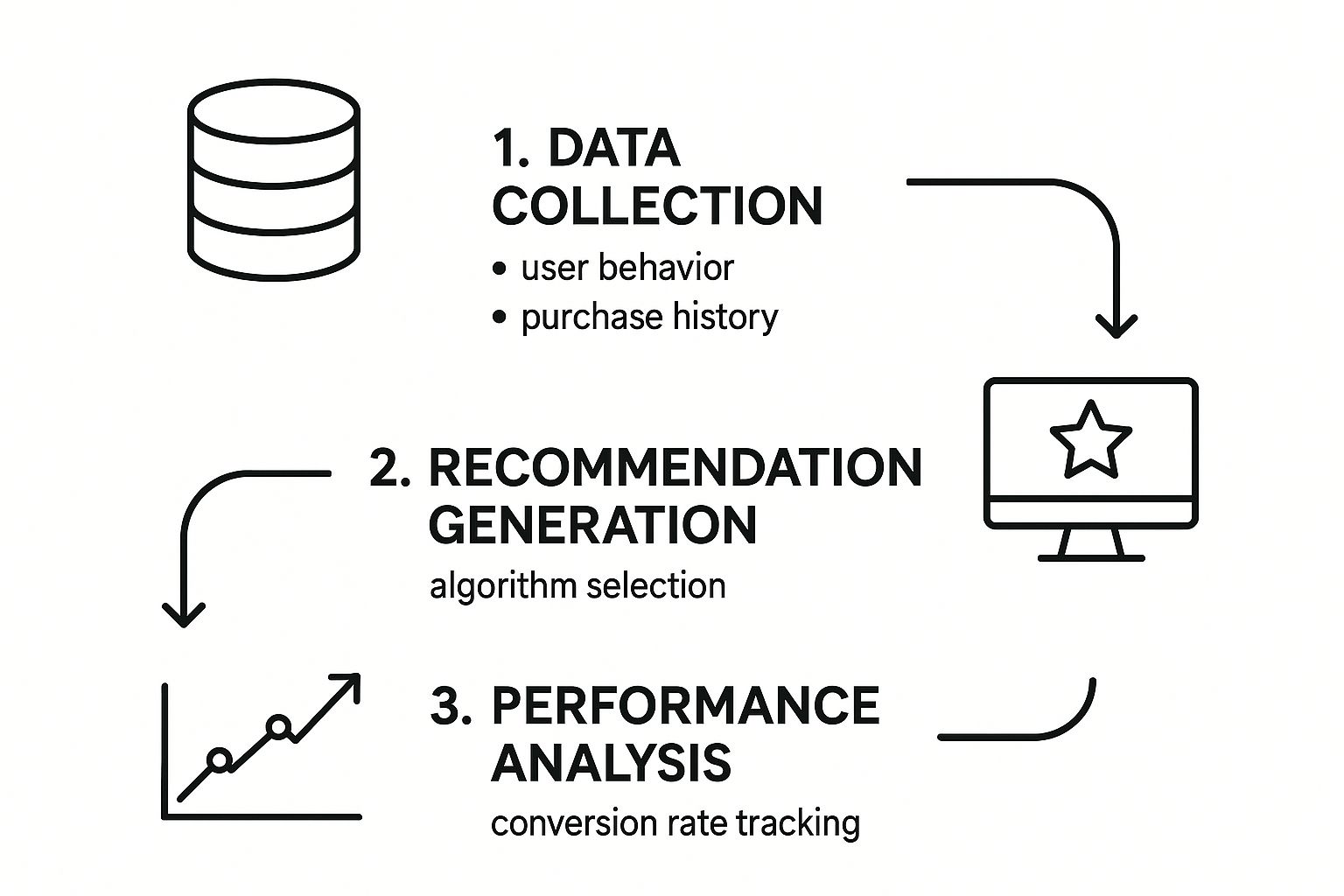
As you can see, optimization isn’t a straight line—it’s a circle. Insights from your performance analysis should directly inform how you generate the next round of suggestions.
Designing Your A/B Tests
Good A/B testing is all about discipline. You have to isolate one variable at a time to really understand its impact. If you change the headline, the number of products, and the algorithm all at once, your results will be a mess. You won't know why things changed. My advice? Start with the simple, high-impact stuff before you dive into the complex algorithm tests.
Consider testing these key variables first:
- Headline Copy: The title of your widget matters more than you think. Test a direct call-to-action like "Complete the Look" against something more personal, like "Inspired by Your Browsing." You’d be surprised how much a small language shift can affect click-through rates.
- Number of Products: Does showing four products work better than six? Too few can limit discovery, but too many can cause choice paralysis. The sweet spot often varies by page and device.
- Visual Presentation: Play around with image sizes, the inclusion of star ratings, or price visibility. The best layout for a desktop user might be totally different for someone on a mobile device.
For example, an online clothing store could test a widget titled "Styled For You" (Version A) against the classic "You Might Also Like" (Version B). After two weeks, they might find "Styled For You" drove a 15% higher click-through rate simply because it felt more personal and curated.
Tracking the Right Performance Metrics
To figure out if your tests are actually working, you need to track the right KPIs. Just looking at clicks is a rookie mistake. You need to know how those clicks translate into actual business value. Your analytics dashboard should become your new best friend.
Make sure you’re focusing on these core metrics:
- Click-Through Rate (CTR): This is your baseline. It tells you what percentage of people who see the recommendations actually click one. It’s a great first indicator of whether people are paying attention.
- Conversion Rate from Recommendations: This is where the rubber meets the road. It tracks how many users who click a recommended product actually end up buying it. This KPI directly ties your efforts to sales.
- Impact on Average Order Value (AOV): You need to know if shoppers who engage with recommendations spend more than those who don't. This is absolutely critical for measuring the success of your cross-sell and upsell placements.
Don’t just scratch the surface. A recommendation widget might have a lower CTR but contribute to a much higher AOV. In that case, it’s actually the more valuable widget, even with fewer clicks. You have to dig into the entire customer journey.
Refining Your Underlying Algorithms
Once you’ve squeezed all the juice out of the low-hanging fruit like copy and layout, it’s time to start testing the recommendation logic itself. This is where you can unlock some truly game-changing results.
Work with your recommendation engine provider or your internal dev team to experiment with different algorithms. For instance, on your cart page, you could A/B test a "collaborative filtering" model (like Frequently Bought Together) against a "personalized" model (Picks For You). You might discover one is far better at driving those last-minute impulse additions, directly boosting your AOV.
This cycle of testing, measuring, and refining is what ensures your strategy keeps up with your customers. It’s the single best way to maximize your ROI and turn your recommendation engine into a core pillar of your e-commerce business.
Common Questions About Product Recommendations
Jumping into product recommendations always kicks up a few questions. Whether you’re worried about data privacy, trying to figure out a budget, or just wondering what a realistic return looks like, you’re not alone. Let's tackle some of the most common hurdles store owners face.
Getting these answers straight helps you move forward with confidence, making sure your decisions line up with your business goals and your customers' expectations.
How Much Does a Good Recommendation Engine Cost?
This is usually the first question on everyone's mind, and the answer is... it depends. The cost varies wildly based on how complex of a solution you need. Think of it like buying a car—you can get a reliable used sedan or a high-performance luxury sports car. Both get you where you're going, but the experience and capabilities are worlds apart.
Your options usually fall into a few buckets:
- Plug-and-Play Apps: For platforms like Shopify or WooCommerce, you can find apps starting from $20 per month and climbing up to several hundred. These are perfect for getting started quickly with minimal tech headaches.
- Mid-Tier SaaS Platforms: More advanced solutions give you greater customization, better AI, and dedicated support. These often use a tiered model based on your traffic or revenue, typically landing between $500 to $5,000 per month.
- Enterprise-Level or Custom Builds: For large retailers with very specific needs, a custom-built engine or an enterprise solution is the way to go. These projects can easily run into the tens of thousands of dollars upfront, plus ongoing maintenance.
The key is to match the solution to your stage of growth. Don't overspend on a system built for a massive enterprise if you're just starting out.
Will This Slow Down My Website?
Website speed is non-negotiable, so this is a completely valid concern. A slow-loading recommendation widget can absolutely torpedo your user experience and SEO rankings. The good news? Most modern recommendation engines are built with performance in mind.
They typically use what's called asynchronous JavaScript. This just means the recommendation widgets load independently from the rest of your page. Your customer sees your main product image and description right away, while the recommendations pop in a split second later in the background.
Before you commit to any provider, ask them for performance benchmarks. Better yet, test their solution on a staging site. A well-built engine should have a negligible impact on your site’s perceived load time.
How Do I Handle Data Privacy and GDPR?
In today's world, data privacy is everything. Customers are savvier than ever about how their data is used, and regulations like GDPR (General Data Protection Regulation) in Europe have strict rules.
To stay compliant and keep your customers' trust, stick to these best practices:
- Be Transparent: Update your privacy policy to clearly explain that you use customer data (like browsing history) to personalize their shopping experience. Explain why you collect it—to serve up more relevant suggestions.
- Use Anonymized Data: Most recommendation engines work with anonymized data. They don’t need to know a customer's name or email to see their browsing patterns. They just need to track User ID #12345.
- Choose Compliant Partners: Make sure any third-party provider you work with is fully GDPR-compliant. They should have clear data processing agreements and solid security measures in place.
Building trust is just as important as building revenue. Being upfront about how you handle data shows respect for your customers and protects your business.
How Long Until I See a Return on Investment?
Patience is a virtue, but you also need to see results. The timeline for a positive ROI really depends on your starting point and traffic volume. Generally, you can expect to see initial data and a lift within the first 30 to 90 days.
Here’s a realistic timeline:
- First 30 Days: This is all about implementation and initial data collection. The AI is in its "learning phase," gathering enough behavioral data to start making intelligent connections. You might see a small lift, but this period is about building the foundation.
- 30-60 Days: You should now have enough data to start running your first A/B tests on things like widget placement or headlines. You'll begin to see measurable increases in click-through rates and conversions from the recommendations.
- 90 Days and Beyond: By now, your engine should be fully dialed in and acting as a consistent revenue driver. This is when you can confidently calculate your ROI by comparing the revenue from recommendations against the cost of the tool. Many stores find that recommendations contribute anywhere from 10% to 30% of their total revenue.
Ready to turn your sales data into your most powerful asset? ApusNest analyzes your customer's buying patterns to uncover hidden cross-sell opportunities and deliver the insights you need to boost your average order value. Start making data-driven decisions today at https://apusnest.com.
Article created using Outrank
