

Did you know that over 60 percent of online stores struggle to interpret their own data effectively? Choosing the right analytics tools can reveal hidden sales opportunities, improve marketing decisions, and increase revenue. From understanding where customers drop off to discovering which products sell best together, turning numbers into clear insights transforms an online business and gives you a stronger edge over your competition.
Table of Contents
- 1. Google Analytics: Track Website Traffic and Conversions
- 2. APUS NEST: Unlock Product Pairing and AOV Insights
- 3. Hotjar: Visualize User Behavior on Your Store
- 4. Glew.io: Unify Data Across Multiple Sales Channels
- 5. Triple Whale: Optimize ROAS for Shopify Stores
- 6. Kissmetrics: Deep Dive into Customer Journeys
- 7. Supermetrics: Automate Reporting Across Platforms
Quick Summary
| Takeaway | Explanation |
|---|---|
| 1. Utilize Google Analytics for insights | Track visitor behavior to optimize your e-commerce performance and marketing strategies. |
| 2. Leverage APUS NEST for product pairing | Discover complementary products to enhance average order value through intelligent bundling recommendations. |
| 3. Implement Hotjar for user behavior visuals | Use heatmaps to visualize where users click and scroll, helping optimize user experience on your site. |
| 4. Integrate Glew.io for data unification | Consolidate sales data from multiple platforms for a comprehensive view of business performance. |
| 5. Use Triple Whale to maximize ROAS | Track advertising performance across channels to enhance return on ad spend and allocate budget effectively. |
1. Google Analytics: Track Website Traffic and Conversions
Unlocking the power of digital insights begins with understanding how customers interact with your online store. Google Analytics provides a comprehensive window into your e-commerce performance by tracking website traffic and measuring critical conversion metrics that can transform your marketing strategy.
At its core, Google Analytics helps you understand who visits your site, how they arrive, and what actions they take. According to research published in an academic study, these analytics can predict user shopping stages and enhance conversion rates by revealing deep behavioral patterns. Key metrics to watch include:
- Visitor traffic volume
- Traffic sources (organic search, paid ads, social media)
- User engagement duration
- Conversion rates
- Bounce rates
To maximize this tool’s potential, connect your e-commerce platform and set up goal tracking for purchases, sign-ups, and other crucial conversions. This allows you to see exactly how visitors move through your sales funnel and identify potential roadblocks.
For deeper insights into understanding how web traffic translates to sales, check out our guide on understanding Google Analytics for ecommerce. By mastering these analytics, you can make data driven decisions that directly impact your store’s revenue and growth.
2. APUS NEST: Unlock Product Pairing and AOV Insights
Transforming raw sales data into powerful revenue strategies requires more than basic reporting. APUS NEST emerges as a game changing AI powered platform designed to help e-commerce businesses uncover hidden opportunities for increasing average order value through intelligent product pairing analysis.
By leveraging advanced market basket analysis, APUS NEST reveals intricate connections between products that most merchants overlook. Research indicates these data driven insights can dramatically enhance product bundling strategies and customer purchase behaviors. Key capabilities include:
- Identifying complementary product relationships
- Predicting cross sell opportunities
- Analyzing purchase pattern correlations
- Recommending optimal product bundles
The platform allows you to upload sales data directly from your e-commerce platform and receive comprehensive insights about which products naturally perform well together. For online store owners seeking to move beyond guesswork and implement strategic product recommendations, our guide to increasing average order value provides actionable strategies to maximize these insights.
By understanding the subtle connections between your product catalog, you can create smarter marketing strategies that encourage customers to add more items to their cart and increase overall revenue per transaction. APUS NEST transforms complex data analysis into clear actionable recommendations that any e-commerce business can implement.
3. Hotjar: Visualize User Behavior on Your Store
Understanding how customers interact with your online store goes far beyond basic website analytics. Hotjar provides a visual and intuitive approach to decoding user behavior through powerful heatmaps and interaction tracking tools that reveal exactly how visitors navigate your e-commerce site.
With Hotjar, you can literally see where customers click, how far they scroll, and what elements capture their attention or cause them to lose interest. Key visualization features include:
- Click heatmaps showing most engaged page areas
- Scroll depth tracking
- Session recordings of user interactions
- Conversion funnel analysis
- User feedback and survey tools
These insights help you optimize your store’s user experience by understanding potential friction points in the customer journey. For online merchants looking to transform website design into a strategic conversion tool, our guide to data visualization best practices can help you interpret these insights effectively.
By watching actual user interactions, you can identify why customers might abandon their cart, which page elements attract the most attention, and how to restructure your site for maximum engagement. Hotjar transforms complex user behavior into clear visual stories that help you make data driven design decisions.
4. Glew.io: Unify Data Across Multiple Sales Channels
Modern e-commerce businesses rarely operate on a single platform anymore. Glew.io emerges as a powerful solution that helps online merchants consolidate and analyze sales data from multiple channels creating a comprehensive view of business performance.
Whether you sell through Shopify, Amazon, Etsy, or multiple marketplaces simultaneously, Glew.io provides a centralized dashboard that integrates disparate data sources into actionable insights. Key integration capabilities include:
- Consolidating sales data from multiple platforms
- Generating cross channel performance reports
- Tracking inventory across different sales channels
- Analyzing customer purchasing behaviors
- Identifying top performing product lines
By breaking down data silos, you gain a holistic understanding of your business performance that goes beyond platform specific limitations. For online entrepreneurs seeking deeper strategic insights, our guide to understanding sales data in marketing can help you leverage these complex analytics effectively.
The real power of Glew.io lies in its ability to transform fragmented sales information into a unified narrative about your business growth. Instead of juggling multiple reports and spreadsheets, you get a clear strategic overview that helps you make informed decisions about inventory, marketing investment, and product development.
5. Triple Whale: Optimize ROAS for Shopify Stores
Every dollar spent on advertising needs to work harder and smarter. Triple Whale provides Shopify merchants a sophisticated analytics platform specifically designed to maximize return on ad spend and uncover nuanced performance insights that traditional tools miss.
By integrating data from multiple advertising platforms including Facebook, Google, and TikTok, Triple Whale creates a comprehensive view of your marketing performance. Key optimization features include:
- Real time ROAS tracking
- Cross channel advertising analytics
- Customer acquisition cost measurement
- Predictive performance modeling
- Comprehensive marketing attribution reporting
The platform goes beyond surface level metrics by helping you understand which marketing channels truly drive profitable customer acquisition. For Shopify store owners looking to transform their advertising strategy, our guide to boosting Shopify sales can provide complementary insights into scaling your online business.
Triple Whale transforms complex advertising data into actionable strategies that help you allocate budget more intelligently. Instead of guessing which ads work, you get precise insights that enable you to double down on high performing campaigns and quickly eliminate underperforming marketing efforts.
6. Kissmetrics: Deep Dive into Customer Journeys
Understanding the intricate path customers take from first click to final purchase is more than data tracking its storytelling. Kissmetrics provides a comprehensive platform that transforms customer interactions into meaningful narratives revealing the true motivation behind buying decisions.
By mapping every touchpoint and interaction across your digital ecosystem, Kissmetrics goes beyond traditional analytics to create a holistic view of customer behavior. Key journey mapping capabilities include:
- Detailed individual customer tracking
- Behavioral segmentation analysis
- Conversion funnel visualization
- Lifetime value prediction
- Personalized engagement insights
The platform allows you to understand not just what customers do but why they make specific choices. For marketers seeking to decode complex customer behaviors, our customer insights analytics guide can provide additional strategic frameworks.
Kissmetrics turns anonymous website visitors into fully understood personas by connecting interactions across devices and platforms. Instead of guessing about customer preferences, you gain a granular understanding of their journey revealing precise moments where you can optimize engagement and increase conversions.
7. Supermetrics: Automate Reporting Across Platforms
Reporting across multiple marketing platforms can quickly become a time consuming nightmare for e-commerce professionals. Supermetrics solves this challenge by seamlessly aggregating data from different marketing channels into a single unified interface that saves hours of manual work.
By automating data collection and integration, Supermetrics eliminates the tedious process of manually pulling reports from various platforms like Google Analytics, Facebook Ads, and Google Ads. Key automation features include:
- Automated data extraction
- Customizable reporting templates
- Real time data synchronization
- Cross platform performance comparison
- Scheduled report generation
The platform transforms complex data management from a time intensive task to a streamlined process that allows marketers to focus on strategy instead of spreadsheet maintenance. For professionals looking to optimize their reporting workflows, our marketing report tools guide can provide additional insights into efficient data management.
Supermetrics essentially acts as a universal translator for your marketing data aggregating insights from different platforms and presenting them in a cohesive format that makes performance analysis intuitive and actionable. Instead of juggling multiple dashboards you get a comprehensive view of your marketing ecosystem at a glance.
Below is a comprehensive table summarizing the key insights and tools discussed throughout the article, focusing on enhancing e-commerce performance through analytics and data-driven strategies.
| Tool | Description | Key Features & Insights |
|---|---|---|
| Google Analytics | Comprehensive platform for tracking website traffic and conversions. | Visitor traffic, traffic sources, conversion rates, bounce rates. |
| APUS NEST | AI-powered platform for product pairing and increasing average order value (AOV). | Complementary product identification, cross-sell opportunities. |
| Hotjar | Visual tool to understand user behavior with heatmaps and interaction tracking. | Click heatmaps, scroll tracking, session recordings, user feedback. |
| Glew.io | Platform to unify and analyze sales data across multiple e-commerce channels. | Sales data consolidation, cross-channel reports, top-performing products. |
| Triple Whale | Analytics platform for optimizing return on ad spend (ROAS) in Shopify stores. | Real-time ROAS, cross-channel analytics, customer acquisition cost. |
| Kissmetrics | Provides a holistic view of customer journeys and behaviors. | Customer journey mapping, behavioral segmentation, lifetime value. |
| Supermetrics | Automated reporting tool for aggregating data from diverse marketing platforms. | Data extraction automation, customizable templates, cross-platform comparison. |
Unlock Hidden Revenue Growth With Advanced E-Commerce Analytics
Many e-commerce store owners struggle with turning vast amounts of sales data into clear strategies that boost average order value and maximize cross-sell opportunities. This article highlights powerful tools like Google Analytics, Hotjar, and Triple Whale that provide valuable insights on traffic, customer behavior, and advertising performance. Yet the true challenge lies in connecting these analytics to actionable product pairing and bundling strategies that drive real revenue growth.
APUS NEST is designed specifically to solve this problem by using AI-driven market basket analysis to reveal hidden relationships within your product catalog. Our platform helps Shopify and WooCommerce merchants uncover complementary products, predict cross-sell potential, and optimize average order value through data-backed recommendations. You can easily upload your sales data and receive detailed reports to transform insights into immediate growth.
Ready to move beyond basic reporting and embrace intelligent product pairing?
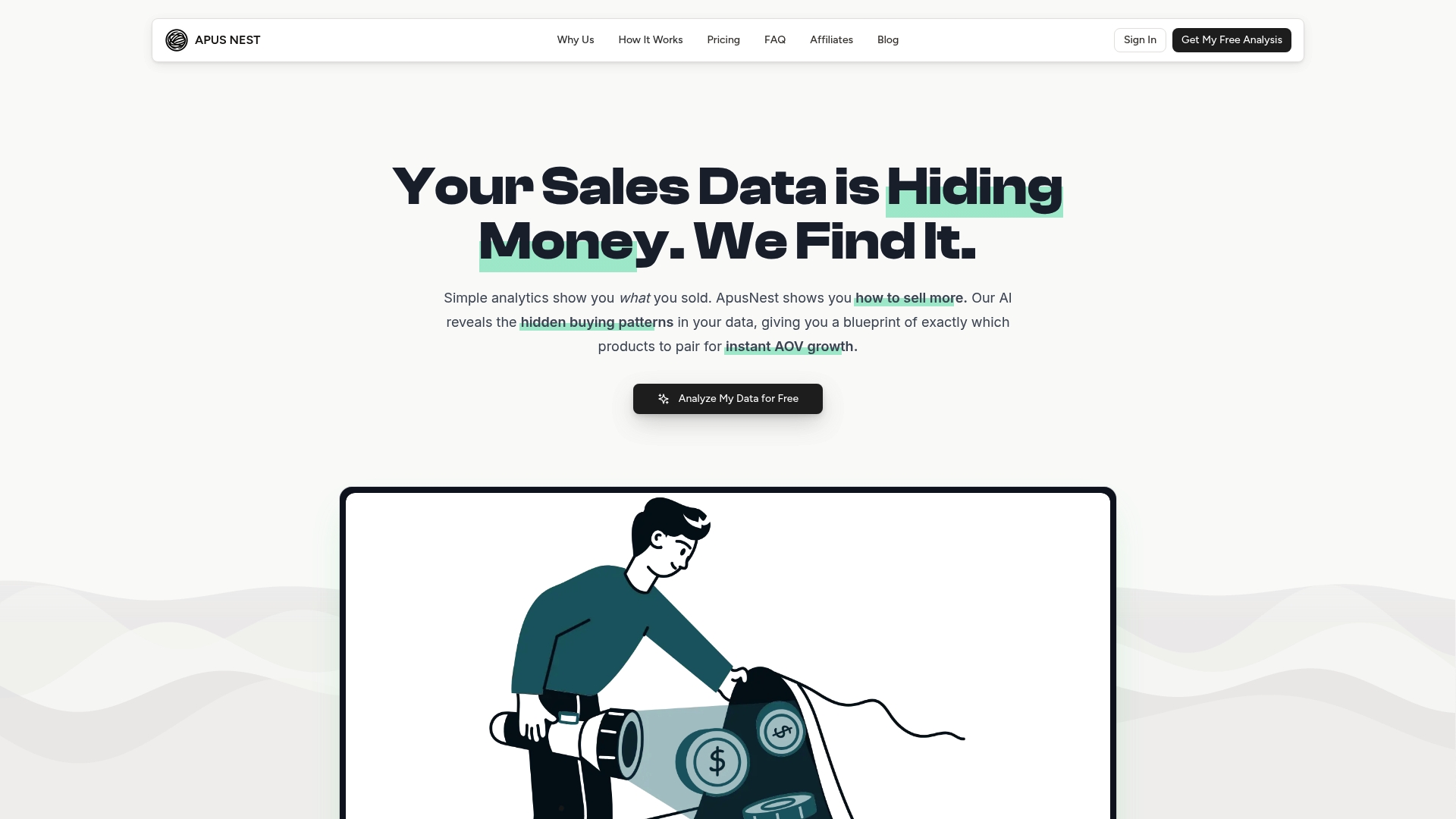
Discover how to unlock your store’s full potential by exploring strategies that increase average order value. Visit APUS NEST now to get started with a free report or explore advanced features that empower you to make confident, data-driven decisions. Learn more with our guide to increasing average order value and see how expert analytics can reshape your marketing approach. Take control of your e-commerce growth today and convert complex analytics into clear revenue opportunities.
Frequently Asked Questions
How can Google Analytics help improve my e-commerce store’s performance?
Google Analytics tracks website traffic and conversion rates, giving you insights into user behavior. Set up goal tracking to measure purchases and sign-ups, and review key metrics like bounce rates and user engagement to identify areas for improvement.
What are the benefits of using APUS NEST for product bundling?
APUS NEST analyzes sales data to reveal product relationships that enhance average order value. Utilize its insights to create complementary product bundles, potentially increasing your sales revenue per transaction by 15-25%.
How can Hotjar’s heatmaps improve user experience on my online store?
Hotjar provides visual data on where users click and scroll, helping you identify engaging content and potential friction points. Use these insights to make design adjustments that enhance navigation and keep customers engaged longer.
What insights can Glew.io provide for managing multiple sales channels?
Glew.io consolidates sales data across platforms, creating a unified dashboard for performance analysis. Leverage this tool to generate cross-channel performance reports and streamline your inventory management processes.
How can Triple Whale help maximize my return on ad spend?
Triple Whale offers real-time tracking of ad performance across various platforms, allowing you to see which channels drive the most profitable customer acquisition. Analyze these insights to adjust your advertising budget allocation effectively and potentially reduce acquisition costs by up to 20%.
What are the main advantages of using Supermetrics for reporting?
Supermetrics automates data collection from different marketing platforms into one interface, saving you time on manual report generation. Use this time to focus on strategy instead, aiming to reduce your reporting workload by approximately 50%.
