
In 2025, e-commerce leaders will gain a decisive edge by harnessing the power of data to reveal hidden buying patterns and fuel smarter business growth. This comprehensive guide to instacart market basket analysis is designed to help you unlock actionable insights that drive measurable results. With access to over 3 million orders and 200,000 users, Instacart’s dataset offers unparalleled opportunities to understand customer behavior and optimize your strategy. Discover how to analyze data, interpret results, and leverage findings for increased sales, sharper segmentation, and more effective recommendations. Follow this guide to stay ahead of competitors and achieve success in the evolving e-commerce landscape.
Understanding Instacart Data and Market Basket Analysis
To succeed with instacart market basket analysis in 2025, it is essential to first grasp the structure and nuances of the underlying data. A deep understanding of how Instacart’s dataset is organized, as well as the fundamentals of market basket analysis, provides the foundation for actionable insights and competitive advantage.
Overview of Instacart’s Dataset
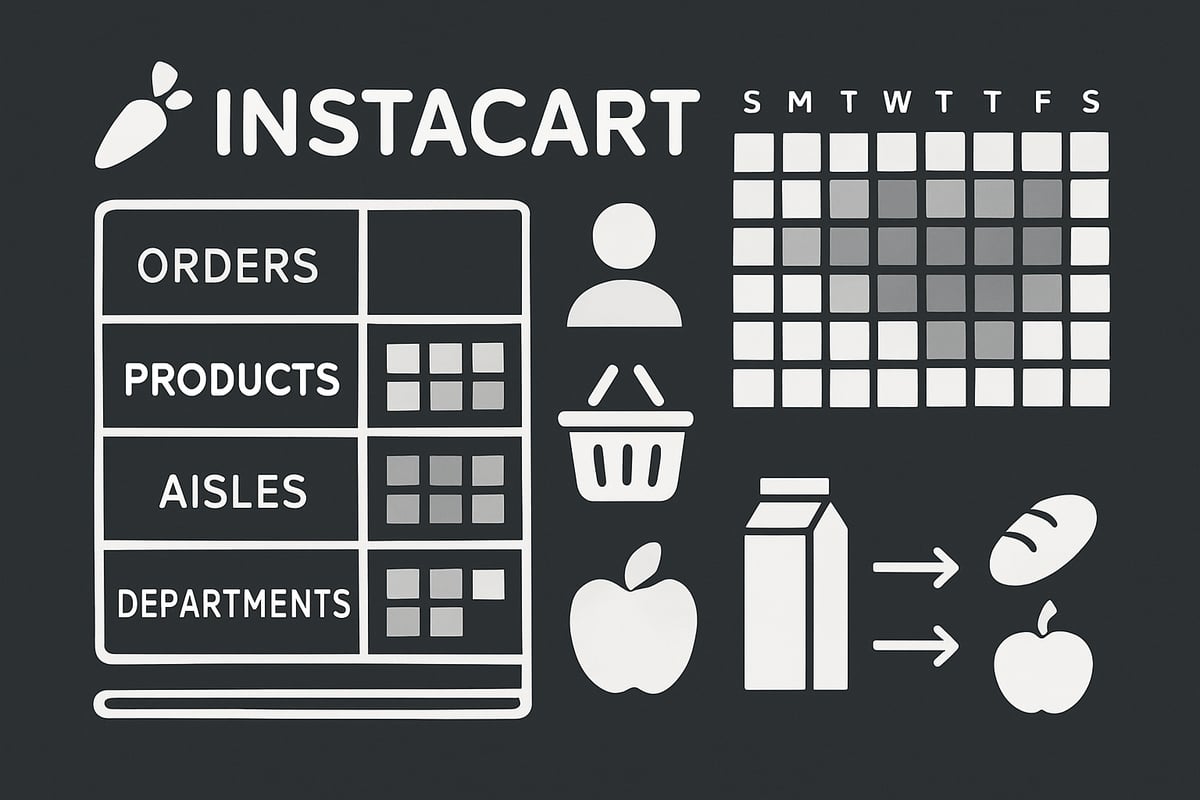
Instacart’s dataset is a rich resource for instacart market basket analysis, featuring more than 3 million orders from over 200,000 users. The data is organized into multiple tables, each capturing a different aspect of the grocery shopping experience. Here’s a simplified overview:
| Table | Description | Key Figures |
|---|---|---|
| Orders | Contains details about each order | 3+ million orders |
| Products | List of all available products | Nearly 50,000 products |
| Aisles | Product groupings within the store | 134 aisles |
| Departments | Higher-level product categories | 21 departments |
| Order-Product | Links products to specific orders | Millions of relationships |
The dataset is split into prior, train, and test sets. The prior set holds historical orders, the train set is used for training models, and the test set is for evaluating predictions. Purchase frequency patterns emerge, with clear weekly cycles and peak ordering times on weekends and evenings. Visualizations like heatmaps are useful to spot these trends, revealing when customers are most active.
Understanding these details is vital. Data quirks, such as how repeat orders are logged or how aisles are grouped, can significantly affect the accuracy of your instacart market basket analysis. For a deeper dive into dataset schema and statistics, see this Instacart Dataset Structure and Statistics resource.
What is Market Basket Analysis?
Market basket analysis is a core technique in e-commerce analytics. It helps uncover relationships between products by analyzing which items are purchased together in a single shopping session. With instacart market basket analysis, the goal is to reveal hidden affinities that can inform cross-selling, bundling, and recommendation systems.
At the heart of market basket analysis are association rules. These rules take the form “if a customer buys X, they are likely to buy Y.” The strength of these rules is measured using:
- Support: Frequency of the itemset in all transactions.
- Confidence: Probability of purchasing Y given X is bought.
- Lift: How much more likely Y is bought with X, compared to random chance.
For instance, if 15% of shoppers who buy “organic strawberries” also buy “bananas,” and this is much higher than average, the rule has high lift. These metrics enable businesses to prioritize which product pairings are most actionable.
Platforms like Instacart use these insights to boost average order value and retention by recommending relevant items at checkout or through personalized marketing.
Business Value of Market Basket Analysis for 2025
The business impact of instacart market basket analysis continues to grow as e-commerce evolves. By identifying product affinities, retailers can optimize marketing, improve cross-selling strategies, and personalize recommendations for each customer segment.
Competitors leverage these insights to predict next likely purchases, enabling timely and relevant offers that drive conversion. For example, if a customer frequently buys granola and almond milk together, targeted promotions or curated bundles can increase both satisfaction and sales.
However, challenges remain. The sheer volume of data, changing consumer preferences, and seasonal fluctuations require robust, scalable analysis methods. It is also crucial to regularly revisit and update your instacart market basket analysis as shopping patterns shift.
By mastering these fundamentals, you set the stage for more advanced techniques and ensure your business makes data-driven decisions that matter in 2025.
Step-by-Step Instacart Market Basket Analysis Process
Embarking on an instacart market basket analysis journey requires a methodical approach. By following a structured process, businesses can extract actionable insights that transform raw data into strategic value. Below, we break down each step to ensure your analysis is robust, reliable, and ready to drive results.
Step 1: Data Preparation and Cleaning
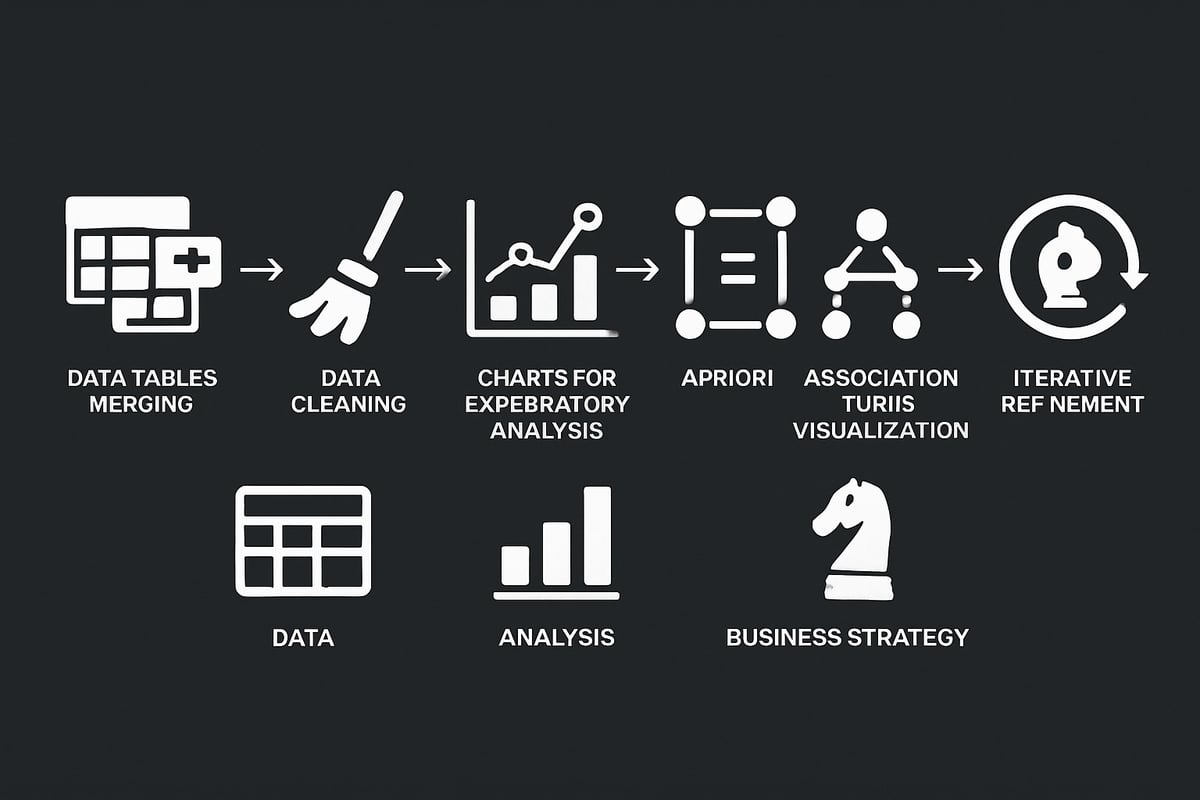
The foundation of any instacart market basket analysis is clean, well-organized data. Begin by importing all relevant Instacart datasets, such as orders, products, aisles, and departments. Merging these tables creates a unified view, linking each product to its department and aisle for deeper insights.
Next, address missing values and data inconsistencies. Remove or impute incomplete entries, and standardize product names or identifiers. Focus on the "prior" orders dataset, as it contains historical transactions crucial for pattern discovery.
Filtering out irrelevant or duplicate transactions ensures only meaningful data is analyzed. For example, exclude orders with very few products or users with only one purchase. This step sharpens the focus of your instacart market basket analysis, increasing reliability.
Data quality is paramount. A well-prepared dataset not only streamlines subsequent steps but also prevents misleading conclusions. Investing time here pays dividends in the accuracy and usefulness of your results.
Step 2: Exploratory Data Analysis (EDA)
With data cleaned, the next phase of instacart market basket analysis is exploratory data analysis. EDA uncovers patterns and guides the direction of deeper investigation.
Analyze order frequencies, identifying top products and common basket sizes. Visualize when customers shop by plotting orders by day of the week and hour of the day. Such heatmaps often reveal peaks on weekends and evenings, which can inform timing for campaigns.
Segment customers based on behavior, such as frequency of purchase or average basket size. Cluster analysis or simple groupings can highlight different user types, from weekly regulars to occasional buyers.
Use these insights to shape your approach to association rule mining. For a practical demonstration of EDA and its impact, see this market basket analysis example. By understanding the data’s nuances, you ensure the instacart market basket analysis is tailored to your business objectives.
Step 3: Applying Market Basket Analysis Algorithms
Once EDA reveals key trends, apply market basket analysis algorithms to discover associations. The two most popular choices are Apriori and FP-Growth. Both are suited for large datasets like Instacart, but FP-Growth is often more efficient with massive transaction volumes.
Set thresholds for support, confidence, and lift to focus on significant itemsets. For example, require a minimum support of 0.01 to ensure rules are based on a meaningful portion of orders. Adjust confidence and lift to prioritize actionable relationships.
Run the chosen algorithm on your cleaned dataset. This process identifies frequent itemsets and generates association rules, such as "customers who buy organic milk also buy bananas." Computational challenges may arise due to data size, so consider parallel processing or sampling if needed.
A summary table can help compare algorithm options:
| Algorithm | Pros | Cons |
|---|---|---|
| Apriori | Simple, interpretable | Slower with big data |
| FP-Growth | Fast, scalable | More complex setup |
Selecting the right tool ensures your instacart market basket analysis is both thorough and efficient.
Step 4: Interpreting Association Rules and Results
The next step in instacart market basket analysis is interpreting the association rules. Focus on rules with high lift and confidence, as these indicate strong, actionable relationships between products.
For instance, a rule like "Organic Strawberries → Banana" with 0.05 support and 2.1 lift means a significant overlap and increased likelihood of co-purchase. Prioritize such patterns for cross-selling or bundling strategies.
Filter out rules that are either too obvious or not actionable, such as items always bought together due to promotions. Look for seasonal or segment-specific trends, which can inform targeted campaigns.
Prepare your results in a clear format for business stakeholders. Visualizations such as network graphs or simple tables can make complex associations understandable and ready for deployment in marketing or recommendation systems.
Step 5: Validating and Refining Insights
Validation ensures that your instacart market basket analysis delivers results that stand up to real-world application. Test your association rules on holdout data or different time periods to check consistency.
Simulate how implementing a rule, like recommending a commonly paired product, affects cross-sell rates. Use A/B testing or historical simulations to measure impact. Iteratively refine your analysis by adjusting thresholds or segmenting customers further.
Compare rules across different customer groups to identify unique affinities. As purchasing behavior evolves, revisit your analysis regularly to keep insights current.
Maintaining a cycle of validation and refinement ensures your strategies remain effective, and your instacart market basket analysis keeps driving business growth.
Leveraging Market Basket Insights for Business Growth
Unlocking the full potential of instacart market basket analysis can transform business outcomes in e-commerce. By moving from raw data to strategic action, companies gain a critical edge in 2025. The following approaches show how to translate analytical findings into measurable growth.
Translating Insights into Actionable Strategies
The insights from instacart market basket analysis empower organizations to optimize product recommendations and boost average order value. When high-frequency product pairings are identified, businesses can create targeted cross-sell and upsell campaigns. For example, if data shows "organic strawberries" and "bananas" are often purchased together, these items can be bundled or promoted as a package.
Retailers also use these findings to refine store layouts, both online and in physical locations. By placing commonly paired products near each other, the shopping experience becomes more intuitive, encouraging larger baskets. Personalized marketing messages, shaped by market basket insights, increase conversion rates by suggesting relevant items at the right time.
Key strategies include:
- Bundling products with high co-purchase rates
- Featuring recommendations based on recent customer orders
- Creating limited-time offers for complementary items
With instacart market basket analysis, every recommendation is grounded in proven buying patterns, ensuring marketing efforts are both efficient and effective.
Customer Segmentation and Personalization
Segmentation is a cornerstone of successful e-commerce. Instacart market basket analysis enables businesses to divide their customers into meaningful groups based on purchase frequency, basket composition, and preferred product categories. This approach ensures that offers and communications are tailored for maximum relevance.
For example, weekend shoppers can be targeted with time-sensitive promotions, while loyal customers who frequently buy certain brands receive exclusive deals. By leveraging detailed segmentation, companies improve customer retention and drive repeat purchases.
Competitors are increasingly using advanced affinity analysis and clustering to fine-tune their personalization efforts. For practical approaches to segmentation, see customer segmentation examples in e-commerce.
The result is a more engaging, customized shopping journey that keeps customers coming back. Instacart market basket analysis provides the insights needed to build these targeted experiences.
Measuring the Impact of Market Basket Strategies
To ensure that insights from instacart market basket analysis are driving business growth, it is essential to measure performance using clear KPIs. Common metrics include average order value (AOV), conversion rate, cross-sell rate, and customer retention.
A/B testing is a practical way to compare new recommendation engines or bundling strategies against existing methods. For instance, after implementing association-based campaigns, businesses can track revenue uplift and customer engagement to assess effectiveness.
A simple KPI tracking table:
| Metric | Goal | Measurement Method |
|---|---|---|
| Average Order Value | Increase by 10% | Pre vs. post analysis |
| Conversion Rate | Boost by 5% | A/B testing |
| Cross-sell Rate | Raise by 15% | Recommendation impact |
| Retention | Improve by 8% | Repeat purchase cohort |
Continuous, data-driven refinement ensures that instacart market basket analysis delivers ongoing value. Teams should revisit insights regularly and adjust strategies as customer preferences evolve.
How AI-Powered Tools Like ApusNest Accelerate Market Basket Analysis
AI-driven platforms are revolutionizing instacart market basket analysis for modern e-commerce. These tools automate complex data processing, generate actionable reports, and offer seamless integration with major platforms.

Key benefits include rapid setup, strong data privacy, and exportable insights without ongoing subscription costs. Businesses can quickly identify optimal product pairings, enhance marketing campaigns, and boost AOV.
With AI-powered solutions, companies stay agile and competitive, adapting to market changes and maximizing growth through smart, scalable analytics.
Advanced Techniques and Future Trends in Market Basket Analysis
Staying ahead in e-commerce requires a forward-thinking approach to instacart market basket analysis. With rapid advancements in technology, businesses need to leverage machine learning, real-time analytics, and scalable solutions to maintain their edge. Let’s explore how advanced techniques are shaping the future of basket analysis and what strategies will matter in 2025.

Incorporating Machine Learning and Predictive Analytics
Machine learning is revolutionizing instacart market basket analysis by moving beyond simple association rules. Advanced models like neural networks, LSTM, and XGBoost can predict what a customer is likely to buy next, leveraging sequence data and user history. For example, LSTM models capture the order in which products are purchased, enabling highly accurate next-product recommendations.
Unsupervised learning techniques, such as LDA and Word2Vec, help extract deeper product and user features, revealing affinities that traditional approaches may miss. Dynamic embeddings allow platforms to personalize suggestions at scale, adapting to changing user behavior.
For practical insights and a look at real-world projects, the Instacart Data Analysis Project offers a hands-on example of using predictive analytics to forecast future orders and understand purchasing patterns.
Real-Time and Sequential Market Basket Analysis
The evolution of instacart market basket analysis is shifting toward real-time data processing. By analyzing transactions as they occur, businesses can make time-sensitive recommendations and capture sequential purchase patterns. This approach is vital for delivering relevant offers based on what customers have just bought or viewed.
Capturing the sequence of purchases enables platforms to identify trends such as seasonal preferences or changes in shopping habits. For instance, if a user buys bread and peanut butter in one order, the system can suggest jam in the next session, increasing the likelihood of a purchase.
Implementing real-time analysis requires robust infrastructure, including parallel processing and optimized algorithms. These technologies ensure that insights remain actionable even as data volumes grow.
Addressing Challenges: Data Volume, Privacy, and Interpretability
Handling the scale of instacart market basket analysis poses significant challenges. Massive transaction volumes demand efficient algorithms and scalable data pipelines. Parallel processing and distributed computing are essential for processing millions of orders quickly.
Data privacy is also a top priority. Businesses must comply with regulations and safeguard customer information, especially as data sharing and cross-platform analysis become more common. Techniques like differential privacy and secure multiparty computation are increasingly important.
Interpretability remains a key concern. While complex models offer better predictions, business users need clear, actionable rules. Providing transparent explanations ensures that teams can trust and act on insights, closing the gap between advanced analytics and practical business value.
Preparing for the Future: Trends for 2025 and Beyond
Instacart market basket analysis is entering a new era, marked by omnichannel integration and explainable AI. Businesses will increasingly analyze baskets across online, in-store, and mobile touchpoints, creating unified customer profiles. Integration with loyalty programs and in-app experiences will drive higher engagement and retention.
Explainable AI is gaining traction, making analytics more accessible and trustworthy for decision-makers. Regular model updates and agile analytics practices will be crucial as consumer behaviors continue to evolve rapidly.
To dive deeper into upcoming strategies and machine learning advancements, explore these advanced market basket analysis strategies that highlight techniques shaping the future of e-commerce.
Businesses that embrace these advanced approaches to instacart market basket analysis will be best positioned to anticipate customer needs, create personalized experiences, and achieve lasting growth in 2025.
Best Practices and Expert Tips for Instacart Market Basket Analysis Success
Success with instacart market basket analysis requires more than just running algorithms. It depends on a combination of strategic planning, technical rigor, and ongoing adaptation. By following proven best practices, businesses can ensure their analysis yields actionable and sustainable results.
Define Clear Business Objectives
Start by clarifying what success looks like for your instacart market basket analysis project. Are you aiming to boost average order value, improve customer retention, or optimize product recommendations? Setting measurable goals allows you to focus efforts and measure impact.
- Define KPIs before analysis begins.
- Align objectives with overall business strategy.
- Involve stakeholders to set realistic targets.
Maintain Rigorous Data Hygiene
Clean, accurate data is the foundation of effective instacart market basket analysis. Inconsistent or outdated datasets can lead to misleading patterns and poor business decisions.
- Regularly check for missing or duplicate values.
- Standardize product and customer identifiers.
- Use automated scripts to validate data quality.
# Example: Remove duplicates in order-product data
orders = orders.drop_duplicates(subset=['order_id', 'product_id'])
For a comprehensive approach to data preprocessing and visualization, consult this Introduction to Market Basket Analysis.
Balance Actionability and Precision
Avoid generating overly complex or hyper-specific rules in your instacart market basket analysis. Focus on insights that are both statistically significant and practically useful for business teams.
- Set appropriate support and confidence thresholds.
- Filter out rules with low lift or limited business relevance.
- Prioritize rules that align with current marketing or merchandising goals.
Foster Cross-Functional Collaboration
Instacart market basket analysis is most impactful when analytics, marketing, and product teams work together. Diverse perspectives help translate data insights into effective campaigns and product strategies.
- Hold regular meetings to review findings.
- Encourage feedback from end users and decision-makers.
- Document insights in shared dashboards or knowledge bases.
Monitor, Iterate, and Measure Impact
The e-commerce landscape evolves rapidly, so instacart market basket analysis should be an ongoing process. Use dashboards to track performance, run A/B tests, and refine your approach based on results.
| Best Practice | Action Step | Outcome |
|---|---|---|
| Set objectives | Define KPIs and goals | Focused analysis |
| Ensure data hygiene | Clean and validate datasets | Reliable insights |
| Actionable rule selection | Set thresholds and filter rules | Practical recommendations |
| Cross-team collaboration | Involve stakeholders in interpretation | Holistic business impact |
| Monitor and iterate | Use dashboards, A/B tests, and feedback loops | Continuous improvement |
Stay Current and Learn from the Community
Keep up to date with the latest tools, algorithms, and industry benchmarks. Engage with open-source projects, participate in Kaggle competitions, and learn from experts who have tackled instacart market basket analysis at scale.
For advanced segmentation strategies and practical examples, review Instacart Users Segmentation and Analysis.
Embrace a continuous improvement mindset. Regularly revisit your processes, update your models, and incorporate new data to ensure your instacart market basket analysis remains relevant and drives long-term business success.
