

Most online stores chase bigger profits by driving more traffic, but the real secret often sits right under their noses. Average order value reveals customer spending patterns and purchasing behaviors far beyond a basic sales figure. Cramming more products into the cart does not always mean you need more shoppers dropping by. Sometimes the smartest growth play is making each order worth more, with shifts so simple they get overlooked.
Table of Contents
Quick Summary
| Key Point | Explanation |
| 1. Analyze Current Average Order Value | Gather sales data to understand customer spending patterns, guiding strategies for increasing profitability. |
| 2. Identify Upsell and Cross-sell Opportunities | Examine purchase data to uncover complementary products that enhance customer experience and revenue. |
| 3. Implement Effective Product Bundles | Create strategic bundles of complementary products with perceived savings to encourage larger purchases. |
| 4. Optimize Pricing and Promotions | Design pricing strategies, such as tiered discounts, to incentivize higher spending without feeling manipulative. |
| 5. Enhance the Checkout Experience | Simplify checkout and use product recommendations to reduce friction and encourage additional purchases. |
Step 1: Analyze Your Current Average Order Value
Analyzing your current Average Order Value (AOV) is the critical foundation for any strategic revenue enhancement plan. This initial step transforms raw sales data into a powerful roadmap for increasing your e-commerce store’s profitability. By understanding precisely where your current order values stand, you can craft targeted strategies that directly boost your bottom line.
To begin calculating your AOV, gather comprehensive sales data from your e-commerce platform. You’ll want to compile total revenue and divide it by the total number of orders within a specific timeframe, typically a month or quarter. For most online retailers, this calculation reveals insights far beyond a simple number. It provides a snapshot of customer spending patterns and purchasing behaviors.
Accurately tracking AOV requires accessing your platform’s analytics dashboard or utilizing specialized e-commerce reporting tools. Shopify, WooCommerce, and similar platforms typically offer built-in reporting features that make this process straightforward. Discover more about interpreting your sales metrics to ensure you’re extracting maximum value from your data.
Pay attention to potential variations in your AOV across different customer segments, product categories, and marketing channels. Some segments might demonstrate significantly higher order values, indicating opportunities for targeted upselling or cross-selling strategies. By segmenting your data, you transform a basic metric into a strategic insights tool.
As you analyze your current AOV, look for these key indicators:
-
Seasonal fluctuations in order values
-
Differences in AOV between new and returning customers
-
Product combinations that consistently drive higher order values
Remember, this initial analysis sets the stage for all subsequent revenue optimization efforts. Your AOV isn’t just a number it’s a powerful lens through which you can view your store’s revenue potential. The more precisely you understand your current performance, the more effectively you can design strategies to incrementally increase customer spending.
Successful AOV analysis means having a clear, objective understanding of your current sales landscape, ready to implement targeted improvements in the subsequent steps of your revenue enhancement journey.
Step 2: Identify Upsell and Cross-sell Opportunities
Identifying upsell and cross-sell opportunities is the strategic bridge between understanding your current Average Order Value and actually increasing it. This critical step transforms your sales approach from passive to proactive, using data-driven insights to encourage customers to spend more with each transaction. The goal is to recommend complementary or upgraded products that genuinely enhance the customer’s purchasing experience.
Begin by analyzing your existing transaction data to uncover natural product relationships. Look for patterns where certain items are frequently purchased together or where customers consistently upgrade to premium versions of products. Learn more about advanced cross-sell strategies to refine your approach and maximize revenue potential.
Customer purchase history provides the most valuable intelligence for developing upsell and cross-sell strategies. Examine which product combinations generate the highest combined value and create logical bundles or recommendations. For instance, if customers buying running shoes frequently purchase moisture-wicking socks in subsequent transactions, you can proactively suggest these complementary items during the initial purchase process.
Technology plays a crucial role in identifying these opportunities. Utilize product recommendation engines that leverage machine learning to suggest personalized upsells based on individual customer behavior. These systems analyze historical purchasing patterns, browsing history, and product relationships to generate highly targeted suggestions that feel natural and helpful rather than intrusive.
Consider these strategic approaches for identifying upsell and cross-sell opportunities:
-
Examine product purchase frequency and combined transaction values
-
Analyze customer segmentation and buying behaviors
-
Review product category interactions and natural complementary items
Successful upsell and cross-sell identification requires a nuanced understanding of your product ecosystem. It’s not about pushing random additional purchases, but creating meaningful value propositions that genuinely improve the customer’s experience. By carefully mapping product relationships and understanding customer needs, you transform simple transactions into strategic revenue-generation opportunities.
Below is a comparison table summarizing key upsell, cross-sell, and product bundling techniques with examples and their main objectives to help clarify the differences among these methods.
| Strategy | Description | Example | Objective |
| Upsell | Recommending a higher-end version of a product | Suggesting a premium laptop instead of a basic model | Increase order value per item |
| Cross-sell | Suggesting complementary products during purchase | Recommending socks when buying running shoes | Boost combined transaction value |
| Product Bundle | Combining multiple products into a discounted package | Offering a camera, bag, and memory card together | Encourage larger multi-item buys |
| Tiered Promotion | Incentivizing spending with increasing discounts | 5% off at $50, 10% off at $100 | Motivate higher-cart totals |
| Free Shipping Threshold | Setting a minimum spend for free shipping | Free shipping on orders over $75 | Push customers to add extra items |
Step 3: Implement Compelling Product Bundles
Implementing compelling product bundles represents a powerful strategy for increasing average order value by creating irresistible purchasing opportunities that provide genuine value to customers. Bundles transform individual product transactions into more comprehensive, attractive shopping experiences that motivate customers to spend more while feeling they are receiving an exceptional deal.
Learn advanced techniques for creating effective product bundles that drive revenue and customer satisfaction. The art of crafting successful bundles goes beyond simply grouping random products together. It requires a strategic approach that considers complementary items, customer preferences, and perceived value.
Start by analyzing your product catalog to identify natural product pairings that solve customer problems or enhance user experience. For example, a camera bundle might include additional memory cards, a protective case, and a cleaning kit. These combinations should feel intuitive and provide clear added value beyond individual product purchases. The key is creating bundles that feel like thoughtful solutions rather than forced sales tactics.
Pricing strategy plays a crucial role in bundle effectiveness. Offer a modest discount that makes the bundle feel like a compelling deal without undermining the perceived quality of individual products. Typically, a 10-15% discount on bundled items creates sufficient motivation for customers to increase their order value. Experiment with different pricing structures and monitor customer response to find the optimal approach for your specific product mix.
Consider these essential bundle implementation strategies:
-
Focus on complementary products that enhance each other
-
Create tiered bundle options with varying price points
-
Highlight the total savings compared to individual purchases
Successful bundle implementation requires continuous refinement. Regularly analyze bundle performance, track customer feedback, and be prepared to adjust your offerings. By treating product bundling as a dynamic, data-driven process, you can create increasingly sophisticated strategies that drive higher average order values while delivering genuine value to your customers.

Step 4: Optimize Pricing and Promotions for AOV
Optimizing pricing and promotions represents a nuanced approach to strategically increasing your average order value by creating intelligent incentive structures that motivate customers to spend more. The goal is to design pricing strategies that feel like opportunities rather than manipulations, encouraging customers to perceive additional spending as valuable rather than coercive.
Explore advanced market basket analysis techniques to refine your promotional approach. Psychological pricing strategies play a critical role in this optimization process. Consider implementing techniques like tiered discounts, where customers receive incrementally better deals as their total purchase value increases. For instance, offering a 5% discount at $50, 10% at $100, and 15% at $150 creates a clear incentive for customers to add more items to their cart.
Dynamic pricing represents another sophisticated approach to AOV optimization. By leveraging real-time data and customer segmentation, you can create personalized pricing scenarios that adapt to individual purchasing behaviors. This might involve offering specific customers targeted promotions based on their historical purchasing patterns, product preferences, or overall customer lifetime value.
Free shipping thresholds serve as a powerful psychological trigger for increasing order values. Most customers will happily add an extra item to their cart to qualify for free shipping, effectively increasing their total purchase amount. Set your free shipping threshold slightly above your current average order value to encourage customers to stretch their spending.
Consider these strategic pricing optimization techniques:
-
Implement volume-based discounts that reward larger purchases
-
Create time-limited promotions that incentivize immediate higher-value transactions
-
Use price anchoring to make higher-priced bundles seem more attractive
Successful pricing optimization requires continuous experimentation and data analysis. Regularly review your pricing strategies, track customer response, and be prepared to make swift adjustments.
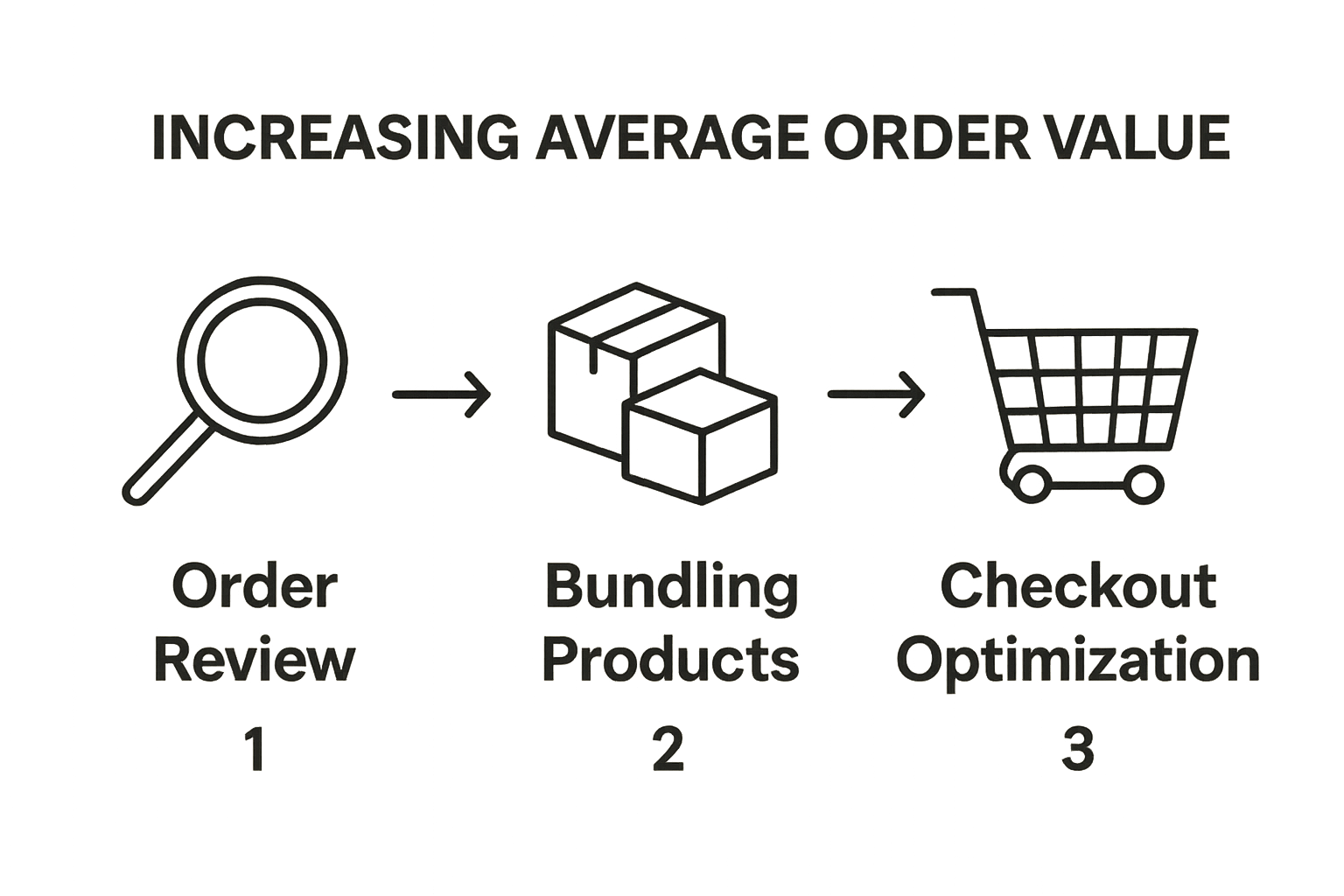 By treating pricing as a dynamic tool rather than a static element, you can create a responsive system that consistently drives higher average order values while maintaining customer satisfaction and perceived value.
Step 5: Enhance the Checkout Experience
Enhancing the checkout experience represents the final critical step in strategically increasing your average order value. This phase transforms the transaction from a potential point of friction into an opportunity for additional revenue generation. The checkout process is not merely a functional necessity but a strategic touchpoint where carefully designed elements can significantly influence customer spending behavior.
Discover proven strategies to optimize your e-commerce sales funnel and create a seamless purchasing journey. Begin by simplifying the checkout interface, removing unnecessary steps that might cause customer hesitation. A clean, intuitive design reduces cart abandonment and creates psychological space for customers to consider additional purchases. Implement progress indicators that show customers exactly how close they are to completing their transaction, which reduces anxiety and increases the likelihood of finalizing the purchase.
Integrate intelligent product recommendations directly into the checkout workflow. These suggestions should be highly relevant, based on the items already in the customer’s cart. The key is presenting complementary products that solve additional problems or enhance the utility of existing selections. Position these recommendations subtly yet prominently, ensuring they feel like helpful suggestions rather than aggressive upsells.
Consider implementing flexible payment options that make larger purchases more accessible. Buy now, pay later services and transparent installment plans can psychologically reduce the perceived financial barrier, encouraging customers to add more items to their cart. These options transform potentially intimidating larger purchases into manageable transactions that feel within reach.
Consider these strategic checkout enhancement techniques:
-
Minimize form fields to reduce cognitive load
-
Offer multiple payment and financing options
-
Display trust signals like security badges and customer reviews
Successful checkout optimization requires continuous testing and refinement. Regularly analyze your checkout conversion rates, gather user feedback, and be prepared to make incremental improvements. By treating the checkout experience as a dynamic, customer-centric process, you can create a seamless journey that not only facilitates transactions but actively encourages higher-value purchases.
Step 6: Monitor and Adjust Strategies Based on Results
Monitoring and adjusting strategies based on results transforms average order value optimization from a static process into a dynamic, responsive system. This final step ensures your revenue enhancement efforts remain agile and aligned with evolving customer behaviors and market conditions. The key is establishing a robust analytical framework that allows for continuous learning and strategic refinement.
Explore comprehensive sales analysis techniques to develop a sophisticated approach to tracking performance. Begin by implementing a comprehensive tracking system that captures granular data across multiple dimensions. This includes not just overall average order value, but detailed metrics like conversion rates for different product bundles, the effectiveness of specific promotional strategies, and customer segmentation insights.
Utilize advanced analytics tools that provide real-time dashboards and automated reporting. These platforms can help you quickly identify trends, anomalies, and opportunities that might otherwise go unnoticed. Pay close attention to leading indicators that signal potential shifts in customer purchasing behavior. For instance, a gradual decline in bundle acceptance rates might indicate that your current product combinations need reevaluation.
Develop a systematic approach to strategy adjustment that balances data-driven insights with strategic intuition. This means setting clear performance benchmarks, establishing regular review intervals, and creating a responsive mechanism for implementing changes. Quarterly reviews provide an excellent cadence for comprehensive strategy assessment, allowing sufficient time to gather meaningful data while preventing stagnation.
Consider these critical monitoring and adjustment techniques:
-
Establish clear key performance indicators for average order value
-
Create a structured process for quarterly strategy reviews
-
Develop a flexible implementation framework for quick strategy pivots
Successful monitoring is not about perfection but continuous improvement. Embrace a mindset of experimentation, where each strategy adjustment is viewed as a learning opportunity. By maintaining a disciplined yet adaptive approach, you can create a resilient system that consistently drives higher average order values while remaining responsive to the dynamic nature of e-commerce markets.
The following checklist table summarizes essential steps and critical focus areas for monitoring and adjusting your average order value strategy, ensuring a disciplined and data-driven approach to continual improvement.
| Task | Description | Frequency |
| Set Key Performance Indicators (KPIs) | Establish clear benchmarks for AOV and related metrics | Initial setup |
| Track Bundle & Promo Effectiveness | Monitor conversion rates and performance for each strategy | Monthly/Quarterly |
| Analyze Customer Segments | Review how different customers respond to interventions | Quarterly |
| Conduct Strategy Review | Systematic evaluation of overall approach and tactics | Quarterly |
| Implement Strategic Adjustments | Update strategies and offers based on insights | As needed |
| Gather User Feedback | Collect real customer feedback on new features/offers | Ongoing |
Ready to Turn Your Data Into Higher Order Values?
If you have followed the steps to increase Average Order Value but still feel uncertain about where the real opportunities lie, you are not alone. Many store owners struggle to pinpoint which product combinations actually drive bigger sales or how to optimize bundles that customers cannot resist. The frustration of guesswork and slow results can slow down your growth and leave money on the table. If your goal is to truly unlock hidden revenue, master upsells, and make each checkout count, you need more than just ideas. You need real data-driven clarity.
Take action today and see how APUS NEST can transform your e-commerce results with powerful market basket analysis and AI-driven product insights. Upload your sales data for a free report that reveals product pairing opportunities and actionable recommendations. If you’re ready to go further and make every promotional dollar work harder, review our detailed analytics and advanced cross-sell strategies. The sooner you secure these insights, the faster you will boost your sales and achieve your AOV goals. Visit APUS NEST now to claim your edge in e-commerce.
Frequently Asked Questions
What is Average Order Value (AOV)?
Average Order Value (AOV) is a key metric in e-commerce that represents the average amount spent by customers per transaction. It is calculated by dividing total revenue by the number of orders over a specific period.
How can I effectively analyze my current AOV?
To analyze your current AOV, gather your total revenue and the total number of orders from your e-commerce platform within a specific timeframe, such as a month or quarter. Use this data to identify customer spending patterns and variations across different segments.
What are upselling and cross-selling strategies?
Upselling involves encouraging customers to purchase a higher-end version of a product, while cross-selling suggests complementary products to enhance the overall customer experience. Analyzing past purchase data can help identify effective upsell and cross-sell opportunities.
How can I optimize my checkout process to increase AOV?
To optimize your checkout process, simplify the interface, minimize form fields, integrate intelligent product recommendations, and offer flexible payment options. These strategies create a smoother experience and encourage customers to add more items to their cart.
