

Every online store holds a wealth of insights tucked away in its sales and marketing data. The right tools can shine a light on patterns between products, reveal customer habits, and turn simple numbers into ideas that grow revenue. With so many choices for analytics and recommendations, it can feel tricky to know which solution matches your shop’s needs. Some promise powerful reports with a few clicks. Others focus on making your product pairings smarter or your email campaigns more personal. What sets each platform apart and how can these differences help your business? The answers might surprise you.
Table of Contents
apusnest
At a Glance
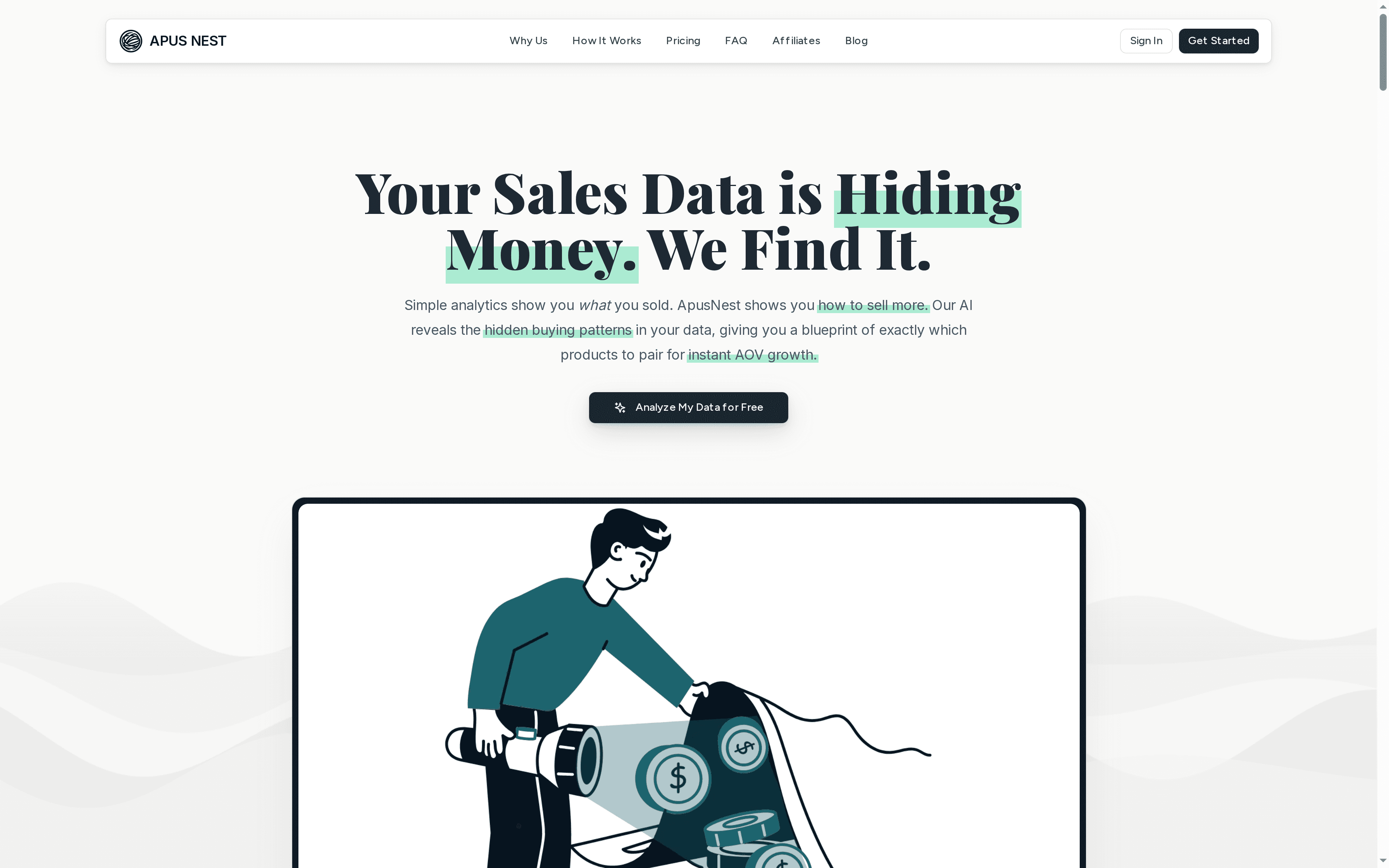
Apusnest is an AI-powered market basket analysis SaaS built specifically for e-commerce stores using Shopify and WooCommerce. It turns raw sales data into clear product-pairing recommendations and financial impact estimates, helping merchants increase average order value (AOV) without hiring a data scientist. The free report is intentionally limited (3 association rules for 72 hours), while a one-time $29 payment unlocks the full, exportable report and advanced analytics.
Core Features
Apusnest applies AI-driven market basket analysis to identify which products shoppers buy together and why. You can upload CSVs from Shopify, WooCommerce, or other sources, generate interactive reports with AI explanations and estimated revenue impacts, and export association rules for use in recommendation engines, email workflows, or ad platforms. The platform emphasizes transparency and data ownership: you retain and can export raw data and analysis outputs. Setup is fast and user-friendly, although non-standard data sources may require manual mapping during upload — a pragmatic trade-off to keep the tool flexible and affordable.
Pros
- Easy for non-technical users: The interface and explanations require no data science background, letting store owners act on insights immediately.
- Actionable, revenue-focused recommendations: Reports include financial impact estimates so you can prioritize changes that will move the needle.
- No subscription lock-in: A one-time payment grants full access, removing recurring fees and simplifying budgeting.
- Complete data ownership and exports: You can export association rules and raw data to plug into other marketing tools or BI systems.
- Fast setup and reporting: Quick CSV uploads and rapid report generation mean you get insights in hours, not weeks.
Who It’s For
Apusnest is ideal for small to medium-sized e-commerce owners, Shopify and WooCommerce merchants, and e-commerce managers who want high-impact recommendations without complex analytics teams. If you run a store and need to increase AOV, improve product placement, or build better cross-sell bundles with minimal technical overhead, apusnest fits your workflow.
Unique Value Proposition
Apusnest stands out by narrowing its focus: market basket analysis delivered as actionable, exportable, and explainable insights tailored for merchants. Unlike general analytics platforms that bury association signals in dashboards, apusnest surfaces specific product pairings, provides AI-generated explanations, and quantifies financial impact so you can prioritize tests and campaigns. The one-time payment model and explicit emphasis on data ownership (exportable association rules and raw data) remove common barriers—ongoing costs and vendor lock-in—so you retain control and can integrate results into existing marketing stacks. The platform’s parity between simplicity and depth—user-friendly reports that also export machine-readable rules—makes it uniquely practical for shop owners who want immediate lift and long-term integration capability.
Real World Use Case
A WooCommerce owner uploads three months of order data, uncovers two strong product pairings the store hadn’t merchandised, implements a “frequently bought together” block and a timed bundle email, and measures a noticeable lift in cross-sell revenue within the first month. The exported rules are later fed into the store’s recommendation engine for automated upsells.
Pricing
Starting at a one-time payment of $29 to unlock the full report and features; a limited free report (3 association rules for 72 hours) is available.
Website: https://apusnest.com
DaaSity
At a Glance
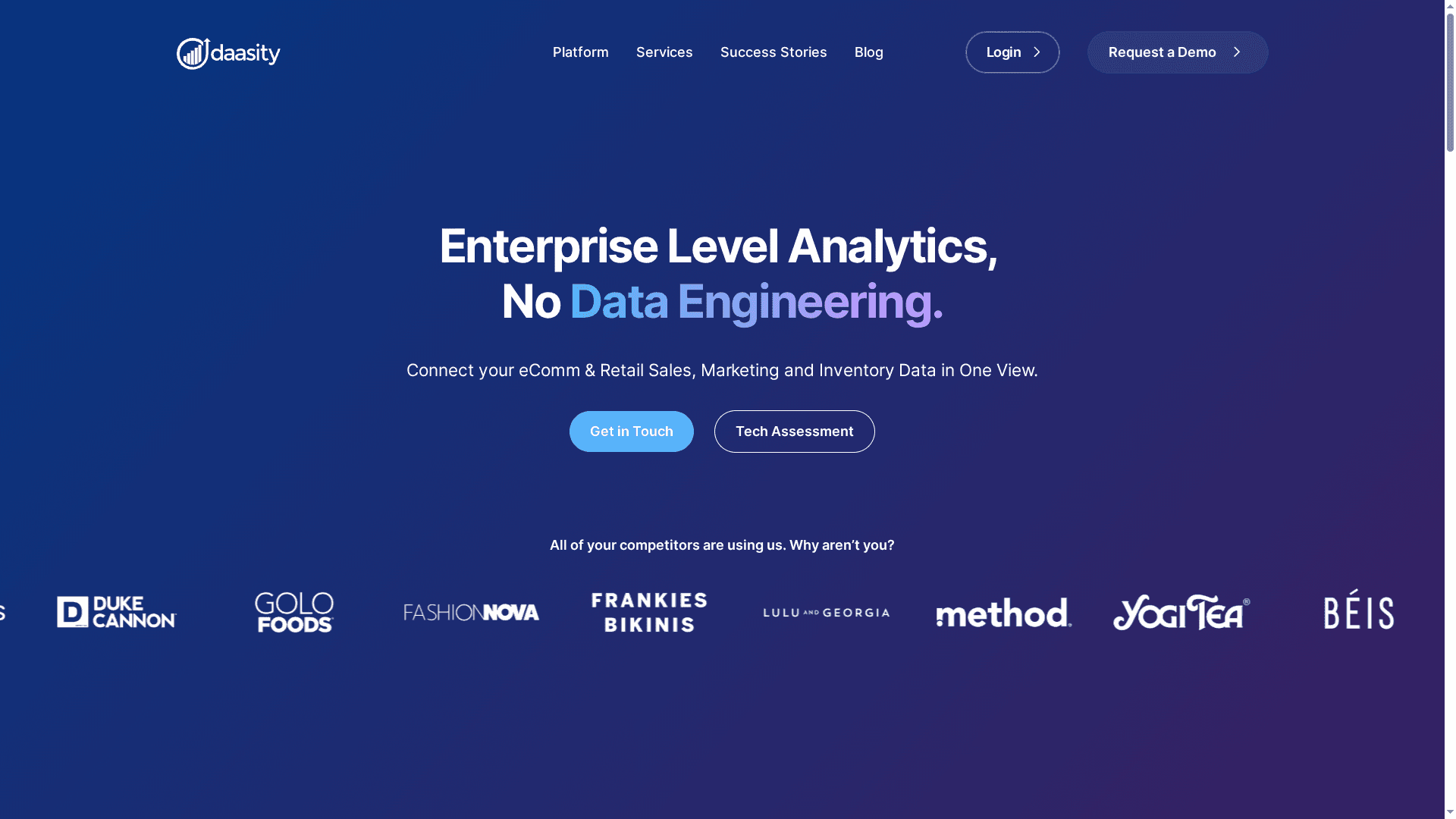
DaaSity provides omnichannel analytics built for consumer brands that want enterprise-level insights without hiring data engineers. It unifies e-commerce, retail, marketing, and inventory data into a single view and surfaces actionable signals for pricing, promotions, inventory, and loyalty. If you need a central analytics layer to tell a consistent retail story across channels and regions, DaaSity is a strong candidate — though the vendor’s public materials leave pricing and onboarding details unclear.
Core Features
DaaSity connects ecomm and retail sales, marketing, and inventory data in one unified view and promises omnichannel analytics without a heavy technical lift. The platform advertises integrations with 300+ data sources across 30+ countries, merchandising categorization for clearer product performance analysis, and tools to track the customer journey from visit to checkout. It also supports optimizing subscription programs and personalized customer experiences, and it exposes pricing, promotion, and retail expansion insights for better decision-making.
Pros
- Unified view of sales, marketing, and inventory data: DaaSity combines multiple data streams into a single pane, which reduces manual reconciliation and speeds insight delivery.
- Enterprise-level analytics without technical burden: The product is designed to deliver advanced analytics without requiring in-house data engineering, lowering the barrier for scaling brands.
- Global connectivity with 300+ integrations: Broad connector coverage across 30+ countries helps brands consolidate international sales and marketing signals in one place.
- Helps optimize pricing, promotions, and retail placements: The platform surfaces actionable recommendations that support margin and placement decisions.
- Supports personalized marketing and retention: DaaSity enables segmentation and subscription optimization to boost lifetime value.
- Real-time insights for faster decisions: Near-real-time visibility into key metrics can reduce latency between insight and action.
Cons
- Pricing not specified: The provided content does not include any pricing details, so cost expectations and budget fit are unclear.
- Integration complexity unknown: While DaaSity claims 300+ integrations, the materials don’t explain how complex or time-consuming specific connections can be for custom stacks.
- Onboarding and support details are lacking: There’s no clear information about customer success, implementation timelines, or training resources in the provided content.
Who It’s For
DaaSity is best suited for consumer brands and growing retailers that sell across direct-to-consumer and retail channels and need a consolidated analytics layer. If you want enterprise-grade reports without hiring data engineers and you have multi-channel sales, marketing, and inventory signals to unify, DaaSity is aimed at you. Smaller single-channel shops may find parts of the platform more than they need.
Unique Value Proposition
DaaSity’s core promise is to deliver omnichannel enterprise analytics without forcing brands to build or maintain data engineering pipelines. That single-minded focus—combine many sources, categorize merchandise, and deliver retail storytelling—positions it as a practical analytics hub for brands expanding into new retail channels or international markets.
Real World Use Case
A consumer goods brand connects its e-commerce, retail POS, subscription, and ad platform data to DaaSity to analyze category performance and customer journeys. The team uses the combined view to optimize promotional cadence, reduce stockouts through better inventory planning, and refine subscription offers to raise retention and AOV.
Pricing
Not specified in the provided content.
Website: https://daasity.com
Glew
At a Glance
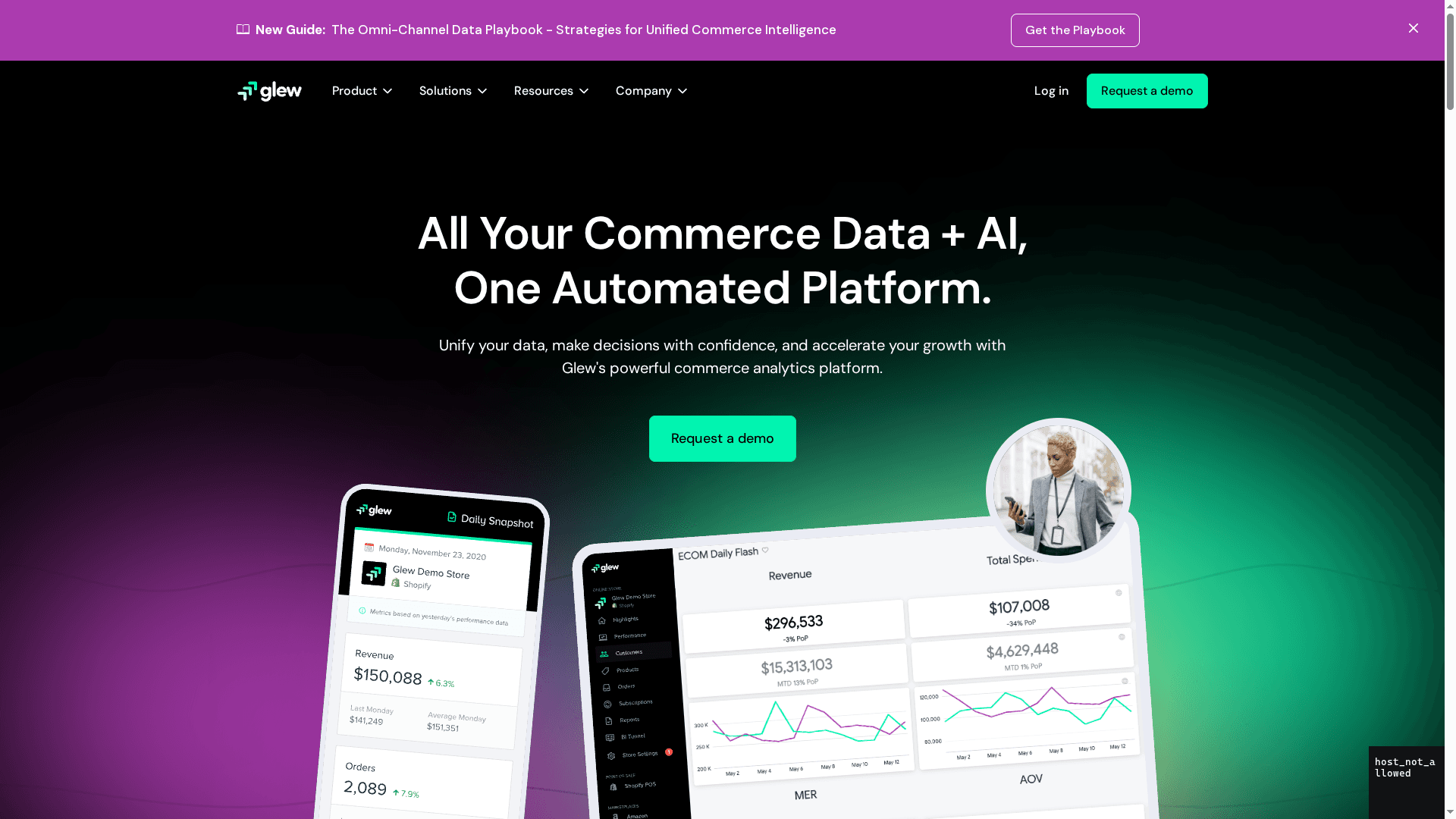
Glew is an all-in-one commerce data platform that unifies multi-channel sales and customer data to deliver analytics and AI-powered insights. Trusted by thousands of stores and integrating with over 170 platforms, it’s built for teams that need a single source of truth across brands and channels. Expect powerful reporting, automated data updates, and a no-code approach to custom reports — but plan for an initial setup effort and potentially custom pricing. In short: robust and enterprise-ready, with a learning curve.
Core Features
Glew combines end-to-end retail intelligence with seamless data ingestion and warehousing, creating unified dashboards and reports from disparate commerce sources. Its strengths lie in powerful reporting and analytics, multi-channel and multi-brand aggregation (omni-channel support), and broad integration capabilities — over 170 commerce platforms and APIs. The platform emphasizes automated data updates and validation, plus customizable, no-code reporting for marketing, financial, and operational analytics.
Pros
- Unified view of commerce data across multiple channels and brands: Glew brings sales, customer, and channel data into a single place so you can compare performance without juggling spreadsheets.
- Extensive integrations and API capabilities: With connections to over 170 platforms, Glew makes it feasible to centralize fragmented systems quickly.
- Customizable reports with no-code platform: Non-technical users can build tailored reports without scripts, letting marketing and finance teams move faster.
- Automated data updates and validation for accuracy: Automated pipelines reduce manual syncing and help keep insights reliable for fast decision-making.
- Supports a wide range of analytics types (marketing, financial, operations, etc.): You can run customer segmentation, ROI analysis, and operational KPIs from the same platform.
Cons
- Complex for new users without technical background: The platform’s breadth means some features require onboarding or technical support before teams can use them effectively.
- Pricing details are possibly custom and may vary depending on needs: Pricing appears tailored to each customer, so budget-conscious merchants may need a consultation to get exact figures.
- Requires initial setup and integration effort: Integrating multiple brands and channels takes time and coordination during the first implementation.
Who It’s For
Glew is aimed at medium to large retail and e-commerce businesses that need comprehensive, integrated analytics to drive decisions across marketing, operations, and finance. If you operate multiple brands or sell across many channels and you want a centralized analytics stack, Glew fits well — especially when you have the resources for setup and customization.
Unique Value Proposition
Glew’s unique value is its ability to unify omni-channel commerce data at scale and turn it into actionable insights with automated, validated data pipelines and no-code reporting. That combination—broad integrations plus strong analytics—lets teams focus on growth rather than data wrangling.
Real World Use Case
A multi-brand retailer consolidates sales and channel data into Glew to create unified dashboards that monitor performance by brand, optimize marketing spend, and streamline operations. The result: clearer customer insights, better campaign ROI, and more efficient cross-brand planning.
Pricing
Quote-based (pricing available on request; plans range from basic to advanced offerings such as Glew Pro and Glew Plus).
Website: https://glew.io
Limespot
At a Glance
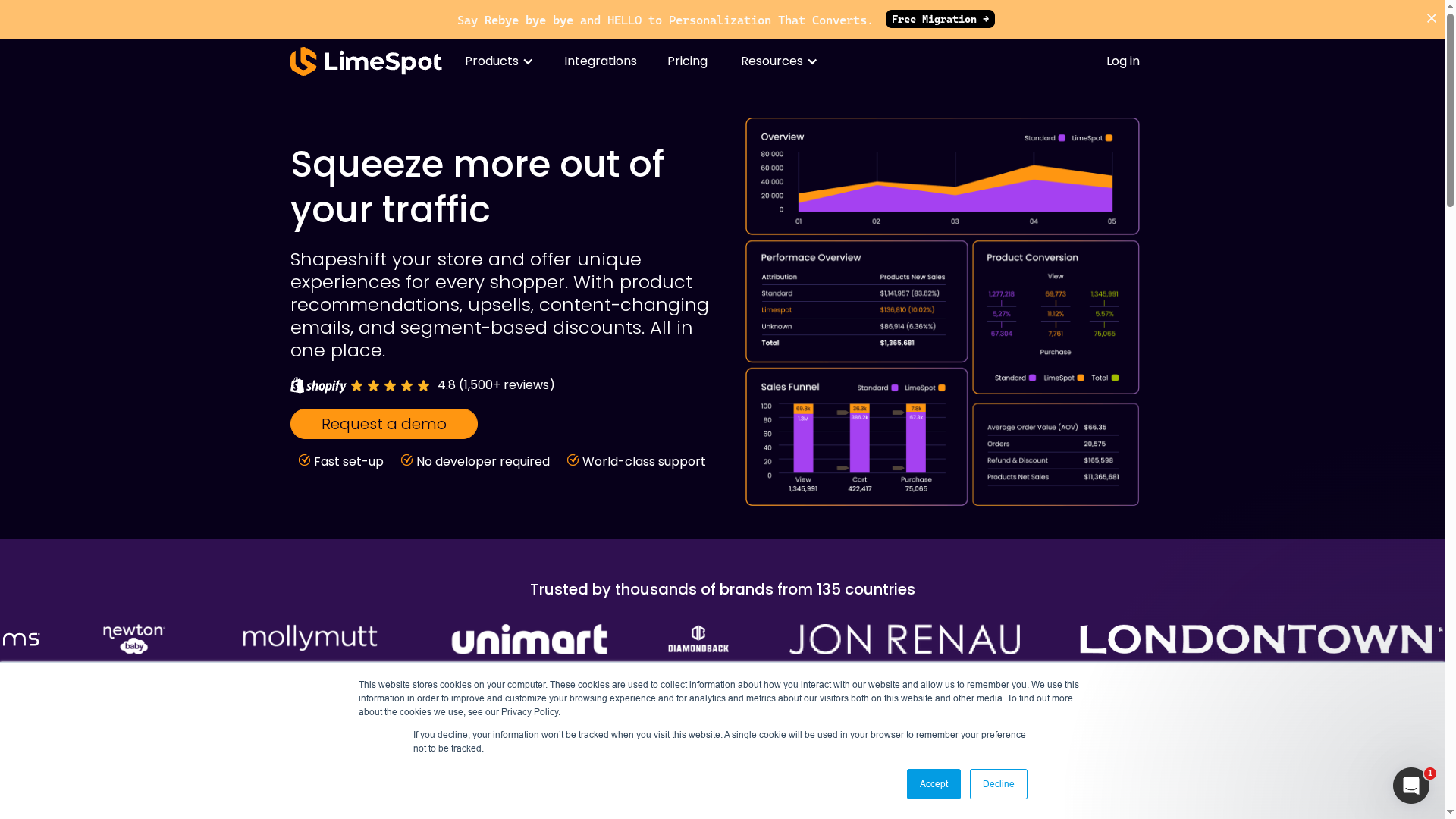
Limespot is an AI-driven personalization platform that helps Shopify and BigCommerce stores deliver product recommendations, segmented offers, and tailored content across web, email, SMS, and mobile. It’s built for merchants who want fast, low-friction personalization—no developer required—and measurable lifts in conversion and AOV. The tool emphasizes omnichannel delivery and behavior-driven upsell flows, making it a practical option for stores that want results without a huge integration project. In short: powerful personalization, straightforward setup, real revenue impact.
Core Features
Limespot’s core capabilities focus on automated, shopper-level personalization: product recommendations (related items, upsell, cross-sell, frequently bought together), segmentation with personalized discounts, and content customization including images, HTML blocks, and collections. It supports behavior-based bundles and upsells, plus checkout and post-purchase optimization tools that serve recommendations and offers when they matter most. Everything is designed to plug into the full e-commerce stack and serve consistent experiences across channels.
Pros
- Easy to set up with no developer required: merchants can get recommendations running quickly without heavy engineering resources.
- AI-powered personalization tailored to individual shoppers: the platform adapts recommendations based on behavior so content feels custom to each visitor.
- Seamless integration with popular eCommerce platforms and tech stack: native support for Shopify and BigCommerce reduces implementation friction.
- Proven increase in conversion rates and AOV (average order value): Limespot advertises measurable lifts, giving you clear ROI signals to evaluate success.
- Supports omnichannel personalization including web, email, SMS, and mobile: you can keep messaging consistent across touchpoints to improve engagement.
Cons
- Pricing may be tiered and based on store revenue, which could be complex for some merchants and make forecasting costs harder.
- The need to evaluate the fit based on store size and traffic levels means smaller stores must confirm ROI before committing.
- Limited detailed customization options visible from the overview may frustrate merchants who want deep, granular control over every recommendation rule.
Who It’s For
Limespot is aimed at online retailers using Shopify or BigCommerce that want an easy-to-implement personalization layer to boost conversions and AOV. It’s a good match for merchants who prefer low-code solutions and measurable outcomes—store owners, e-commerce managers, and digital marketers who want to test behavior-driven upsells without a large development backlog.
Unique Value Proposition
Limespot’s strength is its combination of AI-driven recommendations and omnichannel delivery that requires minimal technical overhead. You get automated personalization that covers the entire customer journey—site, email, SMS, and post-purchase—backed by configurable bundles and checkout optimizations. The value is simple: faster setup, consistent personalization, and clear revenue signals.
Real World Use Case
A Shopify retailer installed Limespot to power on-site recommendations and tailored discounts; within the test period they reported a 14.5% increase in conversion rate with minimal setup effort. That demonstrates how behavior-based recommendations plus targeted discounts can convert incremental traffic into measurable revenue.
Pricing
Limespot offers a 15-day free trial. Paid plans (examples: Max and Turbo) use flat-rate pricing tied to monthly revenue or number of orders, with no overage fees and tiered billing based on selected levels.
Website: https://limespot.com
marketbasket.io
At a Glance
Marketbasket.io is a focused market basket analysis tool built for small to medium-sized businesses that need enterprise-style insights without enterprise complexity or cost. It surfaces product relationships using familiar metrics (support, confidence, lift) and packages those insights for practical actions like bundling, placement, and cross-selling. The interface and export options make it easy to move from insight to implementation quickly. If your catalog and transaction volumes fall within its limits, it’s a high-value, low-friction option.
Core Features
Marketbasket.io performs classic market basket analysis to identify which products sell together, then calculates the key association metrics—support, confidence, and lift—to quantify those relationships. The tool helps you translate findings into business moves by suggesting product placement and bundling opportunities, and it supports CSV and PDF exports so you can feed results into reporting or marketing workflows. A free 24-hour trial and discounts for annual plans lower the friction to try it out.
Pros
- Affordable for SMBs: The pricing approach and trial options make it accessible to small and medium-sized merchants who need insights but lack big analytics budgets.
- Simplicity and ease of use: The product is designed without complex configurations, so store owners and marketers can run analyses without technical support.
- Enterprise-like insights: It provides powerful association metrics that mirror what larger firms use, bringing advanced analytics to smaller operations.
- Appropriate capacity for mid-range datasets: With capacity for datasets around 100,000 transactions and 1,000 products, it fits many independent retailers and growing shops.
- Data export for actionability: Built-in CSV and PDF export options let you move findings into merchandizing plans, email campaigns, or BI tools.
Cons
- Not suited for very large enterprises: The system is explicitly designed around limits of roughly 100,000 transactions and 1,000 products, so retailers with bigger catalogs or higher transaction volumes may outgrow it.
- Feature set is focused, not comprehensive: It concentrates on market basket tasks, which means you won’t find a full-suite analytics platform with customer lifetime value modeling or advanced segmentation in the same tool.
- Support detail is sparse: Public information doesn’t clarify customer support levels or SLAs, which can be important when you’re relying on analytics to drive merchandising decisions.
Who It’s For
Marketbasket.io is aimed at small to medium-sized business owners, Shopify and WooCommerce merchants, and e-commerce managers who want an affordable, easy-to-use way to uncover product pairings and improve average order value. If you run a single or multi-location retail operation with up to mid-range data volumes and you prioritize actionable cross-sell recommendations over broad analytics, this fits well.
Unique Value Proposition
Marketbasket.io’s unique value lies in delivering enterprise-style association analytics in a simplified, cost-effective package tailored to the operational realities of SMB retailers. It trades breadth for clarity: focused outputs you can immediately act on, without a heavy analytics learning curve.
Real World Use Case
A retail store uploads its POS or e-commerce sales file, runs a 24-hour trial analysis, and identifies high-lift product pairs. The team rearranges aisle placement and creates a bundled offer based on those pairs, then exports the CSV to the marketing tool to power targeted email cross-sells—measuring lift in the following month.
Pricing
Free 24-hour trial available; two months free on yearly plans; monthly and yearly payment options are offered.
Website: https://marketbasket.io
Metorik
At a Glance
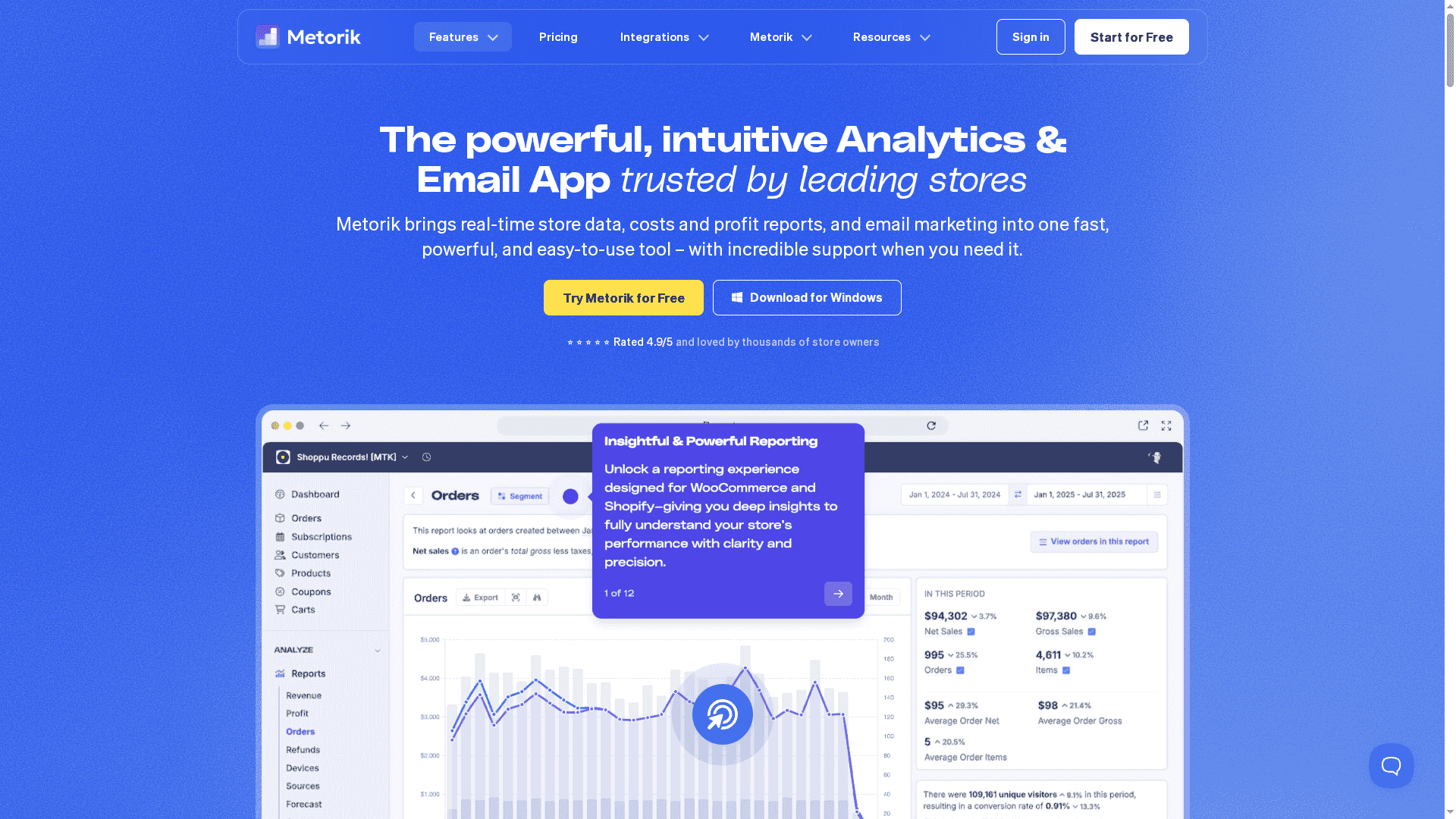
Metorik is a unified analytics and email marketing platform built for WooCommerce and Shopify stores, trusted by over 8,000 merchants. It turns raw orders into real-time reports, automated digests, and actionable customer segments so you can stop guessing and start planning. For store owners who want deep ecommerce visibility plus built-in engagement tools, Metorik delivers powerful insights without forcing you to stitch together multiple apps. It isn’t the cheapest option for very high-volume stores, though.
Core Features
Metorik’s core includes real-time analytics and detailed reports (including cohort analysis, product reporting, and ecommerce forecasting), an email marketing and engagement suite that handles abandoned cart flows and broadcasts, and extensive integrations across ads platforms and support tools. It also provides cost & profit reporting—tracking cost of goods and shipping—and advanced customer and product segmentation with custom columns and cohort tools. Everything is designed to live in one dashboard so you can move from insight to action quickly.
Pros
- User-friendly, intuitive interface: The dashboard and report builder are straightforward, helping non-technical store owners find answers fast.
- Comprehensive analytics and reporting: Metorik combines cohort analysis, forecasting, and product-level reports that surface trends you’d otherwise miss.
- Strong integrations with ecommerce and marketing tools: Native links to ads platforms and support tools let you compare ad ROI and customer conversations in one place.
- Excellent customer support and resources: Users report timely support and clear documentation that shorten the learning curve.
- Automation that saves time: Automated digests and scheduled reports free you from manual exports and weekly spreadsheets.
Cons
- Pricing tied to order volume can be costly for large stores: If your store processes very high monthly orders, Metorik’s volume-based pricing may outpace flat-rate competitors.
- Some features assume analytics familiarity: Advanced segmentation and cohort analysis require a basic understanding of ecommerce metrics to use effectively.
- Relies on third-party integrations for full visibility: Complete cross-channel insight depends on connecting multiple platforms, so gaps appear if an integration isn’t available or configured.
Who It’s For
Metorik is aimed at online retailers on WooCommerce or Shopify who need advanced analytics, reporting, and integrated email automation. If you’re a merchant or marketing lead who wants to understand customer lifecycles, track cost and profit per SKU, and send targeted campaigns from the same place, Metorik fits well.
Unique Value Proposition
Metorik’s edge is combining live ecommerce analytics with built-in engagement tools so insights lead directly to action. Rather than exporting data to separate marketing platforms, you can segment customers, build campaigns, and monitor ROI in one continuous workflow.
Real World Use Case
A Shopify owner used Metorik to automate weekly performance reports, segment repeat customers for a reactivation email, and track ad channel ROI—saving hours of manual reporting and improving campaign targeting that led to measurable sales lift.
Pricing
Pricing scales based on average monthly orders, with a free 30-day trial and plans that include all features, unlimited users, and multi-store coverage.
Website: https://metorik.com
Peel Insights
At a Glance
Peel Insights is an all-in-one analytics platform built for Shopify brands that automates data consolidation and surfaces actionable recommendations to boost e-commerce results. It pulls multiple data sources into customizable dashboards, refreshes daily, and focuses on outcomes like subscriptions, bundles, and cross-sell performance. In short: it’s powerful for teams ready to act on data, but it can feel pricey and feature-dense for very small merchants.
Core Features
Peel centralizes integrations with Shopify, Amazon, Google Analytics (including GA4), ad networks, and subscription platforms, then layers automated daily refreshes and proprietary reports on top. You get customizable dashboards, cohort KPIs, RFM-style segmentation, product metrics, multi-channel performance analytics, market basket analysis for bundling and cross-sell strategies, scheduled automated insights, and Snowflake access for advanced querying and raw data exploration.
Pros
- Automated daily data refreshes keep your reports current, so decisions are based on fresh sales and marketing signals rather than stale snapshots.
- Deep, customizable analytics give you both breadth and depth, letting teams mix pre-built reports with tailored views for specific campaigns or products.
- Easy multi-source integration reduces manual data wrangling, bringing Shopify, marketplaces, ad networks, and subscription platforms into one place.
- Market basket analysis and proprietary reports reveal concrete cross-sell and bundling opportunities, enabling strategies that directly target AOV growth.
- Advanced segmentation support (including RFM) helps you target customers precisely, improving retention and upsell effectiveness.
- Dedicated onboarding and support smooth the ramp-up, which is helpful given the platform’s breadth.
Cons
- Pricing may be prohibitive for very small shops with low order volume, since plans start at $179/month billed annually and higher tiers scale to several hundred dollars a month.
- Feature complexity creates a learning curve for teams without analytics experience, so you’ll need time or support to extract full value.
- Dependence on correct integrations means setup requires care to ensure data accuracy, and misconfigured sources can skew insights.
Who It’s For
Peel is best suited for mid-size to large Shopify and e-commerce brands that need automated, in-depth analytics and have the operational bandwidth to act on recommendations. If you run multiple channels, use subscriptions or bundles, and want to reduce manual analysis time, Peel is a strong fit.
Unique Value Proposition
Peel’s strength is automating the tedious parts of e-commerce analytics—data ingestion, daily refreshes, and proprietary reports—so you spend less time wrangling spreadsheets and more time executing growth strategies like bundles and cross-sells. The Snowflake access and advanced segmentation options also make it attractive for teams that want to combine self-serve analysis with managed insights.
Real World Use Case
A Shopify brand used Peel to redesign its bundling strategy and achieved a 236% year-over-year revenue increase from bundles, illustrating how targeted market basket analysis and actionable recommendations can translate directly into revenue gains.
Pricing
Starting at $179/month (Core plan, billed annually); higher tiers—Essentials, Accelerate, and Tailored—add features and support, with prices rising to several hundred dollars per month depending on volume and customization.
Website: https://peelinsights.com
E-commerce Analytics Tools Comparison
This table provides a comprehensive comparison of e-commerce analytics tools mentioned in the article. It highlights their key features, pros, cons, pricing, and who they’re best suited for, helping you choose the right tool for your business needs.
| Product | Key Features | Pros | Cons | Pricing |
|---|---|---|---|---|
| Apusnest | AI-driven market basket analysis, full report export, user-friendly setup | Easy for non-technical users, revenue-focused, one-time payment | Limited free report, manual mapping for non-standard data sources | $29 one-time payment |
| DaaSity | Omnichannel analytics, 300+ integrations, enterprise-level insights | Unified data view, enterprise-level analytics, global connectivity | Pricing not specified, unclear complexity for integrations | Not specified |
| Glew | All-in-one commerce data platform, no-code custom reports, 170+ integrations | Unified commerce data, customizable no-code reports, automated updates | Complex setup, custom pricing | Quote-based, available on request |
| Limespot | AI-driven personalization, omnichannel delivery, tailored recommendations | Easy setup, seamless integration, proven conversion increase | Tiered pricing, complexity for smaller stores | Flat-rate based on revenue/orders |
| Marketbasket.io | Market basket analysis, CSV/PDF exports, support for 100k transactions | Affordable for SMBs, simplicity, enterprise-like insights | Limited capacity for large enterprises, focused feature set | Free 24-hour trial, annual discounts |
| Metorik | Real-time analytics, email marketing, detailed reporting, advanced segmentation | User-friendly, comprehensive analytics, strong integrations | Costly for high-volume stores, analytics familiarity needed | Based on order volume |
| Peel Insights | Centralized analytics, daily data refresh, multi-source integration, advanced segmentation | Automated data refreshes, deep customizable analytics | High pricing for small shops, complex features | Starting at $179/month |
Unlock Hidden Revenue with AI-Driven Market Basket Analysis
Struggling to make sense of complex e-commerce data and boost your average order value? Many store owners face this challenge when trying to uncover actionable product pairings that drive sales growth. The expert comparison underscores the importance of clear insights like association rules and financial impact estimates to prioritize cross-sell opportunities. If you want to avoid costly subscriptions and technical headaches while turning raw data into powerful recommendations, there is a smarter way to work.
Discover how APUS NEST helps Shopify and WooCommerce merchants reveal hidden product relationships through advanced AI-powered market basket analysis. Easily upload your sales data and get transparent, exportable reports that empower you to optimize product placement, create bundles, and launch targeted campaigns. We focus on simplicity, full data ownership, and actionable insights so you can quickly increase your store’s revenue without hiring data scientists.
Elevate your e-commerce strategy today with APUS NEST’s market basket analysis platform. Explore detailed strategies for leveraging these insights, learn about seamless WooCommerce integration, and start transforming raw data into growth-driving actions.
Boost your store’s performance with the tool built specifically for e-commerce success.
Ready to uncover your next revenue opportunity before your competitors do?
AI-Driven Product Pairing Insights Await You
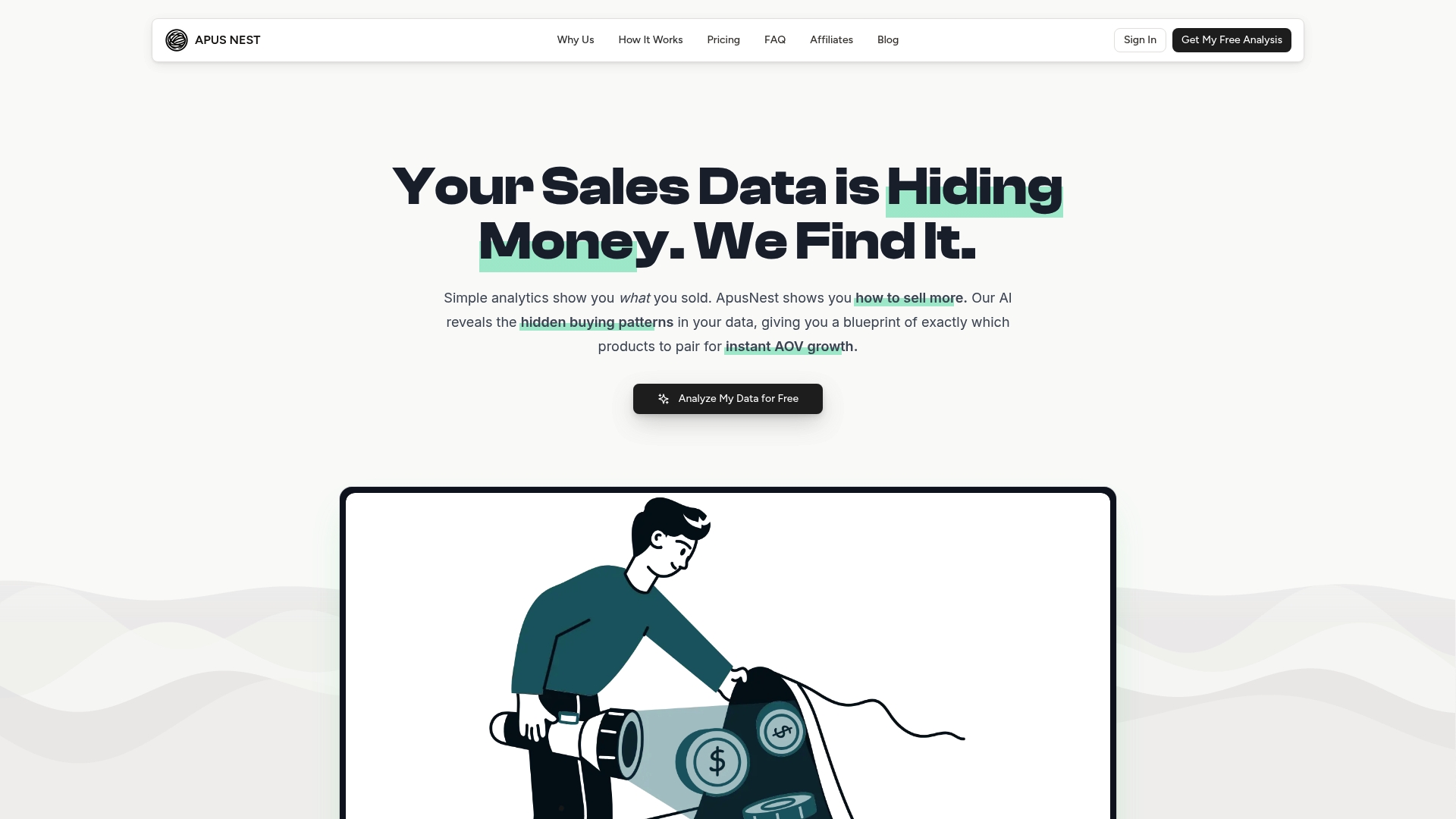
Dive in now at https://apusnest.com and unlock your store’s true potential with zero subscription fees and full control over your data.
Frequently Asked Questions
What are the key features to look for in an ecommerce insights platform?
A great ecommerce insights platform should offer comprehensive data integration, real-time analytics, and user-friendly reporting. Focus on features like multi-channel performance tracking and customizable dashboards to ensure you can analyze data effectively.
How can I choose the right ecommerce insights platform for my business?
To select the right platform, assess your specific needs, such as data volume, required integrations, and budget constraints. Create a list of features important to you, conduct trials if available, and compare the platforms based on these priorities.
What types of reports should an ecommerce insights platform generate?
An effective ecommerce insights platform should generate various reports, including sales performance, customer behavior, and order trends. Look for platforms that provide real-time reporting to help you make informed decisions quickly.
How long does it take to see results from using an ecommerce insights platform?
Typically, users can begin to see actionable insights within 30 to 60 days of implementing an ecommerce insights platform. To maximize benefits, ensure that data is consistently updated and analyze the reports regularly for timely adjustments.
What budget should I allocate for an ecommerce insights platform?
Budget amounts for ecommerce insights platforms vary widely based on features, integrations, and support levels. Determine your budget by comparing ongoing costs of software subscriptions against the potential revenue improvements from data-driven decisions.
Can ecommerce insights platforms support both small and large businesses?
Yes, many ecommerce insights platforms cater to both small and large businesses by offering scalable solutions. Evaluate the user limits and data handling capabilities to ensure the platform can grow with your business needs.
