

Did you know that companies using customer segmentation can experience a 10 percent increase in profits? With so many shoppers browsing and buying online today, understanding exactly who your customers are is more important than ever. Businesses that group shoppers based on their unique behaviors, preferences, and needs can deliver truly personalized experiences. This approach helps drive smarter marketing, stronger loyalty, and better results across every part of your e-commerce store.
Table of Contents
- Defining Customer Segmentation And Its Importance
- Major Types Of Customer Segmentation Explained
- How Segmentation Works In E-commerce Stores
- Practical Use Cases For Retail Marketers
- Common Challenges And Pitfalls To Avoid
Key Takeaways
| Point | Details |
|---|---|
| Customer Segmentation is Crucial | It allows e-commerce businesses to personalize marketing strategies and improve customer engagement through targeted messaging. |
| Multiple Segmentation Types Available | Businesses can utilize demographic, geographic, psychographic, behavioral, and value-based segmentation for deeper customer insights. |
| Data Integration is Key | Successful segmentation relies on robust data collection and analytics to identify meaningful customer patterns and preferences. |
| Avoid Common Pitfalls | Focus on maintaining data quality and respecting privacy concerns to ensure segmentation strategies remain effective and compliant. |
Defining Customer Segmentation and Its Importance
Customer segmentation is a strategic approach that transforms how e-commerce businesses understand and engage with their audience. According to research from Coursera, it involves examining customer attributes and methodically grouping them based on shared characteristics like behavior, demographics, psychographics, and specific needs.
At its core, customer segmentation enables businesses to move beyond generic marketing strategies. By dividing customers into distinct groups, online retailers can craft highly personalized experiences that resonate more deeply. As research from TechTarget highlights, this process allows for more targeted messaging that speaks directly to customer preferences, interests, and spending habits.
The benefits of effective customer segmentation are substantial. When implemented strategically, it allows e-commerce businesses to:
- Allocate marketing budgets more efficiently
- Develop more refined product offerings
- Create personalized communication strategies
- Increase conversion rates
- Build stronger customer loyalty
By understanding the nuanced differences within your customer base, you transform raw data into actionable insights that can dramatically improve your online store’s performance. For an in-depth exploration of practical customer segmentation ideas, check out our comprehensive guide that breaks down specific strategies for implementation.
Major Types of Customer Segmentation Explained
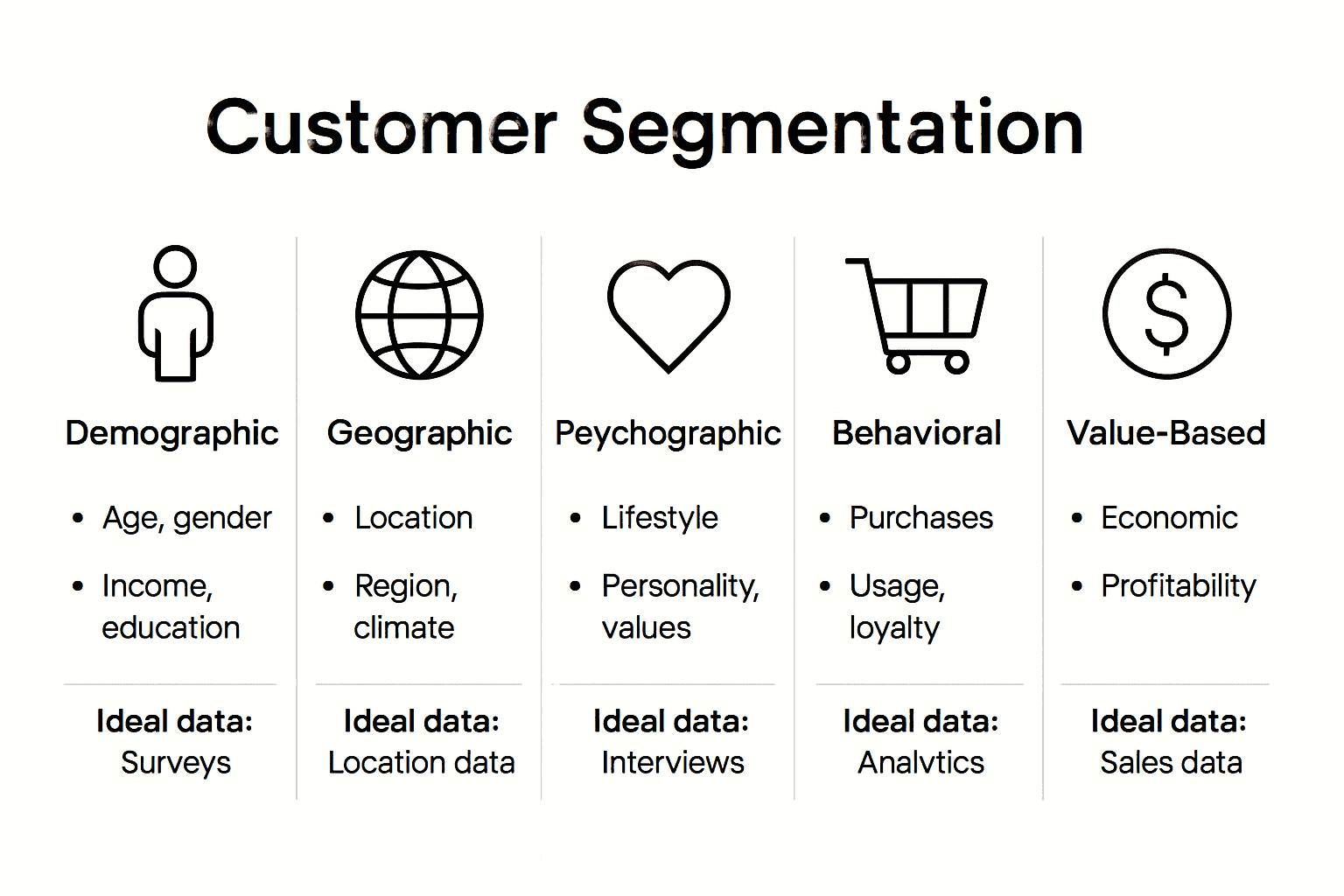
Customer segmentation encompasses multiple strategic approaches to understanding and categorizing your audience. According to research from TechTarget, businesses can leverage various segmentation types to gain deeper insights into customer characteristics and behaviors.
Here’s a comparison of the major types of customer segmentation used in e-commerce:
| Segmentation Type | Key Characteristics | Typical Data Sources |
|---|---|---|
| Demographic | Age Gender Income |
Surveys Profile data |
| Geographic | Country Region Climate |
Shipping info IP analytics |
| Psychographic | Lifestyle Values Personality |
Questionnaires Social media |
| Behavioral | Purchase history Loyalty Engagement |
Web analytics CRM records |
| Value-Based (RFM) | Purchase amount Frequency Recency |
Transaction logs Orders |
Demographic Segmentation breaks down customers by objective characteristics like age, gender, income, education, and occupation. This fundamental approach allows businesses to create broad, foundational marketing strategies that speak to specific population segments. Geographic Segmentation takes this further by considering location-based differences, enabling businesses to tailor offerings based on regional preferences, climate, or cultural nuances.
More advanced segmentation techniques dive deeper into customer psychology and behavior. Psychographic Segmentation explores customers’ inner motivations, lifestyle choices, values, and personality traits. Behavioral Segmentation analyzes actual customer interactions, such as purchasing patterns, brand loyalty, product usage, and engagement levels. For e-commerce specifically, RFM (Recency, Frequency, Monetary) analysis provides a powerful method to categorize customers based on their recent purchases, purchase frequency, and total spend.
The ultimate goal of these segmentation strategies is to transform raw data into actionable insights.
 By understanding the nuanced differences within your customer base, you can:
- Create hyper-targeted marketing campaigns
- Develop personalized product recommendations
- Optimize pricing and promotional strategies
- Improve customer retention efforts
- Predict future purchasing behaviors
How Segmentation Works in E-commerce Stores
In the dynamic world of e-commerce, customer segmentation transforms raw data into a strategic roadmap for personalized marketing and sales. The process begins with comprehensive data collection, gathering critical information from multiple touchpoints including website interactions, purchase history, customer profiles, and engagement metrics.
Data Integration is the crucial first step, where businesses consolidate information from various sources like:
- Website analytics
- Purchase transaction records
- Customer support interactions
- Social media engagement
- Email marketing responses
Once data is collected, advanced analytics tools help identify meaningful patterns and group customers with similar characteristics. E-commerce data analysis plays a pivotal role in extracting actionable insights, allowing businesses to create nuanced customer profiles that go beyond basic demographic information.
The segmentation process involves sophisticated algorithms that evaluate multiple variables simultaneously. These algorithms cluster customers based on complex interactions, predicting future behaviors, potential purchase likelihood, and individual customer value. By understanding these intricate relationships, e-commerce stores can develop hyper-targeted marketing strategies, personalized product recommendations, and tailored communication approaches that resonate with specific customer segments.
Practical Use Cases for Retail Marketers
Customer segmentation transforms marketing strategies from generic broadcasts to precision-targeted experiences. According to research from Saras Analytics, leading brands like Amazon, Nike, and regional retailers have successfully leveraged various segmentation approaches to create powerful, personalized marketing campaigns.
Value-Based Segmentation emerges as a particularly potent strategy. Amazon Prime exemplifies this approach by creating a premium segment of high-value customers who receive enhanced benefits and personalized experiences. Nike takes a different approach, using psychographic segmentation to target consumers based on lifestyle and activity levels, crafting marketing messages that resonate with specific athletic and style-conscious personas.
Retail marketers can implement segmentation strategies through multiple lenses:
- Demographic targeting for age and income-specific campaigns
- Behavioral analysis to predict future purchasing patterns
- Geographic segmentation for location-based promotions
- Psychographic profiling to understand customer motivations
- Value-based clustering to prioritize high-potential customers
Market basket analytics provides an additional layer of sophistication, allowing marketers to understand complex product relationships and create more intelligent cross-selling strategies. By combining multiple segmentation approaches, e-commerce businesses can develop nuanced, data-driven marketing initiatives that speak directly to individual customer needs and preferences.
Common Challenges and Pitfalls to Avoid
Customer segmentation is powerful, but fraught with potential missteps that can derail even the most well-intentioned marketing strategies. Data Quality stands as the primary challenge, with many e-commerce businesses struggling to collect, integrate, and maintain accurate customer information across multiple touchpoints.
Privacy concerns present another significant hurdle. According to research from UNICON, businesses must carefully balance hyper-personalization with data protection. The framework suggests adopting group-based segmentation strategies that deliver personalized experiences while minimizing reliance on individual-level data. This approach helps maintain customer trust and comply with evolving data protection regulations.
Technical challenges can also undermine segmentation efforts. Deep learning algorithms often create opaque customer embeddings that lack interpretability. Research highlights the importance of generating human-readable customer personas—such as “Busy Parents” or “Bargain Hunters”—to make segmentation insights actionable for marketing teams. Common pitfalls to watch for include:
- Over-segmentation leading to unnecessarily complex strategies
- Relying on outdated or incomplete customer data
- Failing to regularly update and refine segments
- Ignoring privacy and consent requirements
- Creating segments too narrow or too broad
Understanding retail analytics can help marketers navigate these challenges, ensuring that customer segmentation remains a powerful tool for personalization rather than becoming a compliance and strategic liability.
Unlock the Power of Customer Segmentation with APUS NEST
Understanding your customers through detailed segmentation is key to delivering personalized marketing and increasing sales. This article highlights how demographic, behavioral, and value-based segmentation can reveal deep insights about your audience but also emphasizes challenges in managing and acting on complex data sets. If you want to move beyond guesswork and use precise data-driven strategies to increase your e-commerce store’s average order value, APUS NEST offers the perfect solution.
APUS NEST uses advanced AI-powered market basket analysis to help Shopify and WooCommerce store owners uncover hidden product relationships and optimize cross-selling opportunities. With our platform, you can upload your sales data and receive actionable reports tailored to your unique customer segments. Don’t let valuable insights remain buried in your data. Visit APUS NEST now and experience how easy it is to transform customer segmentation insights into real revenue growth. Start with a free report and see immediate opportunities to personalize your product bundling and marketing campaigns. For a comprehensive guide on driving growth through data, explore our educational resources on e-commerce data analysis and powerful market basket analytics. Make smarter segmentation decisions today and boost your store’s performance.
Frequently Asked Questions
What are the main types of customer segmentation used in e-commerce?
Customer segmentation typically includes demographic, geographic, psychographic, behavioral, and value-based segmentation. Each type focuses on different customer characteristics and helps businesses tailor their marketing strategies accordingly.
How can customer segmentation improve marketing strategies for e-commerce businesses?
By utilizing customer segmentation, e-commerce businesses can create hyper-targeted marketing campaigns, develop personalized product recommendations, optimize pricing strategies, enhance customer retention efforts, and predict future purchasing behaviors more effectively.
What is RFM analysis in customer segmentation?
RFM stands for Recency, Frequency, and Monetary value. It is a method used in customer segmentation that categorizes customers based on how recently they made their last purchase, how often they make purchases, and how much they spend, enabling businesses to identify their most valuable customers.
What challenges should e-commerce businesses consider when implementing customer segmentation?
E-commerce businesses may face challenges such as data quality issues, privacy concerns regarding customer information, technical difficulties in using advanced analytics, and the risk of over-segmentation. Regularly updating customer data and ensuring compliance with data protection regulations are essential for successful segmentation.
Recommended
- 7 Effective Customer Segmentation Examples for E-commerce - ApusNest Blog | ApusNest
- 7 Customer Segmentation Ideas to Boost Your Sales - ApusNest Blog | ApusNest
- Master RFM Analysis to Boost E-Commerce Sales - ApusNest Blog | ApusNest
- 7 Effective Ways to Maximize Revenue in E-commerce - ApusNest Blog | ApusNest
