

Only about 35 percent of online shoppers add recommended products to their carts, leaving huge growth potential untapped. Spotting real cross selling opportunities starts long before you launch promotions or bundle offers. Smart e-commerce teams know that success hinges on clear data, precise AI analysis, and customer-centered recommendations. Get ready to transform your sales approach with actionable steps that reveal hidden product pairings, optimize your store, and steadily increase average order value.
Table of Contents
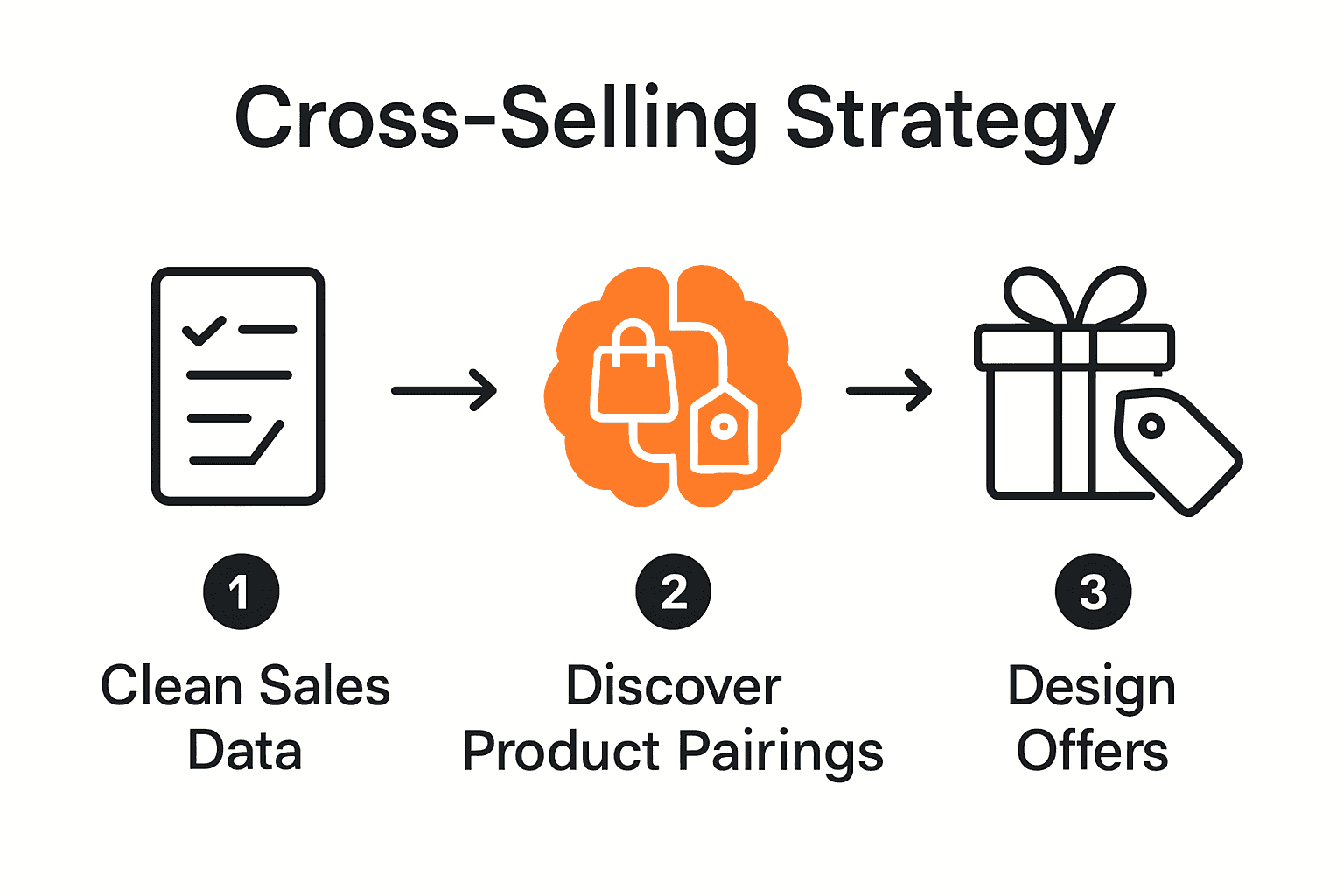
- Step 1: Prepare Your Sales Data For Analysis
- Step 2: Uncover Product Pairing Opportunities Using AI
- Step 3: Design Effective Cross Sell Offers For Your Store
- Step 4: Integrate Recommendations Into Shopify Or WooCommerce
- Step 5: Monitor Performance And Refine Strategies
Quick Summary
| Key Point | Explanation |
|---|---|
| 1. Clean Your Sales Data | Ensure your sales data is accurate and formatted correctly to provide reliable insights for analysis. |
| 2. Utilize AI for Insights | Leverage AI algorithms to discover hidden product relationships and enhance cross selling opportunities effectively. |
| 3. Design Relevant Cross Sell Offers | Create personalized product recommendations based on customer behavior and complementary items to increase perceived value. |
| 4. Seamlessly Integrate Recommendations | Implement AI-driven suggestions within your e-commerce platform to enhance user experience and drive sales naturally. |
| 5. Monitor and Optimize Performance | Regularly track key metrics to refine cross selling strategies, ensuring continual improvement in revenue generation. |
Step 1: Prepare Your Sales Data for Analysis
Successful cross selling begins with clean accurate data. Your mission is to transform raw sales information into a powerful analytical resource that reveals hidden product relationships and revenue opportunities.
According to Statology, data preparation involves several critical steps to ensure quality insights. Start by thoroughly reviewing your sales records for inconsistencies. Check for missing values, incorrect entries, and formatting discrepancies that could skew your analysis. Focus on standardizing product names, categorizing transactions, and ensuring each record contains essential details like product ID, sale price, date, and customer segment.
Practical data cleaning requires attention to detail. Remove duplicate entries that might inflate results, correct typographical errors in product names, and convert all monetary values to a consistent format. Verify that dates are uniform and timestamps match your reporting requirements. By meticulously organizing your data, you create a reliable foundation for uncovering cross selling strategies that can dramatically increase your average order value.
Your next step is transforming this cleaned dataset into meaningful insights that reveal potential product pairings and customer purchasing patterns. With precise data preparation, you are now ready to dive deeper into market basket analysis and strategic cross selling recommendations.
Step 2: Uncover Product Pairing Opportunities Using AI
AI has transformed how online stores discover powerful product relationships. Your goal is to leverage advanced algorithms that uncover hidden connections between items in your product catalog revealing lucrative cross selling opportunities.
Research from arXiv introduces groundbreaking methods for inferring networks of complementary and substitutable products using artificial intelligence. By analyzing purchase patterns and customer behaviors, AI can identify product combinations that customers are most likely to buy together. This approach goes beyond traditional manual analysis by processing massive datasets and detecting subtle relationships that human analysts might overlook.
Additional insights from AAAIRJ demonstrate how reinforcement learning and collaborative filtering can enhance product discovery tools. These advanced techniques allow you to create sophisticated recommendation systems that adapt and improve over time. The key is to look beyond simple transaction history and understand the complex interactions between products.
With these AI powered insights, you can strategically design product bundles recommend complementary items and personalize customer shopping experiences in ways that significantly boost your average order value.
Step 3: Design Effective Cross Sell Offers for Your Store
Creating compelling cross sell offers requires strategic thinking and deep understanding of your customers purchasing behaviors. Your mission is to craft targeted recommendations that feel personalized and valuable to each shopper.
According to Alore, successful cross selling starts with a comprehensive analysis of customer behavior and product relationships. This means going beyond simple transaction data and understanding the intricate connections between items that customers naturally purchase together. Look for patterns in your sales history such as complementary products frequently bought in the same transaction or items that tend to solve related customer needs.
To design truly effective cross sell offers focus on relevance and perceived value. Group products that have logical connections create bundles that provide clear additional benefit and price them attractively. Consider offering slight discounts for combined purchases or highlighting how different products work together to solve a complete customer problem. Your recommendations should feel like helpful suggestions rather than pushy sales tactics.
Your next step is to implement these carefully crafted cross sell offers across your online store. By integrating cross selling strategy recommendations strategically into product pages checkout processes and post purchase communications you can create a seamless experience that naturally increases your average order value.
Step 4: Integrate Recommendations Into Shopify or WooCommerce
Transforming your e-commerce platform with intelligent product recommendations requires strategic implementation across your Shopify or WooCommerce store. Your goal is to seamlessly embed AI driven suggestions that feel natural and enhance the customer shopping experience.
Research from PMC highlights the collaborative potential of AI in retail practices particularly when integrating recommendation systems. For Shopify stores this means leveraging apps and plugins that can analyze customer purchase history browsing behavior and product relationships. In WooCommerce you might use extensions or custom coding to create intelligent recommendation widgets that dynamically update based on user interactions.
Following insights from arXiv a human centered approach to AI product recommendations focuses on creating intuitive and personalized experiences. This means positioning recommendations strategically such as on product pages in cart sections and during checkout. Ensure your suggestions feel helpful not intrusive by using contextual relevance and maintaining a balance between algorithmic precision and genuine user value.
To streamline your implementation consider product recommendations for e-commerce that provide easy integration methods.
 Your next step is testing and refining these recommendation systems to continually improve their accuracy and impact on your stores revenue.
Step 5: Monitor Performance and Refine Strategies
Measuring the success of your cross selling strategies requires a systematic approach to tracking performance and making data driven adjustments.
Your mission is to transform raw metrics into actionable insights that continuously optimize your revenue generation.
According to Alore, effective performance monitoring starts with identifying key performance indicators specific to cross selling efforts. Focus on metrics like average order value increase percentage of orders with recommended products and conversion rates for different product pairings. Track these indicators over time to understand which recommendations resonate most with your customers and which might need refinement.
Create a dynamic feedback loop where you regularly analyze recommendation performance. Look for patterns such as which product combinations generate the highest additional revenue or which customer segments respond most positively to specific cross sell suggestions. Be prepared to experiment with different recommendation placements timing and presentation styles. Small incremental changes can lead to significant improvements in your overall sales strategy.
To streamline this process consider sales analysis strategies that can help you interpret complex data more effectively. Your ongoing goal is to create an adaptive cross selling system that learns and improves with each customer interaction.
Unlock Hidden Revenue with Data-Driven Cross Selling Solutions
Struggling to make sense of complex sales data or unsure how to design cross sell offers that truly resonate? This comprehensive guide highlights the importance of clean data, AI-powered product pairing, and smart implementation strategies to boost your store’s average order value. If you want to move beyond guesswork and see real results, you need a tool that transforms your raw sales information into actionable insights tailored for your unique product catalog.
Experience how APUS NEST harnesses advanced market basket analysis to uncover complementary product relationships and recommend personalized bundles for your Shopify or WooCommerce store. Start by uploading your sales data for a free report to identify key cross selling opportunities. Then unlock full analytics and strategic recommendations with the paid option to take your offers to the next level. Don’t let hidden revenue slip away—visit APUS NEST now and turn insights into increased sales today.
Frequently Asked Questions
What are effective cross selling strategies to boost online store revenue?
Effective cross selling strategies include analyzing customer purchasing behaviors, creating bundles of complementary products, and personalizing recommendations. Start by reviewing your sales data to identify items frequently bought together, then group relevant products into appealing offers.
How can I prepare my sales data for cross selling analysis?
To prepare your sales data, clean and organize it by checking for inconsistencies, removing duplicates, and standardizing formats. Focus on ensuring that each record includes essential details like product IDs and customer segments within a week for optimal analysis results.
What role does AI play in uncovering product pairing opportunities for cross selling?
AI enhances cross selling by analyzing large datasets to identify hidden relationships between products and customer purchase patterns. Implement AI algorithms to explore potential product combinations, which can significantly streamline your recommendation process and improve sales within a couple of months.
How can I design effective cross sell offers for my online store?
To design effective cross sell offers, ensure your product recommendations are relevant and perceived as valuable. Create bundles that address common customer needs and consider offering discounts for bundled purchases to encourage sales conversions during checkout.
How should I implement product recommendations on my Shopify or WooCommerce store?
Integrate product recommendations seamlessly into your Shopify or WooCommerce store by using apps or plugins that fit your needs. Position these recommendations on product pages and at checkout to make them feel natural and useful for customers, aiming to see improved conversion rates in 30–60 days.
What metrics should I track to monitor the performance of my cross selling strategies?
Key metrics to track include the increase in average order value, the percentage of orders that included recommended products, and conversion rates for different product pairings.
 Analyze these metrics regularly to identify trends and areas for improvement, focusing on adjustments that can enhance your sales strategy over time.
