

Most American online retailers overlook a goldmine in their own data. With e-commerce sales in the United States topping 1 trillion dollars in 2023, understanding customer buying behavior is more crucial than ever. Clean and organized sales records are the secret weapon for businesses ready to tap into smarter cross selling. This guide reveals how American brands can turn messy transactions into clear strategies for growing revenue.
Table of Contents
- Step 1: Prepare Sales Data For Analysis
- Step 2: Identify High-Potential Product Pairings
- Step 3: Implement Data-Driven Cross Sell Offers
- Step 4: Monitor Performance And Fine-Tune Offers
Quick Summary
| Key Insight | Explanation |
|---|---|
| 1. Clean and Structure Sales Data | Ensure sales data is formatted properly to derive meaningful insights. Remove duplicates and standardize product names for accuracy. |
| 2. Identify Complementary Product Pairings | Use advanced analysis to find product combinations that boost average order value, focusing on both obvious and nuanced relationships. |
| 3. Design Personalized Cross Sell Offers | Create targeted offers based on insights from pairing analysis, ensuring they feel natural and relevant to the customer’s journey. |
| 4. Monitor Performance Continuously | Implement tracking systems for key metrics to evaluate the impact of cross sell strategies and refine based on performance data. |
| 5. Utilize A/B Testing for Optimization | Test various recommendation strategies systematically to determine what resonates best with customers, adapting offers accordingly. |
Step 1: Prepare Sales Data for Analysis
To unlock powerful cross sell strategies, you must first transform raw sales data into a clean structured format ready for meaningful analysis. This preparation stage is critical for generating actionable insights about your product relationships and customer purchasing patterns.
Begin by exporting your complete sales history from your e-commerce platform. Aim to collect comprehensive sales trend data spanning at least three to six months. You want a dataset that captures seasonal variations and consistent purchasing behaviors. Focus on gathering key metrics like order details, product names, prices, quantities sold, and transaction timestamps. Most platforms like Shopify or WooCommerce allow direct CSV exports that provide these fundamental data points.
When cleaning your dataset, remove duplicate entries, standardize product names, and ensure consistent formatting across columns. Pay special attention to handling missing values logically by either removing incomplete records or using appropriate placeholder data. Pro tip: Create separate columns for product categories, which will help in more granular market basket analysis later. Validate your data by cross checking total order volumes and confirming that your exported records match your platform’s native reporting.

Your meticulously prepared dataset now serves as the foundation for sophisticated cross sell strategy development. In the next step, you will dive into analyzing these carefully curated sales records to uncover hidden product relationships and revenue opportunities.
Step 2: Identify High-Potential Product Pairings
Unveiling the most promising product combinations is a strategic process that transforms raw sales data into revenue generating insights. Your goal is to discover natural product relationships that can boost your average order value and enhance customer shopping experiences.
Leveraging advanced product recommendation techniques, you will explore multiple analytical approaches to detect complementary product connections. Research demonstrates that sophisticated methods can uncover complex complementarity patterns beyond simple linear relationships. The key is understanding not just which products are frequently bought together, but identifying nuanced interactions like asymmetric complementarity where one product significantly increases the likelihood of purchasing another.
To systematically map these relationships, create a matrix comparing product purchase frequencies and transaction overlaps. Look for statistically significant correlations that reveal natural product affinities. Pay special attention to products that might not seem obviously related but show consistent co-occurrence in customer transactions. A kitchen blender and specialized recipe book, for instance, might represent a strong pairing that isn’t immediately apparent. By applying rigorous analytical techniques, you transform historical sales data into a strategic roadmap for intelligent product recommendations and bundling strategies.
With your high potential product pairings now identified, you are ready to move toward designing targeted cross sell strategies that will maximize your revenue potential.
Step 3: Implement Data-Driven Cross Sell Offers
Transforming your product pairing insights into actionable marketing strategies requires a precise and intelligent approach. Your goal is to design cross sell offers that feel personalized and natural to your customers, maximizing both revenue and shopping experience.
Advanced cross selling strategies leverage sophisticated recommendation techniques that go beyond simple product adjacency. Emerging research demonstrates how logical reasoning networks can capture complex product relationships, enabling more nuanced recommendations that consider asymmetric complementarity and high order interactions. This means understanding not just which products are frequently purchased together, but comprehending the deeper contextual connections that drive customer purchasing decisions.
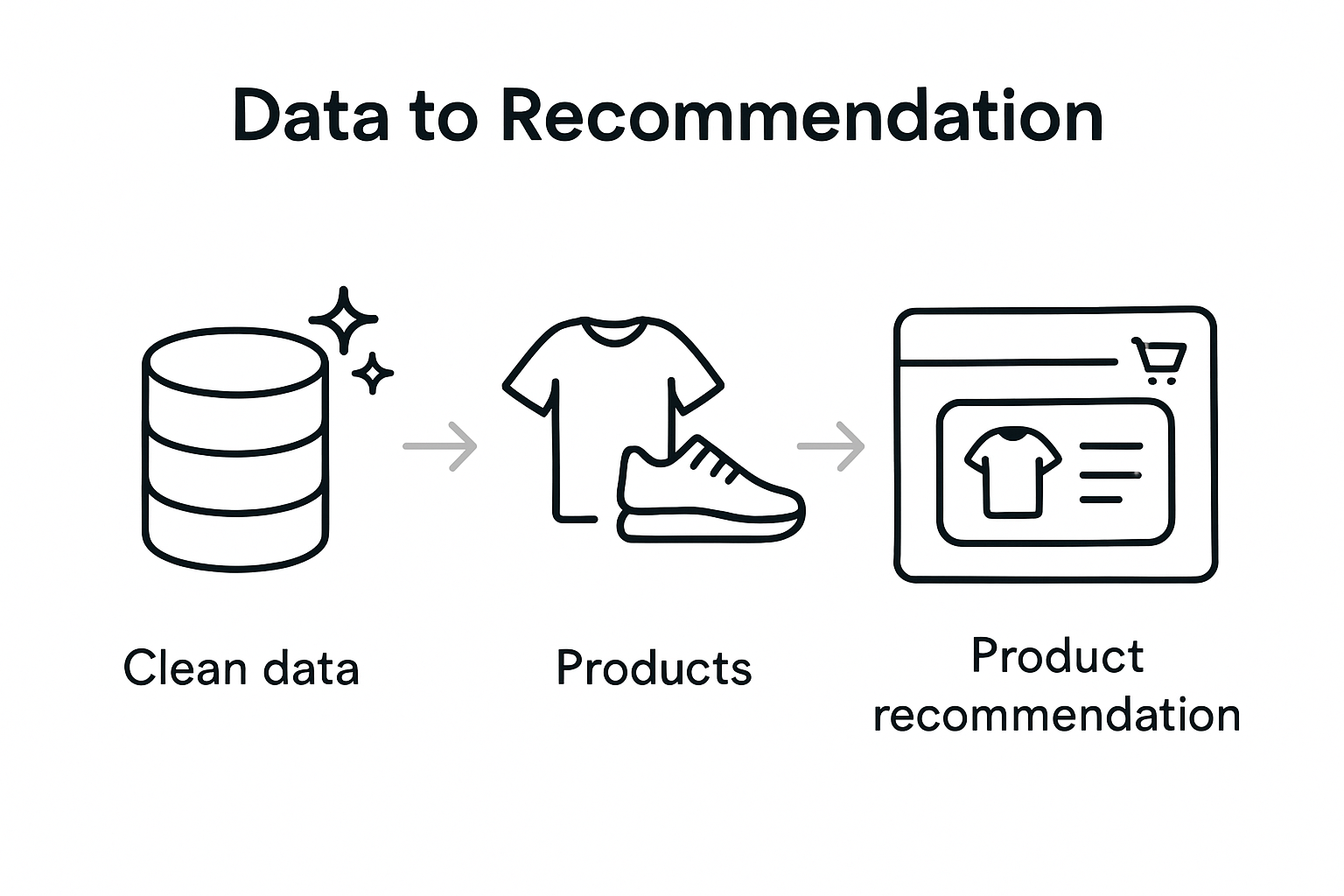
Implement these recommendations through strategic placement and timing. Position complementary product suggestions at critical customer journey touchpoints like cart pages, product detail sections, and post purchase communications. Use dynamic personalization algorithms that adjust recommendations based on individual customer browsing history, previous purchases, and real time behavioral signals. Consider creating bundled offerings that provide clear value propositions, such as discounted package deals or curated product collections that solve specific customer needs. By treating each recommendation as a thoughtful solution rather than a generic upsell, you increase the likelihood of conversion and customer satisfaction.
With your data driven cross sell offers now strategically designed, you are prepared to track performance and continuously refine your approach.
Step 4: Monitor Performance and Fine-Tune Offers
Successful cross sell strategies demand continuous evaluation and strategic refinement. Your objective is to transform initial insights into a dynamic, responsive marketing approach that adapts to changing customer behaviors and market conditions.
Marketing mix modeling provides a sophisticated framework for quantitatively assessing the impact of your cross sell initiatives. By systematically tracking key performance indicators like conversion rates, average order value, and incremental revenue generated from recommendations, you can develop a nuanced understanding of what resonates with your customers. Focus on metrics that reveal not just immediate sales lift but also long term customer engagement and satisfaction.
Establish a robust monitoring system that captures granular performance data across different customer segments, product categories, and recommendation placements. Implement A B testing methodologies to compare alternative recommendation strategies, allowing data to guide your optimization efforts. Pay close attention to subtle variations in customer response signals such as click through rates, time spent exploring recommended products, and the frequency of bundled purchases. Your goal is to create an adaptive recommendation engine that learns and improves with each interaction, transforming raw sales data into increasingly precise and compelling product suggestions.
With a comprehensive performance tracking framework in place, you are now prepared to continually evolve your cross sell approach and unlock progressively more sophisticated revenue opportunities.
Unlock Hidden Revenue with Smart Cross Sell Solutions
Many e-commerce store owners struggle with turning raw sales data into clear, actionable cross sell strategies that boost average order value and customer satisfaction. This article highlights key challenges like identifying high-potential product pairings and implementing data-driven offers that feel personalized and natural. If you want to stop guessing and start using proven methods like market basket analysis powered by AI, APUS NEST is built exactly for your needs.
Discover how simple it is to upload your sales data and get detailed reports revealing hidden product relationships and cross sell opportunities. Our platform supports Shopify and WooCommerce store owners by providing transparent, easy-to-understand analytics—no subscription required. With APUS NEST you can confidently design and optimize your cross sell campaigns backed by data insights.
Ready to transform your e-commerce growth strategies today?

Explore powerful cross sell strategies and claim your free initial report now at APUS NEST. Take control of your sales data, maximize your revenue potential, and turn shopping carts into higher value purchases with intelligent product recommendations. Start your journey toward smarter selling with APUS NEST today.
Frequently Asked Questions
How do I prepare my sales data for cross sell analysis?
To prepare your sales data for cross sell analysis, export your full sales history from your e-commerce platform, focusing on a dataset spanning at least three to six months. Clean this data by removing duplicates and standardizing product names, ensuring that you have key metrics ready for analysis.
What techniques can I use to identify high-potential product pairings?
You can identify high-potential product pairings by creating a matrix that compares product purchase frequencies and transaction overlaps. Look for statistically significant correlations, focusing on pairs that show consistent co-occurrence in sales, even if they seem unrelated at first.
How can I implement effective cross sell offers based on my product pairings?
To implement effective cross sell offers, use dynamic personalization algorithms to recommend products at key touchpoints like cart pages and product detail sections. Position these offers as thoughtful solutions rather than generic upsells, which can lead to higher customer satisfaction and conversion rates.
What key performance indicators should I monitor for my cross sell strategies?
Monitor key performance indicators such as conversion rates, average order value, and incremental revenue generated from your cross sell initiatives. By establishing a robust tracking system, you can refine your offers and adapt to changing customer behaviors within a few weeks.
How can I fine-tune my cross sell offers for better performance?
You can fine-tune your cross sell offers by employing A/B testing to compare different recommendation strategies and analyzing customer response signals like click-through rates. Continuously refine your approach based on these insights to improve your product suggestions and drive revenue growth.
Recommended
- Cross-Selling Strategy Process for E-Commerce Success - ApusNest Blog | ApusNest
- Cross Selling Strategies Guide to Boost Online Store Revenue - ApusNest Blog | ApusNest
- 7 Effective Ways to Maximize Revenue in E-commerce - ApusNest Blog | ApusNest
- Understanding Ecommerce Growth Strategies Guide - ApusNest Blog | ApusNest
- Proven Ways to Increase Online Sales for Businesses - Jarrod Harman
