

Over half of American shoppers now expect personalized deals and targeted product recommendations during every major sales event. For e-commerce businesses, tapping into the power of Black Friday data is more than a trend—it shapes the way retailers connect with fast-changing consumer behavior and rising expectations. Leveraging advanced analytics, this article reveals how understanding and acting on real transaction insights can help American merchants drive smarter sales strategies and lasting customer loyalty.
Table of Contents
- Understanding BF Data In E-Commerce
- Types Of Basket Analysis And Insights
- How AI Discovers Product Relationships
- Implementing Data-Driven Cross-Sell Tactics
- Maximizing Revenue With Report Recommendations
- Common Pitfalls Using BF Data Analytics
Key Takeaways
| Point | Details |
|---|---|
| Utilize Advanced Analytics | E-commerce businesses should leverage advanced analytics to transform Black Friday transaction data into actionable insights for optimizing sales and enhancing customer engagement. |
| Implement Robust Security Measures | Security protocols are essential for protecting both merchants and customers during high-traffic periods, ensuring smooth transaction experiences. |
| Adopt Comprehensive Cross-Basket Analysis | Market basket analysis can reveal purchasing patterns and cross-selling opportunities, guiding targeted marketing strategies and improving sales performance. |
| Avoid Common Pitfalls in Data Usage | E-commerce analysts must be mindful of data quality and analytical limitations to prevent strategic missteps, ensuring models adapt to complex consumer behaviors. |
Understanding BF Data in E-Commerce
Black Friday (BF) data represents a critical strategic asset for e-commerce businesses seeking to optimize sales performance and customer insights. Modern e-commerce platforms now leverage advanced analytics to transform raw transaction information into powerful strategic intelligence. Analyzing complex data patterns allows merchants to understand consumer behavior, predict purchasing trends, and design targeted marketing strategies.
E-commerce data analysis during Black Friday goes far beyond simple sales tracking. Sophisticated merchants utilize market basket analysis techniques to uncover hidden product relationships, understand cross-selling opportunities, and develop intelligent bundling strategies. By examining transactional metadata, online retailers can identify which products customers frequently purchase together, revealing intricate consumption patterns that traditional retail approaches might miss.
Security represents another crucial dimension of BF data management. E-commerce security protocols have become increasingly sophisticated, protecting both merchant and customer interests during high-traffic shopping periods. Advanced data strategies now incorporate robust security measures that analyze transaction patterns in real-time, detecting potential fraudulent activities while maintaining seamless customer experiences.
Key strategic approaches for effectively utilizing Black Friday data include:
- Comprehensive transaction pattern analysis
- Real-time customer behavior tracking
- Advanced predictive modeling
- Intelligent cross-sell recommendation systems
- Adaptive pricing and inventory management
Successful e-commerce businesses recognize that Black Friday data is not just a record of sales, but a strategic roadmap for future growth and customer engagement.
Types of Basket Analysis and Insights
Market basket analysis transforms raw e-commerce transaction data into strategic insights, enabling businesses to understand complex consumer purchasing behaviors. Association Rule Mining techniques help merchants uncover intricate patterns of product interactions, revealing which items customers frequently purchase together and creating opportunities for sophisticated marketing strategies.
There are several critical types of basket analysis that e-commerce businesses can leverage:
- Affinity Analysis: Identifies products commonly purchased together
- Sequence Analysis: Tracks the order in which products are bought over time
- Cross-Category Analysis: Explores purchasing patterns across different product categories
- Seasonal Trend Analysis: Examines how buying patterns shift during specific periods
Advanced analytics approaches enable businesses to develop nuanced insights beyond simple transaction tracking. By examining granular purchase data, merchants can create intelligent recommendation engines, optimize product placements, and design targeted promotional campaigns that dramatically increase average order values.

The most sophisticated basket analysis strategies go beyond mere correlation, diving deep into predictive modeling. These advanced techniques help e-commerce businesses anticipate customer needs, create personalized shopping experiences, and develop data-driven inventory management approaches that minimize waste while maximizing potential revenue streams.
Key benefits of comprehensive basket analysis include:
- Precise cross-selling opportunities
- Enhanced customer segmentation
- More effective inventory management
- Improved marketing campaign targeting
- Increased average order value
Successful implementation requires robust data collection, advanced analytical tools, and a strategic approach to interpreting complex purchasing patterns.
How AI Discovers Product Relationships
Artificial Intelligence has revolutionized how e-commerce businesses understand and predict consumer purchasing behaviors. Neural Pattern Associator models enable sophisticated systems to encode complex user intentions, transforming raw transaction data into intelligent, predictive recommendations that go far beyond traditional product matching techniques.
AI discovers product relationships through several advanced methodological approaches:
- Contextual Pattern Recognition
- User Behavior Clustering
- Semantic Product Mapping
- Dynamic Intent Analysis
Advanced vector representation techniques allow AI systems to learn intricate connections between products by analyzing both basket contents and browsing session data. These sophisticated algorithms can identify complementary product relationships, predict potential customer interests, and even address challenging scenarios like recommendations for entirely new product lines.
The most powerful AI product relationship discovery strategies leverage multiple data dimensions simultaneously. By integrating purchase history, browsing patterns, user demographics, and real-time interaction data, these intelligent systems create nuanced, dynamic product relationship maps that continuously evolve with emerging consumer trends.
Key capabilities of AI-driven product relationship discovery include:
- Predictive product pairing
- Personalized recommendation generation
- Cold start problem mitigation
- Real-time intent recognition
- Dynamic learning and adaptation
Successful implementation requires robust data infrastructure, advanced machine learning models, and a commitment to continuous algorithmic refinement.
Implementing Data-Driven Cross-Sell Tactics
Cross-selling strategies transform ordinary e-commerce interactions into sophisticated revenue optimization opportunities. Apriori Algorithm techniques enable merchants to generate intelligent product recommendations by analyzing intricate sales data patterns, uncovering hidden relationships between seemingly unrelated items.
Successful data-driven cross-sell tactics require a strategic, multi-dimensional approach:
- Comprehensive Data Collection
- Transaction history analysis
- Customer browsing patterns
- Purchase frequency tracking
- Advanced Pattern Recognition
- Correlation mapping
- Intent prediction
- Contextual recommendation generation
Data mining technology provides powerful insights into consumer purchasing behaviors, enabling merchants to design highly targeted cross-sell strategies that feel personalized and intuitive rather than intrusive. These sophisticated approaches go beyond simple product recommendations, creating a nuanced understanding of customer preferences and potential purchasing trajectories.
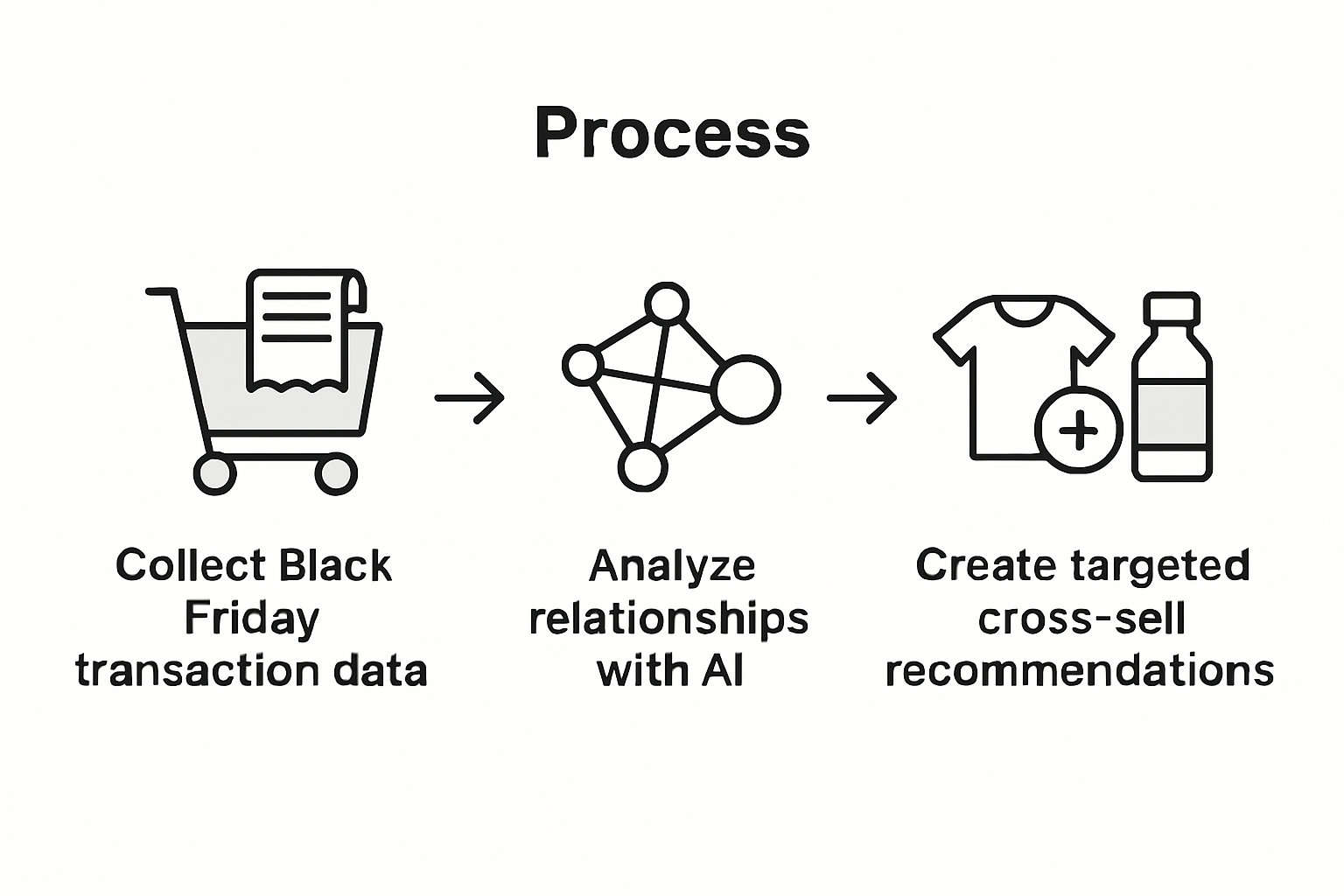
The most effective cross-sell implementations leverage machine learning algorithms that continuously adapt and refine recommendation strategies. By analyzing multiple data dimensions simultaneously—including historical purchases, browsing behavior, demographic information, and real-time interactions—these intelligent systems create dynamic, responsive recommendation engines.
Key implementation strategies include:
- Developing granular customer segmentation
- Creating contextually relevant product bundles
- Designing intelligent recommendation workflows
- Implementing real-time personalization
- Continuously testing and refining recommendation models
Successful cross-sell tactics require a commitment to data quality, advanced analytical capabilities, and a deep understanding of customer behavior dynamics.
Maximizing Revenue With Report Recommendations
Sales analytics reports transform raw data into strategic revenue opportunities, providing e-commerce businesses with actionable insights that drive meaningful growth. Cross-behavior integration frameworks address complex noise in recommendation systems, enabling more precise and robust product suggestions that directly impact bottom-line performance.
Effective revenue maximization through report recommendations involves a multi-layered strategic approach:
- Comprehensive Data Interpretation
- Detailed transaction pattern analysis
- Customer segmentation insights
- Purchasing behavior mapping
- Predictive Recommendation Strategies
- Personalized product suggestions
- Contextual bundle recommendations
- Dynamic pricing optimization
Next-basket recommendation algorithms provide sophisticated mechanisms for predicting and influencing customer purchasing decisions. These advanced techniques go beyond traditional recommendation models by creating highly contextualized, intelligent suggestion systems that adapt in real-time to changing consumer behaviors.
The most sophisticated revenue optimization strategies leverage machine learning algorithms that continuously refine recommendation models. By analyzing multiple data dimensions simultaneously—including historical purchases, customer demographics, browsing patterns, and real-time interactions—these intelligent systems generate dynamic, highly personalized recommendation engines that significantly enhance conversion potential.
Key implementation strategies include:
- Developing granular predictive models
- Creating intelligent recommendation workflows
- Implementing adaptive pricing strategies
- Designing contextualized product bundles
- Continuously testing and refining recommendation algorithms
Successful revenue maximization requires a commitment to advanced data analysis, continuous learning, and a deep understanding of customer behavior dynamics.
Common Pitfalls Using BF Data Analytics
Black Friday data analytics can be a double-edged sword for e-commerce businesses, presenting both transformative opportunities and significant implementation challenges. Security challenges in big data environments underscore the critical importance of understanding potential risks and mitigation strategies before diving into complex analytics implementations.
Most common pitfalls in Black Friday data analytics fall into several key categories:
- Data Quality Issues
- Incomplete transaction records
- Inconsistent data formatting
- Unvalidated data sources
- Analytical Limitations
- Overfitting predictive models
- Neglecting contextual nuances
- Ignoring cross-behavior complexities
Cross-behavior integration challenges represent a sophisticated technical obstacle that many e-commerce analysts underestimate. Noise in data interpretation can lead to misleading recommendations, potentially causing significant strategic missteps that reduce rather than enhance revenue potential.
The most critical errors emerge from oversimplified analytical approaches that fail to recognize the multidimensional nature of consumer behavior. Successful Black Friday data strategies require nuanced models that can dynamically adapt to complex purchasing patterns, account for seasonal variations, and provide truly intelligent insights.
Key pitfalls to avoid include:
- Relying on single-dimensional analysis
- Neglecting data privacy and security protocols
- Failing to continuously update predictive models
- Overlooking contextual purchasing behavior
- Implementing generic recommendation strategies
Mitigating these risks requires a holistic approach that combines advanced technical capabilities with deep understanding of consumer psychology and robust data management practices.
Unlock Hidden Revenue With Smart Black Friday Data Solutions
The challenge with Black Friday data is transforming overwhelming transaction numbers into clear growth opportunities. This article highlights the need to overcome common pitfalls like data quality issues and analytic limitations while leveraging advanced techniques such as market basket analysis and AI-driven product relationship discovery. If you want to boost your e-commerce sales by identifying precise cross-sell opportunities and creating intelligent product bundles, overcoming these challenges is critical.
APUS NEST empowers Shopify and WooCommerce store owners to harness the power of sophisticated data analysis without complexity. Our platform analyzes your sales data to reveal product pairings and hidden buying patterns uncovered through AI-powered market basket analysis. By turning raw Black Friday data into actionable insights, you can increase your average order value and design targeted marketing strategies that drive lasting customer engagement. Get started now and see how easy it is to maximize revenue with our free and premium reports at https://apusnest.com. Discover how precise cross-selling and real-time recommendations can transform your store by exploring APUS NEST today.
Frequently Asked Questions
What is Black Friday data and how can it benefit e-commerce businesses?
Black Friday data consists of sales metrics and customer behavior insights that can help e-commerce businesses optimize their sales strategies and customer engagement during high-traffic shopping periods.
How can market basket analysis enhance cross-selling opportunities?
Market basket analysis identifies products that are frequently purchased together, allowing e-commerce businesses to develop targeted cross-selling strategies and intelligent product bundling.
What role does AI play in understanding product relationships for e-commerce?
AI utilizes advanced algorithms to analyze transaction data, discover complex relationships between products, and generate personalized recommendations that improve customer experience and increase sales.
What are some common pitfalls when utilizing Black Friday data analytics?
Common pitfalls include data quality issues, overfitting predictive models, and neglecting the complexities of consumer behavior. These can lead to ineffective strategies and missed revenue opportunities.
Recommended
- Understanding Data-Driven Campaign Optimization for E-Commerce - ApusNest Blog | ApusNest
- 7 Types of Ecommerce Promotions to Boost Sales - ApusNest Blog | ApusNest
- 10 Essential Tips for Boosting Online Sales - ApusNest Blog | ApusNest
- Understanding Ecommerce Growth Strategies Guide - ApusNest Blog | ApusNest
